
The Department of State Services (DSS) has come under fire for allegedly breaching the privacy rights of detained TikToker, Gali Ismail Abdullahi—popularly known as “Sultan”—by reportedly compelling him to hand over passwords to his personal digital accounts while being held at the Keffi Correctional Centre in Nasarawa State.
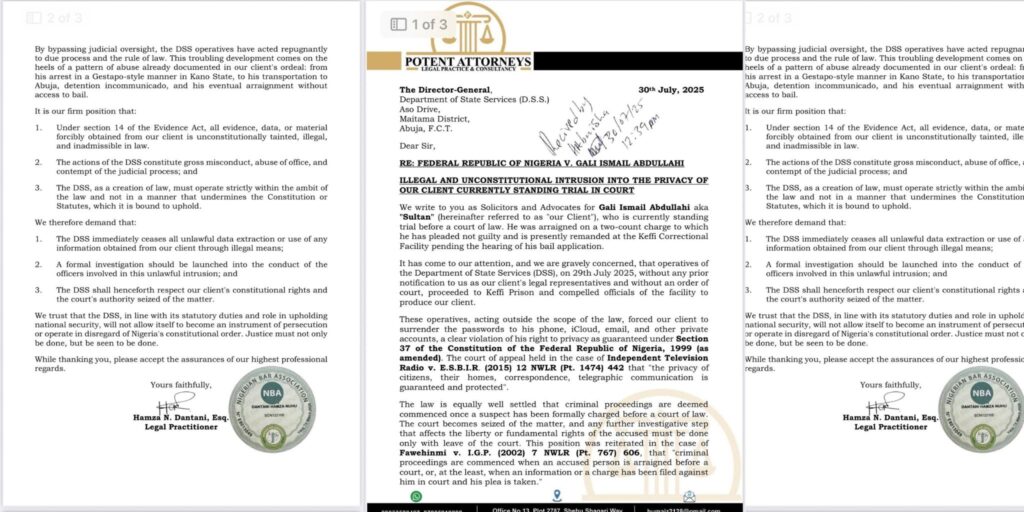
A petition dated July 30, 2025, addressed to the Director-General of the DSS and signed by Abdullahi’s legal counsel, Hamza N. Dantani, Esq., details the accusations against the intelligence agency. The letter accuses DSS operatives of forcefully accessing Abdullahi without a court order or prior notification to his legal team.
In the strongly worded petition titled “Illegal And Unconstitutional Intrusion Into The Privacy Of Our Client Currently Standing Trial In Court”, the DSS was condemned for bypassing due process and infringing on the fundamental rights of a defendant already undergoing trial.
According to the lawyer, “We have been reliably informed and are deeply alarmed that DSS officers, on July 29, 2025, entered Keffi Correctional Centre without notifying us—our client’s legal representatives—and without obtaining court approval. They then pressured prison staff to present our client for interrogation.”
Dantani further alleged that DSS operatives acted outside the bounds of the law by compelling Abdullahi to disclose passwords to his phone, email, iCloud, and other personal accounts—an act he said constitutes a clear violation of Section 37 of Nigeria’s 1999 Constitution (as amended), which guarantees citizens’ right to privacy.
Gali Ismail Abdullahi is being prosecuted over a viral TikTok video in which he allegedly claimed that President Bola Ahmed Tinubu had died. He has been charged with two counts and has entered a plea of not guilty. He remains in detention as his bail hearing is still pending.
The petition also referenced landmark judicial cases, such as Fawehinmi v. I.G.P. and Independent Television Radio v. E.S.B.I.R., to argue that any further investigative action that interferes with an accused person’s liberty must receive the express permission of the court.
“Once criminal charges are filed before a court, legal precedent dictates that no investigative measure affecting the defendant’s rights should proceed without judicial approval,” the petition emphasized.
Dantani also highlighted what he described as a consistent pattern of rights violations since his client’s arrest—from the way Abdullahi was picked up in Kano “in a Gestapo-like manner” to his secret transfer to Abuja, prolonged incommunicado detention, and denial of legal counsel and bail.
The lawyer argued that any digital evidence obtained through such coercive methods is fundamentally flawed and inadmissible under Section 14 of Nigeria’s Evidence Act. He called for a formal inquiry into the conduct of the DSS officers involved.
Key demands outlined in the petition include: halting any ongoing or future use of the data retrieved through coercion, launching a formal investigation into the DSS personnel involved, and ensuring that the accused’s constitutional rights are fully respected throughout the legal process.
“The DSS must remember that it is a creation of law, and must strictly adhere to legal and constitutional provisions. Any conduct that sidesteps these responsibilities only serves to weaken public trust in lawful institutions,” Dantani concluded.
Stay informed with the latest legal and political updates via our WhatsApp channel:
https://whatsapp.com/channel/0029VabITrvEAKW7DSkTfP0J