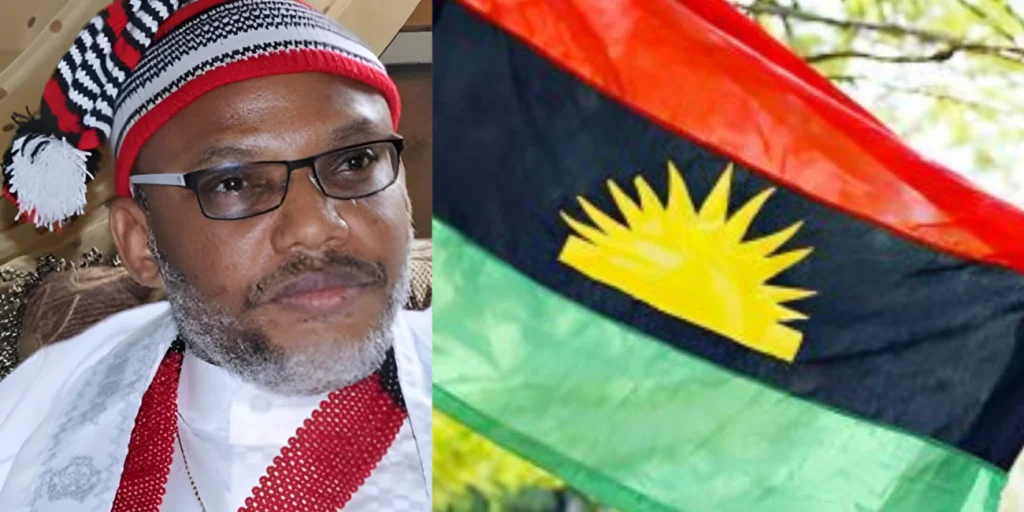
The Indigenous People of Biafra (IPOB) has accused the British Government of complicity in the alleged abduction and extraordinary rendition of its leader, Nnamdi Kanu, from Kenya to Nigeria, describing his subsequent detention, prosecution and life imprisonment as part of what it called a longstanding colonial strategy against the people of South-East Nigeria.
The separatist group also accused the President Bola Tinubu-led All Progressives Congress (APC) administration of using Kanu’s transfer to Sokoto Prison as a political manoeuvre to court Northern votes, alleging that the decision was designed to present the IPOB leader to the Northern political establishment as an ethnic trophy ahead of future political contests.
IPOB made the allegations in a statement issued on Tuesday, November 10, by its Media and Publicity Secretary, Emma Powerful, while reacting to comments by the Catholic Bishop of Nsukka Diocese, Bishop Godfrey Onah, concerning Britain’s historical influence on Nigeria’s political and economic structure.
Bishop Onah had stated in a viral sermon that Britain never truly left Nigeria and remains a major obstacle to the realisation of an independent and sovereign Biafran state.
The cleric argued that the continued absence of an independent Biafra was not primarily due to opposition from Nigerians but to deliberate British intervention and sustained geopolitical manoeuvring.
According to him, Britain orchestrated Nigeria’s nominal independence without granting the country genuine functional sovereignty, establishing political structures designed to protect its strategic and economic interests in Africa.
The bishop also referenced the 1966 coup, the alleged mistreatment of young military officers and the Nigerian Civil War, arguing that the suppression of Biafra, including the use of starvation as a weapon, was a calculated effort supported or enabled by foreign powers.
He specifically mentioned Britain, the United States, France and Italy, alleging that their interests were threatened by the possibility of Biafra emerging as a progressive African nation capable of influencing the continent’s political and economic direction.
Bishop Onah described the struggle for Biafran self-determination as a battle against external neo-colonial forces rather than merely an internal Nigerian political disagreement, urging young people to exercise patience and reflect on the historical circumstances surrounding the Biafran struggle.
“If we don’t have the independent state of Biafra now, it is because Britain didn’t want it, not because Nigerians didn’t want it. Because they know that if Biafra had succeeded as an experiment, Africa would have been redesigned and would have been put on the path of progress and development that would have been to the disadvantage of Europe and the Western World,” the bishop said.
Reacting, IPOB said the cleric’s intervention reinforced its longstanding position that Britain’s colonial legacy and subsequent diplomatic involvement contributed significantly to historical injustices and structural inequalities affecting South-East Nigeria.
The group specifically accused the British Government of complicity in Kanu’s alleged abduction in Kenya by Nigerian authorities and his extraordinary rendition to Nigeria.
It also faulted Britain for allegedly disregarding United Nations calls for Kanu’s release and failing to address court decisions concerning his case.
IPOB questioned the legal foundation of Kanu’s conviction, insisting that the Nigerian Government relied on repealed laws and what it described as harsh judicial measures to sustain his prosecution.
The group argued that these developments represented a continuation of British geopolitical interests dating back to the 1967 Nigerian Civil War, when, according to IPOB, foreign economic interests were prioritised over justice and the protection of human lives.
IPOB further accused the British Broadcasting Corporation (BBC) and other Western media organisations of promoting what it described as an anti-Kanu narrative through their online coverage and search engine results.
The group alleged that searches for Kanu’s name on international platforms, including Google, predominantly produced negative reports, claiming that such coverage had influenced public perception while obscuring alleged atrocities committed against the people of Eastern Nigeria.
It also criticised the British Government for what it described as diplomatic silence despite Kanu’s British citizenship and the circumstances surrounding his arrest in Kenya and continued prosecution in Nigeria.
On Kanu’s transfer to Sokoto Prison, IPOB alleged that the decision was politically motivated and orchestrated by the APC-led administration to exploit ethnic and religious divisions ahead of future political contests.
The group claimed that the transfer was designed to present Kanu to the Northern political establishment as an ethnic trophy and influence voting calculations involving prominent opposition figures, including former Vice President Atiku Abubakar.
IPOB, however, claimed that the alleged political strategy had backfired, alleging that sections of the Northern population and Fulani leaders were unhappy with what it described as attempts to use them as instruments of political manipulation.
The group also rejected statements attributed to the presiding judge, Justice James Omotosho, during Kanu’s trial, particularly the description of the IPOB leader as someone who “hates the North with a passion.”
IPOB described the judicial comments as deliberate misrepresentations of Kanu’s position, insisting that his campaign was directed against what the group considers a corrupt political and neo-colonial structure rather than any ethnic or religious community.
“Any person intimate with Mazi Nnamdi Kanu’s broadcasts will testify that he does not hate any ethnic group; he fights strictly against a corrupt, neo-colonial structure designed to trade the blood and resources of the masses for elite political survival,” Powerful stated.
The group maintained that Bishop Onah’s intervention reflected growing support for what it described as the peaceful emancipation of Biafra.
It warned that alleged media manipulation, judicial intimidation, political manoeuvring and international complicity would not stop its campaign for self-determination.
“No amount of search engine manipulation, judicial blackmail, political horse-trading, or international collusion will stop the ultimate triumph of justice,” IPOB declared.
The statement comes amid continuing controversy surrounding Kanu’s prosecution, conviction and imprisonment, as well as renewed debate over the circumstances of his return to Nigeria from Kenya and the legal and diplomatic implications of the case.
IPOB reiterated its demand for justice for Kanu and the people of South-East Nigeria, insisting that the British Government must accept responsibility for what it described as its historical and continuing role in Nigeria’s political crisis.