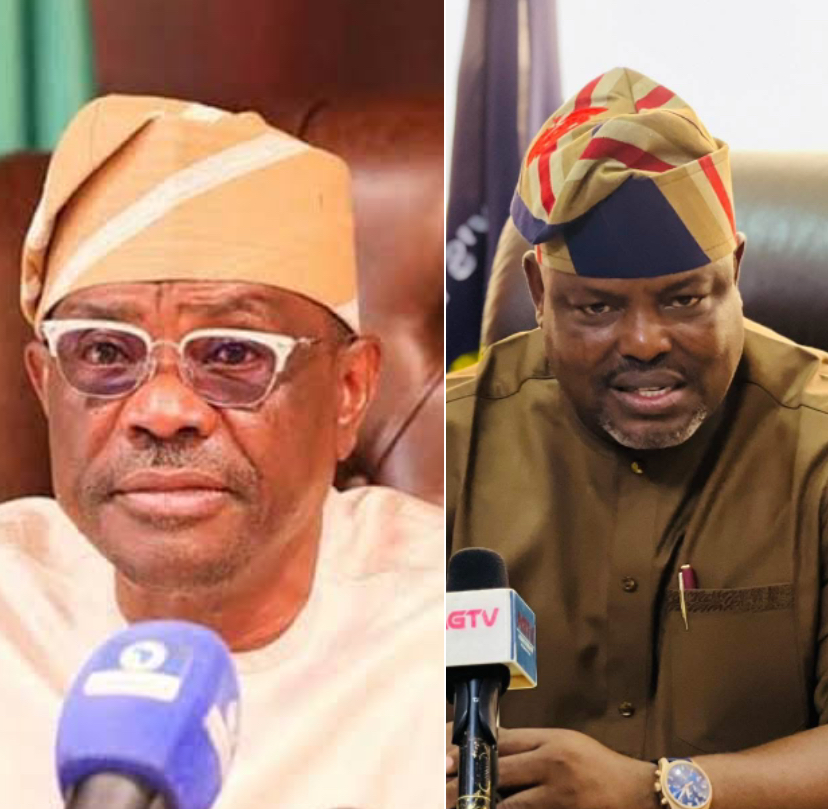
House of Representatives hopeful for Abuja South Federal Constituency, Danladi Bomboyi Chiya, has praised the Minister of the Federal Capital Territory, Nyesom Wike, describing him as a “performing politician” whose record in the FCT, according to him, demonstrates that effective governance is not necessarily defined by political affiliation.
Chiya said President Bola Ahmed Tinubu’s decision to appoint Wike to head the FCT Administration, despite the Minister not being a member of the All Progressives Congress (APC), showed that experience, capacity and an individual’s record could be considered alongside party affiliation when choosing people for public responsibility.
“Mr President knew Wike was not an APC member when he appointed him. That tells you something. Sometimes you have to look at the person, experience, what the person has done, capacity and, most importantly, what the person can contribute to the people,” Chiya said.
He said he intends to apply the same principle to his proposed representation of Abuja South by maintaining constructive relationships with government officials, ministries and agencies whose responsibilities can affect the development of the constituency.
Chiya said his ambition would be to ensure that communities in Abuja South are not merely observers of the wider infrastructure and development activities taking place across the FCT.
He said his proposed partnership with the FCT Administration would focus on identifying areas where the responsibilities of a federal legislator and those of the territory’s administration can complement one another.
According to him, the National Assembly representative can use legislative proceedings, committee work, oversight, budgetary processes and engagement with federal ministries and agencies to pursue constituency interests, while issues within the jurisdiction of the FCT can be taken directly to the relevant authorities.
“I don’t want Abuja South to be watching development from a distance. I want Abuja South to be part of it,” Chiya said.
He explained that this would mean ensuring that communities are considered when infrastructure is planned, that residents are connected to relevant federal programmes and that young people are informed about opportunities available through government and other institutions.
The FCT Administration has continued to expand infrastructure into satellite communities and Area Councils, including road and power-related projects in parts of the territory.
Chiya said his proposed role would therefore involve creating a stronger link between such development efforts and the needs of residents across Abuja South.
He also outlined an agenda centred on roads, agriculture, electricity, water, education, healthcare, youth development and support for small businesses.
On transportation infrastructure, he said attention would be given to roads that connect farming communities with markets and urban centres, noting that poor connectivity can increase the cost of moving agricultural produce and restrict commercial activity.
Chiya said his grassroots experience had exposed him to the consequences of inadequate infrastructure on ordinary residents and businesses.
“I know what a bad road does to a farmer. I know what the absence of electricity does to a small business. I know what lack of water does to a community. I know what unemployment does to young people,” he said.
He said his intention was therefore not to approach the National Assembly solely as a platform for speeches, but as an avenue through which the problems confronting communities could be connected to institutions capable of providing solutions.
Agriculture, he said, would receive particular attention, with emphasis on farm access, storage, processing, market opportunities and relevant government programmes capable of improving the economic returns available to farmers.
For small businesses, Chiya said access to electricity, roads, water and government support programmes would be among the issues his office would pursue.
He also identified youth development as a major component of his proposed agenda, saying young people should have access to vocational training, digital skills, entrepreneurship opportunities and employment-linked programmes.
Rather than limiting his proposed partnerships to government, Chiya said he would also explore opportunities for collaboration with private organisations, development institutions and other stakeholders where such relationships could produce tangible benefits for residents.
He said his broader objective was to connect grassroots needs with federal opportunities.
“We need to connect the local with the federal. We need to connect the community with government. We need to connect infrastructure with economic opportunity. We need to connect young people with skills and jobs. That is the broader picture I have for Abuja South,” Chiya said.
He said another part of his proposed representation would be regular consultation with residents before determining legislative priorities or constituency interventions.
According to him, community engagement would involve farmers, women, young people, business owners, traditional institutions, community leaders and other groups whose experiences can provide a clearer picture of challenges across the constituency.
Chiya said this would help prevent decisions about constituency projects from being based solely on assumptions made from Abuja offices.
He said residents should have a direct channel through which their concerns can reach their representative and be taken to the appropriate level of government.
The former grassroots administrator said his experience at the local level would be valuable when combined with the legislative opportunities available at the federal level.
“I have seen government from the grassroots. Now I want to take that experience to the National Assembly,” he said.
Chiya said his proposed working relationship with Wike would be guided by the same development-focused approach.
He said he would be willing to engage the FCT Minister where the Minister’s office has a role to play, just as he would approach federal ministries or agencies when their intervention is required.
“If that means working with Wike, I will work with Wike. If that means working with a federal ministry, I will work with the ministry. If it means engaging an agency, I will engage the agency. The question should always be: what will Abuja South gain from it?” he said.
He said the proposed approach was not about political convenience but about ensuring that the constituency could benefit from every legitimate avenue available within government.
Chiya also said he would review existing projects and programmes within the constituency to determine what requires completion, rehabilitation, expansion or fresh intervention.
He said useful projects should not be abandoned simply because a new representative assumes office, adding that continuity should be considered where it serves the interests of residents.
He further pledged to pursue stronger advocacy for rural communities whose livelihoods depend on agriculture, small-scale businesses and access to basic infrastructure.
On education and healthcare, he said he would engage the relevant government institutions to pursue interventions in communities where existing facilities require additional support.
Water supply and electricity, he added, would also remain important areas of engagement because of their direct impact on households, businesses, schools, healthcare facilities and agricultural activities.
Chiya said the effectiveness of his proposed representation would ultimately be judged by what residents can physically experience in their communities.
“My target is simple. Let the people see something. Let them see roads. Let them see electricity projects. Let them see water projects. Let them see schools and healthcare interventions. Let young people see opportunities. Let farmers see support. Let communities feel that their representative is connected to government and is bringing government closer to them,” he said.
He said his ambition for Abuja South was to create a practical bridge between the communities, the National Assembly, federal institutions and the FCT Administration, while using every legitimate relationship available to advance the interests of residents.