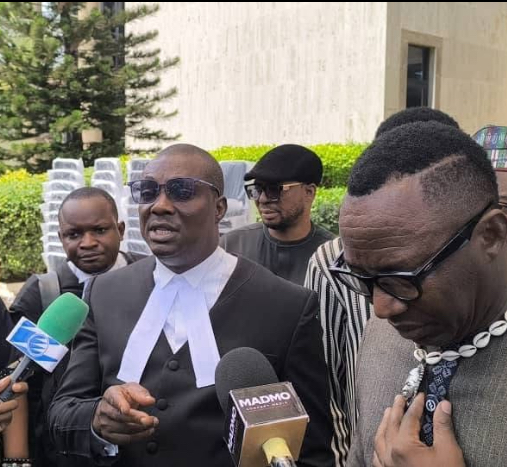
Lawyer and human rights advocate, Tope Temokun, has condemned the decision of the Ikogosi Marathon Initiative to exclude Omoyele Sowore from its 2026 race following an attack on the activist in Ekiti State, demanding an immediate withdrawal of the statement announcing his exclusion and threatening legal action if the organisers fail to comply.
Temokun, who is the Principal Counsel at Tope Temokun Chambers, made the demand in a press release dated October 31, 2026, describing the organisers’ statement as insensitive and questioning the justification for publicly disqualifying Sowore at a time when he was reportedly recovering from injuries sustained in the attack.
The Ikogosi Marathon Initiative had cited security concerns and alleged documented conduct as reasons for its decision, while denying that the exclusion was politically motivated.
However, Temokun argued that the organisers’ public explanation failed to identify the specific conduct attributed to Sowore or the particular participation rule he allegedly breached.
He questioned why the organisers considered it necessary to issue a public statement announcing Sowore’s exclusion when the activist was dealing with the consequences of an attack, arguing that the situation called for sensitivity, concern for his recovery and a fair assessment of any legitimate concerns.
According to the lawyer, if the decision was based on Sowore’s medical condition, the organisers should have expressed sympathy and allowed an appropriate medical assessment to determine his fitness to participate. If security concerns informed the decision, he argued that the priority should have been to address the threat and protect participants rather than impose consequences on the victim of violence.
“An injured victim should not be made to bear the consequences of the violence inflicted on him,” Temokun stated, challenging what he considers an unfair approach to the controversy.
The human rights advocate further described the reasons advanced by the organisers as discriminatory, parochial and inconsistent with constitutional guarantees of human dignity and freedom from discrimination.
He maintained that the organisers’ denial of political motivation was insufficient to resolve questions surrounding the fairness of their decision, particularly given Sowore’s public profile as a political critic.
Temokun also questioned the reliance on unspecified evidence to portray Sowore publicly as a potential security concern without clearly identifying the alleged misconduct or providing him with a fair opportunity to respond.
He called on the marathon organisers to disclose the specific conduct complained of, identify the applicable participation rules and explain how those rules were applied in reaching the decision to exclude the activist.
The lawyer stressed that the central issue was not whether Sowore’s injuries would have prevented him from participating in the race, but whether the organisers were justified in issuing a public statement that could damage his reputation and create uncertainty about his eligibility for future events.
According to him, even if Sowore had been medically unfit to participate, that circumstance would not automatically justify a public announcement capable of casting doubt on his character or future participation.
Temokun consequently demanded the immediate withdrawal of the statement, a public apology to Sowore and the removal of any unsupported adverse designation that could affect his eligibility for subsequent editions of the marathon.
He warned that failure to meet these demands would compel him and his associates to pursue appropriate legal remedies to challenge the exclusion and seek redress for any actionable injury arising from the publication.
Emphasising the broader implications of the controversy, Temokun argued that sporting events should serve as platforms for unity and inclusion rather than become instruments for humiliating individuals who have suffered violence.
“Sport should bring people together. Its organisers must never allow their platform to become another means of humiliating a victim of violence,” he said.
As of the date of the press release, Temokun’s demands were directed at the Ikogosi Marathon Initiative, with the lawyer indicating that legal action remained an option if the organisers failed to withdraw the statement and address the concerns raised.
The controversy raises questions about the responsibility of sporting-event organisers when making public decisions concerning participants, particularly where security considerations, medical fitness, reputational harm and allegations of discriminatory treatment intersect.
Any legal challenge would, however, require consideration of the organisers’ applicable participation rules, the evidence supporting their decision, the precise content of the disputed statement and the legal basis for the remedies sought.