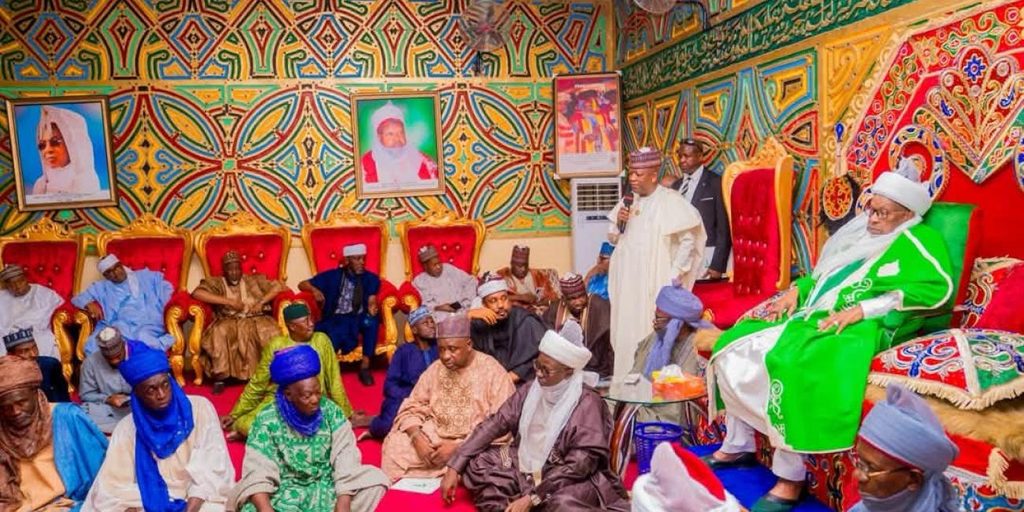
The Emir of Katsina, Alhaji Abdulmumini Kabir Usman, has cautioned Senator Abdulaziz Abubakar Yari, Director-General of the All Progressives Congress (APC) Presidential Campaign Council for President Bola Ahmed Tinubu’s 2027 re-election bid, against lying to Nigerians, urging political leaders to prioritise truth, tackle insecurity and address the economic hardship confronting ordinary citizens.
The monarch also declared that “politics is not madness,” warning politicians against deceit, hatred, envy, backbiting and attempts to destroy others for political gain.
The Emir made the remarks while addressing Yari during the senator’s visit to his palace in Katsina State earlier this week. His comments were captured in a Hausa-language video obtained by ChroniclesReporters.
During the meeting, the monarch expressed concern over the deteriorating security situation in parts of northern Nigeria, particularly the difficulties confronting farmers who can no longer freely access their farmlands because of security threats.
He also lamented the decline of industrial activities in the region, citing the condition of industrial establishments in Kaduna State as an indication of the economic challenges facing northern communities.
Addressing Yari, the Emir stressed that his position as the head of the APC presidential campaign council placed a responsibility on him to communicate the concerns of ordinary Nigerians to political leaders across the country.
“Director-General, you are now in a position of leadership. This is not just about this place; it concerns the entire country. We are all children of this nation, and we must stand for the truth,” the monarch said.
He urged the senator to ensure that his message reached those in positions of authority, emphasising that leadership should be driven by genuine concern for the people rather than personal interests or political calculations.
“I swear to God, unless you love people, help them and work with them, you cannot expect Allah to love you, stand by you and help you,” the Emir said.
The monarch further argued that political engagement should be based on persuasion, consultation, dialogue and the willingness to listen to opposing opinions, rather than confrontation, insults and condemnation.
“Yes, politics, it must be about politics. What is politics? You convince me to accept your conviction,” he said.
“You must be wise enough to listen to what I have to say or consider my point of view. That is politics. It is not fighting or condemning others.
“It is not about backbiting, envy or malice.”
The Emir reminded Yari and other political leaders that public support should come with a responsibility to respect the people, listen to their concerns and work towards improving their living conditions.
According to him, political leadership should not be reduced to the pursuit of power, personal comfort or the persecution of opponents but should involve meaningful consultation and collective efforts to resolve the country’s challenges.
He cited religious teachings to reinforce his argument, noting that both the Holy Quran and the Bible emphasise selflessness and the importance of putting the interests of others before personal gains.
“It has been said, ‘Fellow citizens, we must come together, discuss matters and offer explanations. This is also about consultation.’ Even the Holy Quran and the Bible teach us that the best person among you is the one who puts the interests of others before his own,” he said.
However, the monarch expressed disappointment that such values appeared to be disappearing from political life, accusing some individuals of concentrating on condemning others, destroying their livelihoods and plotting against perceived rivals.
“But that is no longer the case. Why?” he asked.
“Do not tell me that we are working together. It is said that God will not change the condition of a people until they change what is within themselves. We have changed, but there seems to be nothing in our hearts except condemning others, destroying people, preventing them from earning a livelihood and plotting evil against them. Why? Why all this?”
The Emir warned that political leaders and other influential individuals must reflect on their conduct and recognise the consequences of their actions on society.
He cautioned against treating others with contempt, stressing that those who deliberately inflict suffering on their fellow citizens should not assume they would never experience similar treatment.
“Whoever you are, I repeat, whoever you are, if you treat another person with contempt, I swear to God, you will eventually experience something you do not like,” he said.
The monarch also condemned dishonesty in political engagements, insisting that politicians must not misrepresent events or make claims they know to be false simply to win public support.
He acknowledged that Islamic teachings recognise limited circumstances in which deception may be permitted, including efforts to reconcile estranged people, preserve harmony between spouses and certain situations during warfare.
However, he maintained that these exceptions must not be used to justify dishonesty in ordinary political dealings.
“Come, let me explain something to you. There are circumstances in which lying is permissible: for example, to preserve harmony between a husband and his wife, or to reconcile people and prevent further conflict,” the Emir said.
“Lying during warfare is also permitted in certain circumstances, such as using a strategic deception to mislead the enemy about the direction of an attack.
“These are among the circumstances in which it is permitted. But lying in this manner, when you come to me and claim something happened when you know it did not, is unacceptable. May Allah guide us to what is right, I swear to God.”
He emphasised that truthfulness should remain a fundamental principle guiding public officials and political actors, irrespective of their political affiliations or ambitions.
“As for me, wherever I go, whenever I open my mouth, I speak the truth. I have said this based on the Holy Quran,” he added.
The Emir’s remarks also focused on the impact of insecurity on agriculture, food production and livelihoods across northern Nigeria.
He lamented that farmers had been prevented from carrying out their normal activities, questioning how communities could achieve economic progress when residents could not safely access their farmlands.
“Why are we drifting apart? Farmers have been prevented from carrying out their activities,” he said.
The monarch’s concerns highlighted the challenges confronting farming communities whose livelihoods depend on access to agricultural land but who face security threats that disrupt cultivation and other economic activities.
He urged political leaders to pay greater attention to these realities rather than remain preoccupied with political competition, personal advancement and the struggle for influence.
The Emir also questioned the decline of industrial establishments in Kaduna State, citing the DIC and Peugeot company as examples of businesses whose current conditions, in his view, should concern political leaders and elders across the region.
“If you go to Kaduna, look at the DIC and the Peugeot company. Where are they now? They have all collapsed. Why?” he asked.
He expressed disappointment that influential figures in northern Nigeria had not done enough to speak out about the economic and security challenges confronting their communities.
“And we have remained silent. Who are the elders?” the monarch asked.
“We have to speak. We have to speak. We must stand up and take action.”
He called on traditional leaders, elders and influential political figures to use their positions to demand solutions to insecurity, economic decline and the obstacles preventing ordinary Nigerians from earning a living.
The Emir maintained that leadership should be assessed by the practical difference it makes in people’s lives rather than the status, wealth or privileges enjoyed by those in positions of authority.
His remarks placed the welfare of ordinary citizens, the need for truthful political communication and the responsibility of public officials at the centre of the discussion, as political parties and their leaders prepare for the 2027 general elections.