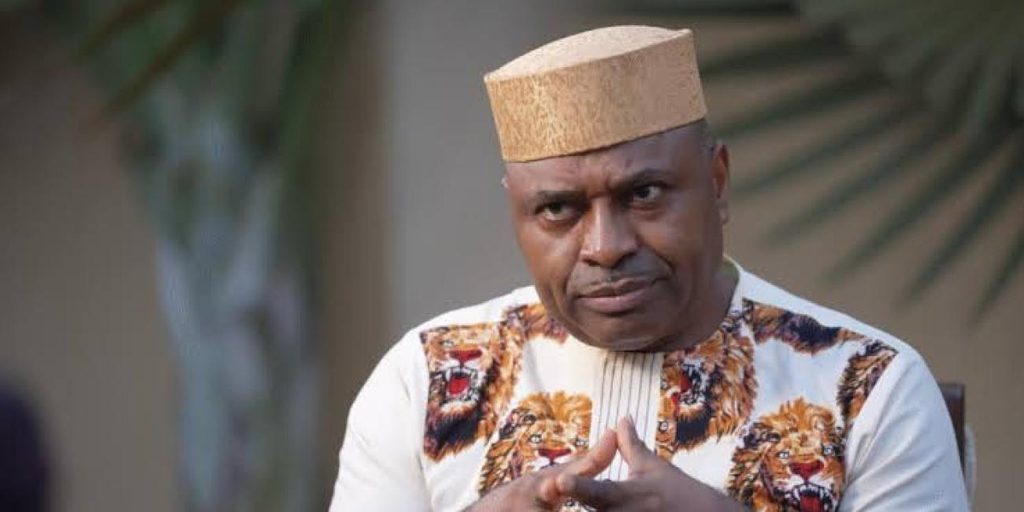
Actor-turned-politician and former Labour Party presidential campaign spokesperson, Kenneth Okonkwo, has criticised President Bola Tinubu’s 66th Independence Day address, rejecting the President’s description of Nigeria as a “sick patient” diagnosed with cancer.
Tinubu, in his Independence Day broadcast on Thursday, compared Nigeria’s economic situation in 2023 to that of a cancer patient requiring difficult and painful treatment, as he defended the economic reforms introduced since he assumed office in May 2023.
The President said his administration had “chosen to excise the cancer”, referring to reforms including the removal of petrol subsidy and changes to the foreign exchange regime.
According to Tinubu, successive governments had focused on treating the symptoms of Nigeria’s economic problems instead of confronting what he described as deeper structural weaknesses.
He argued that his administration had decided to take the difficult decisions necessary to address those problems, despite the hardship associated with the reforms.
“Our reforms did not create the weaknesses in our economy. They confronted them,” Tinubu said.
The President also claimed that the reforms had produced improvements in key economic indicators, saying the economy had grown by more than four per cent in 2026, inflation had fallen substantially from its peak, foreign reserves had been rebuilt and the foreign exchange market had stabilised.
Tinubu further said Nigeria had moved beyond the emergency phase of economic reforms and was entering what he described as an “age of prosperity.”
He rejected calls for a return to petrol subsidy, describing such demands as a “siren song” and warning against returning to what he called the abuse of subsidies.
Reacting to the address, however, Okonkwo rejected the President’s cancer analogy and argued that Nigeria itself was not the problem.
“God forbid! With respect to President Tinubu, Nigeria is a blessed country that has no cancer,” Okonkwo said.
“According to Wike, it is the All Progressives Congress (APC) that has cancer, and Tinubu’s leadership style has made the cancer to metastasise.”
Okonkwo, who is now a chieftain of the African Democratic Congress (ADC), went on to list what he described as worsening economic and social conditions under the Tinubu administration.
He compared key indicators at the beginning of Tinubu’s administration with what he described as their current levels.
Okonkwo said Tinubu inherited petrol prices of about N195 per litre but that the price had risen to about N1,500 per litre under the current administration.
He also recalled that the naira traded at about N450 to the US dollar when Tinubu assumed office but had fallen to about N1,400 to the dollar.
On public debt, Okonkwo said Tinubu inherited total debt of about N77 trillion but that the figure had risen to N166.6 trillion, while accusing the government of continuing to borrow.
He further criticised the administration over insecurity, transportation, food prices, electricity, employment, poverty, infrastructure, the rule of law and human rights.
“Insecurity is at its worst under Tinubu,” he said, while claiming that the President had been outside Nigeria “more than 290 days and about 52 times in just about three and a half years.”
He also said, “Transportation and food costs are horrible, electricity and employment are absent, poverty is ravaging, roads are deplorable, rule of law and human rights trampled on. No microeconomic index is good.”
The claims by Okonkwo contrast sharply with Tinubu’s assessment of the country during his Independence Day address.
Tinubu said the country’s economic outlook had improved three and a half years into his administration, pointing to economic growth, lower inflation, reduced oil theft, rebuilt foreign reserves, greater foreign-exchange stability and increased non-oil exports.
The President said the reforms were necessary because Nigeria’s economic situation had become increasingly difficult before his administration took office.
He maintained that the government’s objective was now to reduce the cost of living, expand productive employment, support businesses and create conditions for what he described as shared and widespread prosperity.
Tinubu also said his administration would focus on agriculture, infrastructure, industrialisation, digital connectivity and skills development as part of its next phase.
However, Okonkwo argued that the hardship being experienced by Nigerians showed that the government’s economic direction remained problematic.
He called on Nigerians to reject what he described as the “APC’s cancerous leadership style” ahead of the 2027 presidential election.
Okonkwo also advocated the introduction of a refined petroleum production subsidy as a means of reducing the cost of living, arguing that the policy would make life more affordable for Nigerians.
He described himself as an “incurable optimist” and maintained that Nigeria remained a blessed country despite the economic and social challenges confronting citizens.