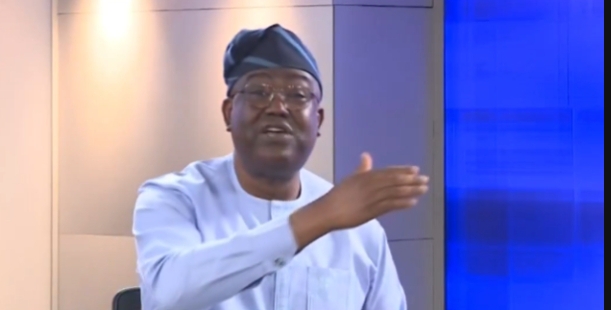
Accord presidential candidate, Gbenga Olawepo-Hashim, has described President Bola Tinubu’s decision to remove the petrol subsidy and allow fuel pump prices to be determined by market forces as “insanity and idiocy,” arguing that Nigerians are paying an inflated price for petrol because of the government’s approach to crude oil pricing.
Olawepo-Hashim made the remarks while appearing on Channels Television, where he challenged the Federal Government’s justification for the continued high price of petrol and questioned the basis for pricing crude oil supplied to domestic refineries at international market rates.
“It is insanity and idiocy for anybody, especially for the president of an oil-producing country, to say that both domestic and international oil prices you leave to market forces. What President Tinubu did was insanity,” he said.
According to the Accord presidential candidate, the current price of petrol is unnecessarily inflated and could be significantly lower if the cost of locally produced crude oil and other associated expenses were properly calculated.
“The truth of it is that the price is currently inflated. By who? By the government,” Olawepo-Hashim said.
He claimed that data from the Nigerian National Petroleum Company Limited showed that the cost of producing a barrel of crude oil in Nigeria was about $30.
He explained that adding a $15 margin to the production cost, approximately $5 for refining and another $7 for transportation and insurance would put the total cost at about $57 per barrel.
Based on his calculation, Olawepo-Hashim said the figure should translate to a petrol price of about 34 cents per litre, which he estimated at roughly N501 per litre using an exchange rate of N1,400 to the dollar.
He, however, proposed a pump price of N605 per litre, saying an additional N100 energy tax could be imposed to generate funds for the development of alternative energy sources.
The Accord candidate also rejected the description of Nigeria’s previous petrol pricing arrangement as a conventional subsidy, arguing that the subsidy debate was largely a consequence of how the government accounted for crude oil and petroleum products.
“What you have had really has never been any subsidy, even when we had lower pump petrol prices. The subsidy issue is more of an accounting magic,” he said.
Olawepo-Hashim argued that crude oil supplied to domestic refineries should not automatically be priced at the same international benchmark used for crude exported abroad.
According to him, although international crude prices represent the opportunity cost of selling Nigeria’s crude in the global market, that price should not necessarily determine the cost of crude consumed domestically.
“You cannot price your local products at international price,” he said.
He cited oil-producing countries such as Saudi Arabia and Kuwait as examples of countries which, according to him, do not apply international crude prices to their domestic markets in the same manner Nigeria does.
The presidential candidate called for greater transparency in the determination of Nigeria’s crude production costs, questioning why locally produced crude supplied for domestic consumption was being priced at its current level.
He also alleged that the existing system could be susceptible to “a lot of over-invoicing,” challenging the Federal Government and other stakeholders to make the underlying figures available for public scrutiny.
“If anyone has a different idea, they should bring their books. Let’s see what it is, how much it costs to produce a barrel of crude in Nigeria,” he said.
Olawepo-Hashim maintained that the current petrol pricing structure was placing an unnecessary burden on Nigerians and urged the Federal Government to review its approach to domestic crude pricing rather than relying solely on market forces.
His comments come amid continued public debate over the economic consequences of the petrol subsidy removal announced by President Tinubu in May 2023, with the policy remaining a major issue in discussions surrounding inflation, transportation costs, food prices, household incomes and the wider cost-of-living crisis confronting Nigerians.