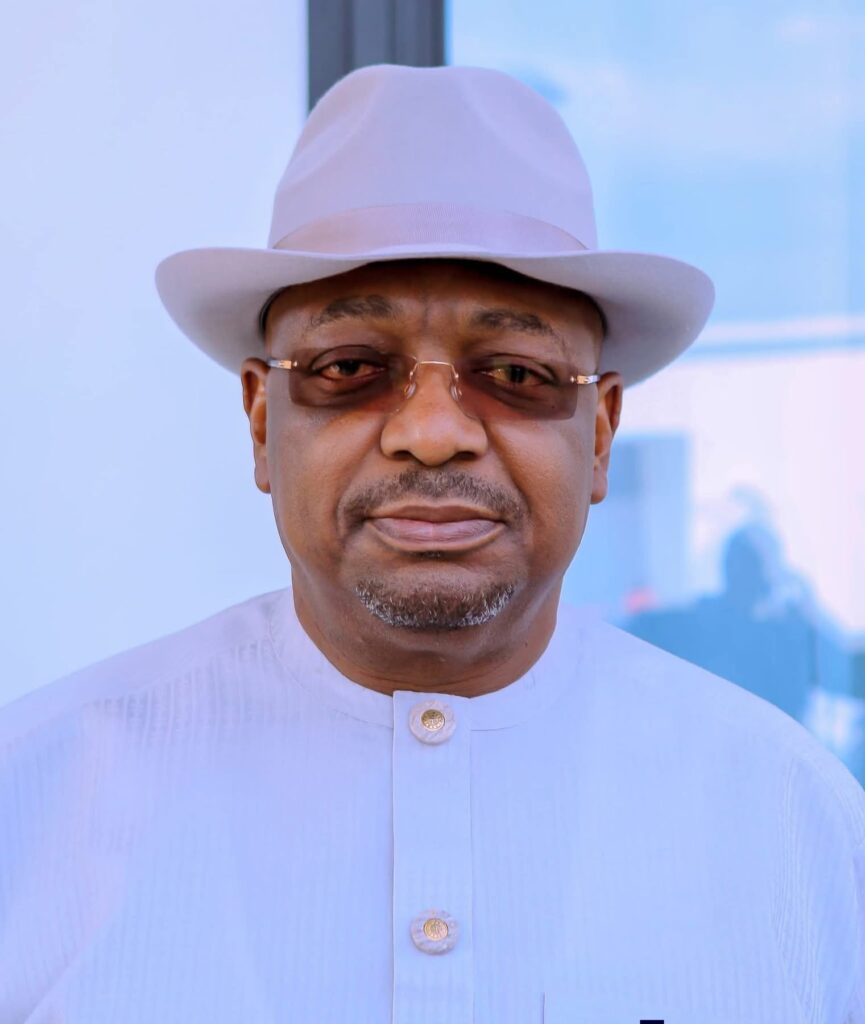
For a politician preparing for another return to the Senate, the most important campaign document should not be a poster, an endorsement or a political rally. It should be his record.
For former Federal Capital Territory Senator Philip Tanimu Aduda, that record deserves renewed examination as political preparations for 2027 intensify.
Aduda represented the FCT in the Senate from 2011 to 2023 and spent years presenting constituency projects as evidence of his representation. In 2023, while defending his record after losing the senatorial election to Ireti Kingibe, he listed numerous roads, town halls, youth centres and other projects which he said he facilitated across the six Area Councils. Among those projects were the Karu Town Hall and the Pai Road project in Kwali Area Council.
But two of those projects raise questions that Abuja voters should demand answers to: a ₦225 million project in Karu and a ₦400 million road project serving Pai and neighbouring communities.
Together, the budget figures amount to ₦625 million.
That does not mean ₦625 million was stolen by Aduda. There is no evidence from the sources reviewed establishing such a criminal finding against him.
The issue is different, and perhaps even more important for taxpayers.
What happened to the public money? What was delivered? Who implemented the projects? Who supervised them? And why did controversies emerge around projects that were presented as achievements of political representation?
The first controversy concerns the Karu Town Hall.
According to reporting by The Nation in 2020, Tracka and BudgIT raised questions about a Federal Government-funded constituency project associated with Aduda and the Federal Ministry of Water Resources.
The project reportedly received ₦100 million in 2016, ₦75 million in 2017 and ₦50 million in 2019, making a reported total of ₦225 million. The project was originally identified as the Karu Town Hall, but photographs circulated showing the facility bearing the name Jumma/Aduda Youth Centre, alongside an engraved image of Aduda’s late mother.
That was the moment a routine constituency project became a public accountability controversy.
Tracka’s position was that the project had been funded with taxpayers’ money and therefore should not be presented as a personal donation or private political project.
The question is fundamental.
If government money built the facility, why should the facility carry the political identity or family association of the lawmaker who nominated or facilitated it?
A senator does not personally own a constituency project because he facilitated its inclusion in the budget.
The money belongs to the Nigerian people.
The project belongs to the public.
And the beneficiaries are citizens.
The controversy was serious enough that a public defence of Aduda was subsequently published arguing that the senator had no direct control over the funds. The defence maintained that the project was domiciled with the relevant government agencies, particularly the Upper Niger River Basin Development Authority, and that Aduda could not personally award or execute the contract. It also claimed that Aduda had contributed his personal funds to the project.
That defence is important and should not be ignored.
It also exposes the question that should have been answered with documents:
If Aduda did not control the money, who did?
Who awarded the contract?
Who approved payments?
Who supervised construction?
Who authorised the naming of the facility?
Who approved the inscription?
Was the facility formally handed over to the community?
Was the project actually delivered according to the original specification?
And if Aduda personally contributed money, where are the records showing the amount and purpose of that contribution?
Those are not political questions.
They are accounting questions.
The second controversy is even more revealing because it involves a rural community that waited for a road that was supposed to transform access to healthcare, markets and agriculture.
The project is the Pai Road and drainage project in Kwali Area Council.
The ICIR investigated the project and reported that it had been budgeted at ₦400 million and was facilitated by then-FCT Senator Philip Aduda.
The implementing agency was reported as the Upper Niger River Basin Development Authority, while the contract was awarded to Kis-Mate Integrated Resources Limited.
According to The ICIR’s examination of financial records, ₦72,089,802.33 had been disbursed by December 2022.
But the physical evidence on the ground raised another question.
A quantity surveyor who examined the road reportedly calculated that only approximately 895 metres had been graded.
The communities were still struggling with the same road conditions that had existed for years.
Residents described difficulties transporting farm produce and accessing healthcare, while one account documented the ordeal of a pregnant woman travelling through the difficult road network to reach medical care.
Then came the most politically sensitive part.
The road construction appeared around the period of the 2023 election.
The ICIR reported that less than one kilometre had been graded before the election and raised the possibility that the limited work may have been connected to electioneering. That allegation was an interpretation reported by the investigation, not a judicial finding, and should therefore be treated as such.
But regardless of the political motive, the physical question remained:
How can a ₦400 million road project be celebrated politically when the community is still waiting for the road?
There was another troubling finding.
The ICIR reported difficulty establishing the contractor’s business profile and said available records described Kis-Mate Integrated Resources as a furniture supplier, office-supplies and ICT business rather than a conventional road-construction company. The investigation raised questions about whether the contractor possessed the technical qualifications required for the work under Nigeria’s procurement framework.
That is not an accusation that Aduda personally selected an unqualified contractor.
The procurement agency, not the senator, bears responsibility for formal procurement and contract administration.
But because Aduda publicly claimed the Pai project as one of the achievements of his representation, Abuja voters are entitled to ask him what he knew about the project’s implementation and whether he ever raised concerns about its slow execution.
Indeed, in March 2023, while defending his record, Aduda himself listed Pai Road among the ongoing projects he said he had attracted to the FCT.
That makes the project’s subsequent history particularly relevant.
The ICIR returned to the project in 2024 and reported that work eventually resumed.
A further ₦73,233,977.79 was reportedly paid to Kis-Mate Integrated Resources in May 2024, bringing the amount released according to publicly available records to approximately ₦145.3 million. Yet, after another visit to the project site, the investigation reported that there was still no significant visible progress beyond the work previously observed.
This is where the story becomes bigger than Aduda.
The former senator may not have been the contracting authority.
He may not have signed the payment vouchers.
He may not have supervised the contractor.
But he was the political sponsor of the project.
And that distinction matters.
Constituency projects are frequently used by Nigerian politicians as evidence of performance during elections. Once politicians claim credit for those projects, they must also be prepared to answer questions about their implementation.
You cannot take political credit for the success of a project while completely disclaiming responsibility when the same project becomes controversial.
That is the accountability gap Abuja voters should close.
The Karu project raises questions about public ownership, naming and the appearance of personalisation of taxpayer-funded infrastructure.
The Pai project raises questions about contractor capacity, expenditure, physical execution, delays and value for money.
Neither controversy, based on the evidence reviewed, establishes that Aduda personally committed a criminal offence.
But both controversies establish something politically important:
The public deserves a transparent audit trail.
Aduda’s supporters have every right to defend his record.
They can point to the roads he facilitated.
They can point to town halls.
They can point to youth centres.
They can point to scholarships and other interventions.
Aduda himself has argued that his representation produced substantial infrastructure across the FCT, including roads in Kubwa, Nyanya, Bwari, Kuje, Kwali and other communities.
But political achievements should not be measured by the number of projects announced.
They should be measured by what was actually delivered.
A road that exists on a budget document but not on the ground is not development.
A town hall funded by taxpayers should not be presented as a politician’s private gift.
A contractor receiving public money must be competent to perform the contract.
And every naira spent should be traceable.
This is particularly important now because Aduda is once again positioning himself within Abuja’s political landscape.
After losing the FCT Senate seat in 2023, he eventually left the PDP and joined the APC in 2026, reopening the question of whether the former senator intends to return to elective office.
If he does, Abuja voters should not ask only what he promises to do.
They should ask him to account for what has already been done.
Where is the full ₦225 million Karu project expenditure trail?
Where are the contract documents?
Where are the completion and handover records?
Who authorised the Jumma/Aduda naming?
What exactly did Aduda personally contribute, if anything, and where are the records?
Why did the ₦400 million Pai Road project take so long to produce substantial physical results?
Why was a contractor reported by an investigative outlet as having a business profile seemingly unrelated to road construction awarded the project?
How much was ultimately paid?
What percentage of the road was eventually completed?
Who should be held responsible for the delays?
And perhaps the biggest question of all:
Should a politician be allowed to campaign on projects funded by taxpayers without publishing a complete account of how those projects were executed?
Chronicles Reporters believes Abuja voters deserve answers before they cast another ballot.
This is not a declaration that Philip Aduda is guilty of corruption.
It is a demand that the public record be opened, examined and independently verified.
If the records prove that everything was properly executed, then Aduda deserves the opportunity to present that evidence to the electorate.
If the records reveal failures, the responsible agencies and individuals should answer for them.
But what Abuja cannot afford is another election in which photographs of projects replace audited records, political slogans replace procurement documents and promises replace evidence.
The ₦225 million Karu controversy and the ₦400 million Pai Road controversy should therefore not be buried beneath the noise of 2027 politics.
They belong in the public conversation.
Because when public money is involved, accountability is not an act of political persecution.
It is the price of public office.