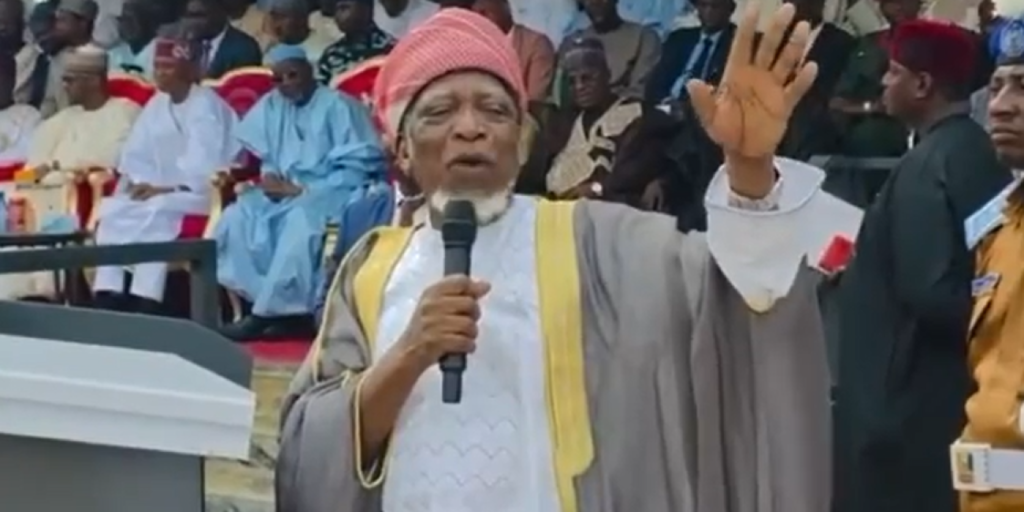
Islamic cleric Sheikh Yahya Jingir has reignited Nigeria’s fiercely contested religious and political debate, declaring his unwavering support for Muslim-Muslim political tickets and urging Muslims to obtain their Permanent Voter Cards (PVCs) ahead of future elections so they can demonstrate what he described as their numerical strength over Christians.
Jingir made the remarks at a political gathering tagged “Abba Go Again” organised in support of Kano State Governor Abba Kabir Yusuf, who was also present at the event.
Speaking in Hausa, the cleric praised President Bola Ahmed Tinubu for championing the Muslim-Muslim ticket and described him as his “political hero” for advancing the political arrangement.
“Special thanks to my political hero, Bola Tinubu, who raised the flag of this political ideology, describing it as a purely Muslim-Muslim coalition,” Jingir said.
The cleric, who described himself as a staunch advocate of the arrangement, called on Muslims to unite behind Muslim-Muslim candidates, making it clear that he had no intention of retreating from the position.
“I am among the staunch advocates of the Muslim-Muslim ticket, and I call on you to come together for Muslim-Muslim ticket,” he said.
“But as a Muslim, I repeat it, Muslim-Muslim! No going back on this.”
Jingir acknowledged that his position had angered Christians and members of other religious communities but questioned whether advocating for Muslim candidates constituted wrongdoing.
He challenged those who oppose the arrangement to explain why Muslims should not be allowed to pursue candidates who share their faith, while pointing out that Christians, Jews and traditional worshippers also have the right to campaign for their preferred political choices.
The cleric, however, went further by framing the issue as a contest over population and electoral strength.
Responding to arguments that Nigeria is a multi-religious democracy, Jingir asked whether those invoking the rights of non-Muslims were speaking on their behalf.
“Some would say it’s a democracy and there are people who are not Muslims, are you their spokesperson?” he asked.
He then urged Muslims gathered at the event to obtain their voter cards and use their electoral participation to demonstrate what he described as the limits of those claiming Christians are more numerous in Nigeria.
“I urge all of us here to go and get our voters’ cards ready. Let’s show the infidels their limit, who claim they are more populous than us in Nigeria. They are lying!” Jingir said.
The statement places religious population claims at the centre of electoral mobilisation, an issue that has remained particularly sensitive in Nigeria, where Christianity and Islam are the country’s two dominant religions and where competing claims over demographic strength have frequently generated controversy.
Jingir also claimed that his uncompromising position on the Muslim-Muslim ticket contributed to the electoral defeat of its opponents in a previous election.
“If it wasn’t for my stance on a Muslim-Muslim ticket, somebody would have claimed they are more populous than us,” he said.
According to the cleric, his side defeated its opponents so decisively that they failed to secure second place in the polls, finishing third instead.
He subsequently made his own voting preference explicit and asked the Muslim faithful to declare theirs.
“Therefore my vote is for a Muslim-Muslim candidate! What about you, the Muslim umma?” he asked.
His remarks are likely to deepen an already heated national argument over the role of religion in Nigerian politics, particularly following the controversy surrounding the Muslim-Muslim presidential ticket adopted by the All Progressives Congress for the 2023 presidential election.
Jingir also warned his audience against what he described as individuals with a “dark history”, before making a controversial allegation concerning the Maitatsine movement and Christians.
“Don’t allow anybody to deceive you. People with a dark history, who are responsible for planting a bomb in our mosque in Kano, calling themselves Maitatsine, the so-called Christians in disguise,” he said.
The Maitatsine movement was a radical Islamic movement that emerged in northern Nigeria and became associated with violent religious disturbances, particularly during the 1980s. Jingir’s allegation linking Christians in disguise to the movement was made during his speech and was not independently substantiated in the account of the event.
The cleric concluded by expressing support for a government he said promoted family values, while also claiming that people were converting to Islam in the United States.
Jingir’s intervention comes as political actors and religious figures continue to mobilise voters along competing ideological, regional and religious lines. His direct appeal for Muslims to obtain their PVCs and vote for Muslim-Muslim candidates transforms his defence of the political arrangement from a theological argument into an explicit electoral mobilisation campaign.
The controversy is unlikely to end with his speech. For critics, the language risks deepening Nigeria’s religious divide; for Jingir and his supporters, it represents an assertion of the political rights and electoral strength of Muslims.
Either way, the message from the Kano gathering was unmistakable: Jingir is doubling down on the Muslim-Muslim ticket — and he wants Muslims to take their political influence to the ballot box.