The Independent National Electoral Commission (INEC) has thrown open the academic credentials, personal records and statutory documents submitted by President Bola Ahmed Tinubu and Vice President Kashim Shettima for public scrutiny, formally commencing one of the most critical legal processes ahead of the 2027 presidential election.
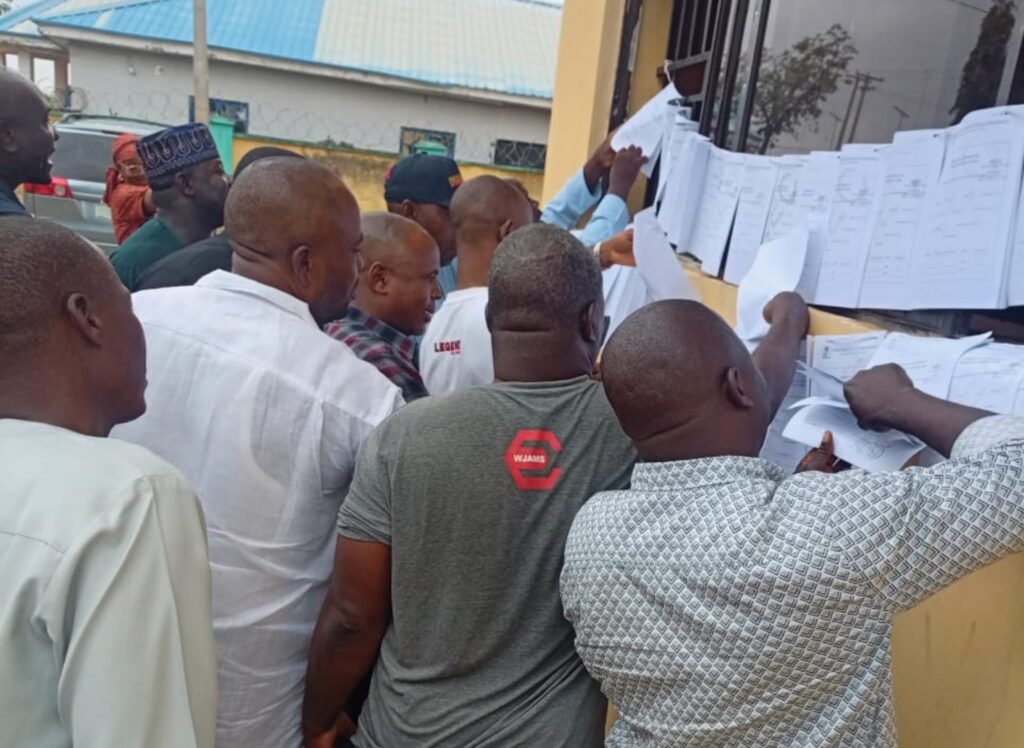
The nationwide public display, which began on Saturday in line with the provisions of Section 29(3) of the Electoral Act, 2026, allows Nigerians to inspect the personal particulars, educational qualifications, affidavits, work history and other nomination documents submitted by candidates seeking the nation’s highest office.
Displayed in Form EC9 at INEC offices across the country, the documents have immediately drawn public attention, particularly over President Tinubu’s educational history, which lists only his university qualification while the years of attendance for his primary and secondary education were entered as “0000.”
According to the documents made available by the electoral commission, President Tinubu submitted a Bachelor of Science (B.Sc.) degree in Business Administration from Chicago State University in the United States. The accompanying academic transcript indicated that the degree was awarded with honours on June 22, 1979.
The President also filed his National Youth Service Corps (NYSC) discharge certificate, showing that he completed the mandatory one-year national service in Oyo State between December 1982 and November 1983 before being formally demobilised.
His employment history, as contained in Form EC9, revealed that he worked with Mobil Nigeria Limited from 1983 until 1992, leaving the multinational oil company for what was described as “advancement.”
The documents further showed that Tinubu served as Governor of Lagos State from 1999 to 2007, with his exit from office recorded as the “legal end of tenure.” They also indicated that he has served under the Federal Government of Nigeria from 2023 to date following his inauguration as President.
Aside from his university degree, however, the President’s educational profile attracted renewed public attention after the sections reserved for the years he attended both primary and secondary schools were left as “0000,” with no certificates from those levels listed among the credentials submitted.
Tinubu’s personal particulars identified his date of birth as March 29, 1952, placing him at 74 years of age. His place of birth was listed as Lagos, while his residential address was recorded as No. 4 Queen’s Drive, Ikoyi. His occupation was simply described as “Politician.”
In contrast, the nomination documents submitted by Vice President Kashim Shettima contained a detailed educational record spanning from primary school to postgraduate studies.
According to the records, Shettima attended Lamisula I Primary School between 1972 and 1978, where he graduated second in a class of 22 pupils. His academic performance reportedly showed particular strength in English, History and Religious Knowledge.
His West African Examinations Council (WAEC) certificate, obtained from Government Secondary School, Potiskum, in June 1983, reflected six credits and passes, including distinctions in Religious Knowledge and Economics.
The Vice President also submitted his Bachelor of Agriculture degree from the University of Maiduguri, where he graduated with a Second Class Upper Division in August 1989, as well as a Master of Science (M.Sc.) in Agricultural Economics from the University of Ibadan.
His NYSC discharge certificate confirmed that he completed the compulsory national service between October 1989 and October 1990.
Explaining the exercise, INEC said the publication of Form EC9 is a mandatory legal requirement intended to promote transparency in the electoral process and provide Nigerians with the opportunity to examine the credentials and declarations submitted by candidates sponsored by political parties.
The commission stated that the forms contain personal particulars, academic qualifications, supporting affidavits and all statutory documents filed by candidates during the nomination process.
According to the electoral body, the documents have been displayed at its headquarters and state offices nationwide, including the Lagos State Office in Sabo-Yaba and relevant Local Government Area offices, where members of the public can inspect them.
The publication also opens the constitutional window for any eligible individual who believes that false information has been supplied in a candidate’s nomination documents to seek legal redress before the courts, as provided under the Electoral Act.
Meanwhile, INEC’s revised timetable indicates that campaigns for the presidential and National Assembly elections will officially commence on August 19, marking the beginning of what is expected to be an intense and closely watched contest for Nigeria’s highest political office.