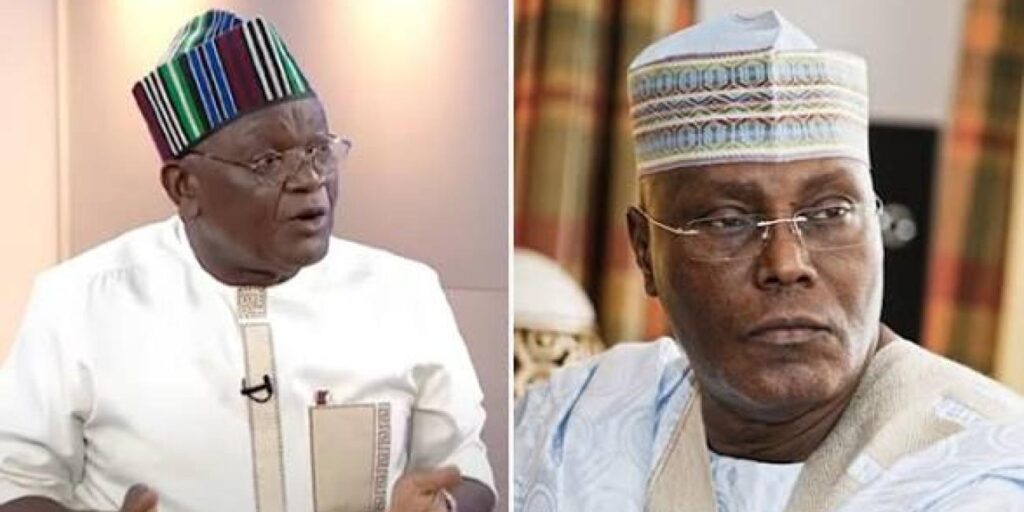
There is growing political tension in Benue State following allegations of a high-level political realignment involving former Vice President Atiku Abubakar, Secretary to the Government of the Federation, Senator George Akume, former Governor Samuel Ortom and former Attorney-General of the Federation, Chief Mike Kaase Aondoakaa, ahead of the 2027 general elections.
The alleged alliance, according to political stakeholders and the International Centre for Transparency Nigeria (ICTN), is being negotiated as part of a broader strategy to reshape the political landscape of the state and challenge the dominance of the ruling All Progressives Congress (APC) in the 2027 elections.
The development has raised questions over the future of the APC in Benue and the possible impact of emerging alliances on President Bola Tinubu’s presidential campaign in the North-Central state.
Prof. Joseph Vershima, national leader of the ICTN, who addressed a press conference at the Sheraton Hotel, Abuja, said the reported political arrangement could have far-reaching consequences for both the presidential and governorship elections in Benue.
According to Vershima, elements within the Benue State chapter of the Peoples Democratic Party (PDP) were allegedly working towards an understanding that would see them support Atiku’s presidential ambition in 2027.
The organisation further alleged that Aondoakaa, whom it described as a long-standing political associate of Atiku, had played a significant role in building a political bridge between Ortom’s political structure and a faction of the APC allegedly loyal to Akume.
Under the purported arrangement, Vershima claimed, Atiku would provide financial support for the PDP governorship candidate in Benue, while Akume’s political structure and some elements within the PDP would allegedly support and mobilise for Atiku’s presidential campaign.
The allegation has introduced a fresh dimension to the political calculations in Benue, where the APC is seeking to consolidate its influence ahead of the 2027 elections.
The ICTN questioned the implications of such an arrangement, particularly whether those allegedly involved would continue to prioritise the interests of the APC and President Tinubu or pursue a separate political agenda ahead of the elections.
Vershima warned that any alleged collaboration aimed at weakening the APC’s support base in Benue could have consequences beyond the governorship contest, stressing that the state remains strategically important to the presidential election in the North-Central.
“Beyond the governorship contest, this development has implications for the presidential election because Benue remains a strategic state in the North Central,” he stated.
He urged President Tinubu and the national leadership of the APC to pay closer attention to the unfolding political dynamics in Benue, alleging that unresolved internal disagreements, competing interests and emerging alliances could pose serious challenges to the party ahead of 2027.
The centre also drew parallels with the 2007 presidential election, alleging that Akume’s political decisions at the time favoured Atiku’s presidential bid against the preferred candidate of the ruling establishment.
It questioned whether a similar political realignment could emerge again in 2027, warning that the lessons of previous political alliances should not be ignored as new calculations take shape.
The reported alignments have consequently heightened political interest in Benue, with influential figures and competing political blocs allegedly repositioning themselves ahead of what is expected to be a fiercely contested 2027 election.
For the APC, the emerging claims present another challenge in its efforts to consolidate its political base in the state, while for opposition forces, any successful realignment involving prominent political actors could significantly reshape the contest for both the governorship and presidency.
However, the allegations remain claims made by the ICTN and have not been independently established.