
Benue State was plunged into fresh mourning on Saturday as the Efeyi-Utikpi Ugboju community in Otukpo Local Government Area conducted a mass burial for 15 residents killed in a violent attack blamed by residents on suspected armed herders.
The solemn ceremony, marked by rows of white caskets, uncontrollable tears and prayers for the dead, has once again thrown the security crisis confronting rural communities in Benue into the national spotlight.
The victims were killed on Tuesday, July 28, when suspected armed herders reportedly invaded Efeyi-Utikpi, an agrarian community in the Ugboju District of Otukpo.
The attack, which occurred in the early hours of the morning, reportedly left 15 people dead, several others injured and homes destroyed.
On Saturday, their remains were brought together for a final farewell.
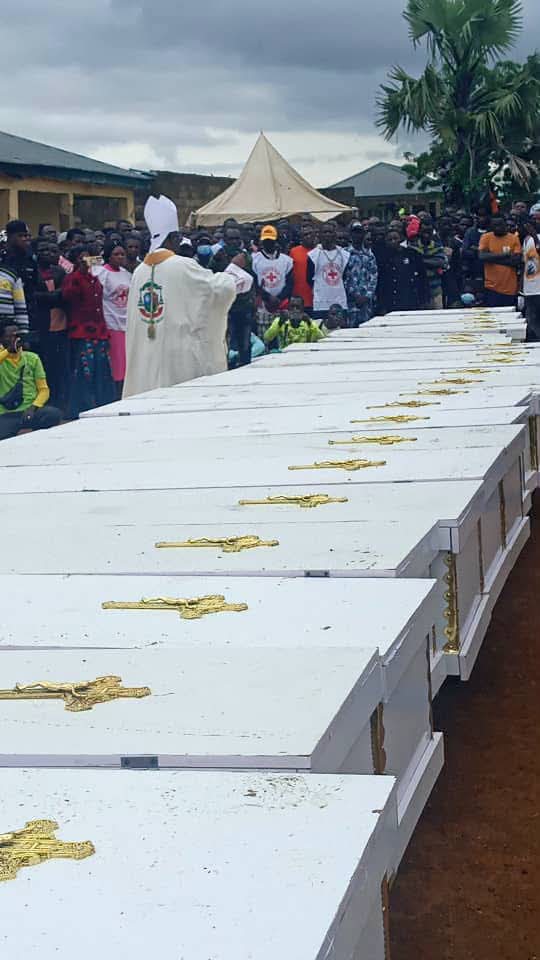
A Catholic bishop officiated over the funeral rites as relatives, community leaders, clergy members and residents gathered around the coffins. For many mourners, however, the ceremony represented more than the burial of loved ones. It was a painful reminder of a security crisis they say has continued to claim lives despite repeated assurances from government authorities.
The victims came from different generations.
Community burial records identified them as Okpe Philip, Joy Samuel, Success Onche, Apeh Samuel, Emmanuel Agwu, Ikpe John, Ameh Fredrick Owoicho, Onche Abechi, Sunday Alechenu, Isaac Ejembi, Emmanuel Ejiga, Edache Abechi, Abogonye Ameh, Chinedu Ameh, Michael Abalike and Emmanuel Adidu.
The youngest victims were children, while the oldest were elderly members of the community. Their deaths therefore robbed Efeyi-Utikpi of people from different stages of life — children who had barely begun living, adults building families and livelihoods, and older residents who had spent decades contributing to the community.
The tragedy has generated anger among residents who question why farming communities continue to experience deadly attacks despite the Federal Government’s repeated declarations that security remains a priority.
For the grieving families, the issue is no longer simply about mourning the dead.
It is about accountability.
It is about whether those responsible for the killings will eventually be identified, arrested and prosecuted.
And it is about whether communities will receive meaningful protection before another attack occurs.
Residents and community leaders have called on the Federal Government and the Benue State Government to move beyond condemnations and promises, demanding concrete security measures capable of protecting vulnerable communities.
The latest mass burial has also revived memories of another tragedy in the same local government area.
On July 12, residents of Otukpo-Nobi community buried eight people killed in an earlier attack blamed on suspected armed herders.
That funeral was similarly conducted amid grief, with family members, traditional rulers, community leaders and religious figures gathered to pay their final respects.
Eight white caskets were placed side by side before a Catholic priest offered prayers and the victims were lowered into their graves.
Attah Rueben, a resident who attended the ceremony, described the funeral as one of the darkest moments in the community’s history.
“The funeral was brief. The atmosphere was charged. Tears were flowing. It was the saddest day for the people of Otukpo-Nobi community,” he said.
The recurrence of mass burials in Otukpo has intensified concerns over the safety of farming communities in the area.
For a state heavily dependent on agriculture, insecurity carries consequences far beyond the immediate loss of lives. When farmers are driven away from their farms by fear, crops are abandoned, livelihoods are destroyed and entire communities become increasingly vulnerable to displacement and hunger.
Governor Hyacinth Alia had previously condemned the Otukpo-Nobi attack, describing it as deadly and calling on security agencies to ensure that those responsible were apprehended and prosecuted.
But as another 15 victims were committed to the earth, the frustration among residents was unmistakable.
They want arrests.
They want prosecutions.
They want security forces capable of preventing attacks rather than arriving after the killings have occurred.
And above all, they want an end to the cycle in which communities bury their dead, officials issue condemnations and the nation moves on until another village is attacked.
The Efeyi-Utikpi burial has therefore become another grim test of the Tinubu administration’s security promises, particularly in rural communities where residents say they remain exposed to armed attacks.
For the families who stood beside the white caskets on Saturday, government assurances offered little comfort against the reality before them.
Fifteen people were dead.
Fifteen families had been changed forever.
And another Benue community had been forced to bury its loved ones while demanding an answer to a question that has become increasingly difficult to ignore:
How many more mass graves will Benue have to open before the killings finally stop?