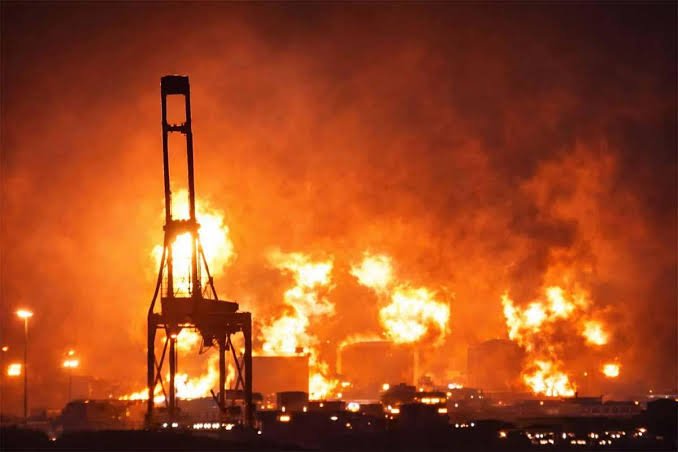
The United States has launched another wave of airstrikes against Iran, deepening fears that the fragile ceasefire between both countries has effectively collapsed and pushing the Middle East closer to another full-scale regional conflict.
The latest bombardment came hours after President Donald Trump declared the temporary ceasefire with Tehran “over,” with the U.S. Central Command (CENTCOM) confirming that American forces struck more than 80 military targets across southern Iran in what it described as a retaliatory operation.
Iranian state and local media reported powerful explosions in several strategic locations along the country’s southern coastline, including Bandar Abbas, Sirik, Bushehr, Qeshm Island, Konarak and Chabahar, as air defence systems were activated in an attempt to repel the attacks.
According to CENTCOM, the strikes targeted Iranian air defence installations, command-and-control centres, coastal radar systems, anti-ship missile sites and more than 60 boats belonging to the Islamic Revolutionary Guard Corps (IRGC). Washington said the operation was intended to weaken Iran’s capacity to threaten international shipping through the Strait of Hormuz, one of the world’s most vital oil transit corridors.
The fresh offensive follows attacks on three commercial vessels transiting the Strait of Hormuz, which the United States blamed on Iran. Washington described Tehran’s actions as a “clear violation” of the ceasefire agreement and vowed to impose what it called “heavy costs” for any further attacks on international commerce.
Iran, however, condemned the American operation as an act of aggression and a breach of the truce, insisting it would not bow to military pressure. Iranian military officials warned that the country reserves the right to respond, raising concerns that retaliatory strikes could further destabilise the Gulf region.
The renewed hostilities have sent shockwaves through global energy markets. Oil prices surged by more than one dollar per barrel amid fears that prolonged fighting around the Strait of Hormuz—which carries roughly one-fifth of the world’s seaborne oil—could disrupt global supplies and trigger fresh economic uncertainty.
Security analysts warn that the latest escalation represents the most serious deterioration in U.S.-Iran relations since the ceasefire was announced, with diplomatic efforts now hanging by a thread. As both sides harden their positions, international observers fear the crisis could rapidly spiral into a wider regional confrontation involving Gulf states and other global powers.