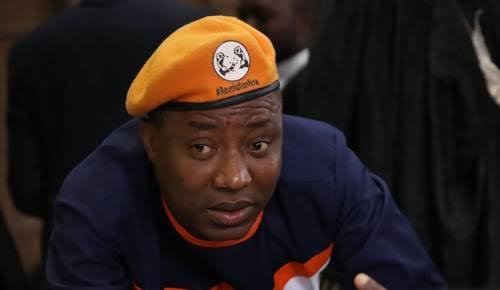
Human rights activist and former presidential candidate, Omoyele Sowore, has raised fresh concerns over conditions at the Kuje Medium Security Custodial Centre in Abuja, revealing that he spent nine days in detention alongside 1,158 inmates, including 37 prisoners undergoing treatment for tuberculosis in overcrowded cells.
Sowore, who regained his freedom after the Federal High Court in Abuja restored his bail, made the disclosure in a personally signed statement titled, “I Am Back From Prison!”, in which he criticised Nigeria’s correctional system and accused successive governments of deepening repression despite the country’s democratic transition.
“Yesterday, after spending nine days in Kuje Prison following the unjust revocation of my bail by Justice M.G. Umar of the Federal High Court, Abuja, I regained my freedom,” he stated.
“During those nine days, I was incarcerated alongside more than 1,158 inmates, including 37 who were undergoing treatment for tuberculosis in overcrowded cells.
“Prison is not new to me, and perhaps that explains how quickly I settle into prison life. But the truth remains that no one should spend even a minute behind bars for an offence unknown to law or for exercising constitutionally protected rights.”
His account has reignited concerns over overcrowding and public health challenges within Nigerian custodial centres, particularly the management of infectious diseases such as tuberculosis.
SaharaReporters had earlier reported that at least 37 inmates diagnosed with tuberculosis as far back as December 2025 remained under treatment at the Kuje facility amid growing scrutiny over prison healthcare services and the deaths of two inmates allegedly linked to inadequate medical attention. The report further highlighted concerns over congestion, sanitation and access to medical care within the prison system.
Sowore also used the statement to launch a scathing attack on successive administrations since the end of military rule, arguing that civilian governments had failed to uphold democratic values and fundamental human rights.
“The Nigerian state has pursued me since my university days, when I joined the struggle to end military rule,” he said.
“Sadly, although the military formally relinquished power in 1999, successive civilian administrations have, in many respects, proven even more repressive – violating human rights, undermining democratic institutions, and eroding the dignity of Nigerians.”
The former presidential candidate further accused security institutions of perpetrating abuses against citizens, alleging that arbitrary arrests, prolonged detentions and extrajudicial actions had continued under democratic rule.
“These abuses are often carried out through security agencies such as the Nigeria Police Force, long associated with extrajudicial killings, and the Department of State Services (DSS), whose record of arbitrary arrests, prolonged detentions, and other serious human rights violations is well documented,” he declared.
Despite his detention, Sowore maintained that his resolve remained intact, insisting that his commitment to political activism and social justice had not been weakened.
“I am back, and I remain unbroken,” he stated.
“I extend my deepest appreciation to our revolutionary comrades across Nigeria and around the world who stood resolute, occupied the streets, raised their voices, and refused to relent until I regained my freedom. Your courage and solidarity made a profound difference.
“Although I have been released on bail under stringent conditions, our mission remains unchanged.”
In what appears to be an early declaration of intent ahead of the next general election cycle, Sowore also announced that preparations for his 2027 presidential ambition had begun.
“The task before us is greater than any individual. The struggle for justice, freedom, and the liberation of Nigeria continues.
“And now, the next major assignment is before us!
“The Sowore Presidential Campaign 2027.
“The campaign must go on.”
The development has once again brought national attention to conditions inside Nigeria’s correctional facilities, with rights advocates renewing calls for urgent reforms to address overcrowding, improve healthcare services and guarantee humane treatment for inmates across the country.