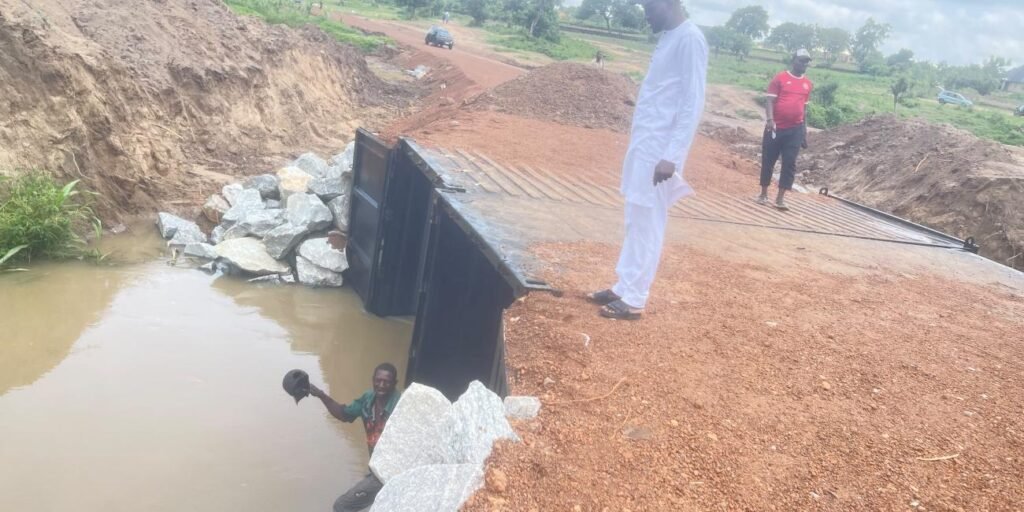
Residents and motorists in Kwara State have expressed outrage and growing fears after the state government constructed a makeshift bridge using shipping containers along the busy Okolowo–Alapa Road in Moro Local Government Area, months after the collapse of the Mooro Bridge claimed a life and left four others critically injured.
The temporary structure, now serving as an alternative crossing on one of the state’s most important transport corridors, has ignited concerns over its ability to support the heavy-duty trucks, fuel tankers, trailers and articulated vehicles that regularly ply the route connecting Kwara communities with parts of Oyo State and the Nigeria–Benin Republic border.
The development has also revived questions over the fate of the permanent bridge reconstruction project, which has reportedly consumed more than N1.2billion through multiple contract revisions over the years without completion.
A visit to the site showed that the state government had completed an alternative access road leading to the improvised crossing, with shipping containers positioned to serve as the bridge over the collapsed section.
A government signboard at the location reads: “Construction of Alternative Access Road at Collapsed Bridge Along Okolowo–Alapa Road, Moro LGA. Supervising Ministry: Kwara State Ministry of Works.”
Despite the intervention, residents insist that the arrangement amounts to a dangerous stopgap that could trigger another disaster, especially during the peak of the rainy season when floodwaters become more aggressive.
One resident acknowledged the government’s efforts to reopen the road but questioned the wisdom of allowing heavy vehicles to use what many now call a “container bridge.”
“If you check the road from where the government started, you will see that they have tried, but the only problem is that the container bridge is not strong enough to withstand the weight of heavy-duty vehicles like trucks that always pass here,” the resident said.
“But we can’t do anything about it. We are just praying to God against calamity.”
He warned that the situation could worsen as the rainy season intensifies.
“If water comes around September during the heavy rains, we are praying the bridge will not be washed away. But if you look beneath the bridge, you will see how the water flows. If the flood becomes heavy, there is a high chance it could wash away the bridge.
“If you also look at the top of the container, it looks somehow. The bridge is not strong enough to withstand the weight the government intends it to carry.”
Observations at the site showed that trailers and other heavy-duty vehicles continue to use the route despite widespread concerns about the structural integrity of the temporary crossing.
Civil engineer Babatunde Abdulganiy, a graduate of Ladoke Akintola University of Technology and a resident of Ogidi, Ilorin, said container bridges could only serve as short-term emergency measures and are unsuitable for continuous heavy traffic.
He noted that the greatest concern was the apparent absence of any visible urgency to commence reconstruction of the permanent bridge.
“I am familiar with the location you are referring to, and I have heard about the collapse of the bridge, although I have not conducted a personal inspection of the site,” he said.
“Based on the videos and pictures, it appears that the government intended the container bridge to serve as a temporary alternative route. The critical question, however, is for how long?
“From what is publicly available, there does not appear to be any strong indication of an urgent commitment to reconstruct the collapsed bridge, raising concerns that this temporary solution could remain in place for an extended period.”
Abdulganiy further warned that the area has historically experienced severe flooding, making the hydraulic design of any temporary structure a matter of public safety.
“The success of such a structure depends largely on whether adequate hydraulic clearance and sufficient waterway have been provided to allow floodwaters to pass freely,” he explained.
“We know that flood intensity in the area typically peaks between September and October. If the water passage is inadequate, there is a real possibility that rising floodwaters could overtop or undermine the bridge, creating a serious safety hazard.”
He stressed that shipping containers were never engineered to withstand sustained heavy axle loads from articulated vehicles.
“It is also important to emphasise that a container bridge is not designed to carry sustained heavy axle loads from articulated trucks, trailers and other heavy-duty lorries that regularly use that route,” he said.
“Such structures are generally intended as temporary installations with strict load limitations. Subjecting them to continuous heavy vehicular traffic would significantly increase the risk of structural failure.
“Allowing heavy trucks to use the bridge would therefore be a dangerous decision, and if the structure were to fail under load, the consequences could be severe, with potentially significant loss of lives and property.”
He urged the state government to immediately restrict heavy-duty vehicles from using the crossing while fast-tracking work on a permanent replacement.
The latest controversy comes barely two months after the tragic collapse of the Mooro Bridge on April 29, 2026.
The disaster claimed one life and left four others critically injured, exposing longstanding concerns over the condition of critical infrastructure in the area.
Residents and community vigilantes said the bridge gave way after a truck loaded with stones attempted to cross the aging structure.
“The truck carrying stones stepped on the bridge and immediately the bridge gave way,” a vigilante member recalled.
The truck reportedly plunged into the collapsed section, while the driver survived and was rushed to hospital in critical condition.
Hours later, four young men from Mandala community riding two motorcycles unknowingly drove into the destroyed bridge because there were no visible warning signs or barricades at the scene.
One of the victims died instantly, while the remaining three sustained severe injuries.
The incident reignited public anger over the prolonged delay in completing the bridge reconstruction despite multiple budget augmentations that reportedly pushed the total project cost beyond N1.2billion.
Investigations by the International Centre for Investigative Reporting had earlier revealed that the reconstruction contract, initially awarded to Bili Joe + Berger Construction Limited for N865million, was subsequently reviewed upward on several occasions.
An additional N92.9million was approved in 2019, increasing the contract value to nearly N938million, while another augmentation approved in 2022 reportedly raised the total cost to over N1.2billion.
For many residents, the emergence of a container bridge in place of a permanent structure represents not progress but a troubling symbol of failed infrastructure planning, abandoned public projects and a looming danger on one of Kwara’s busiest highways.