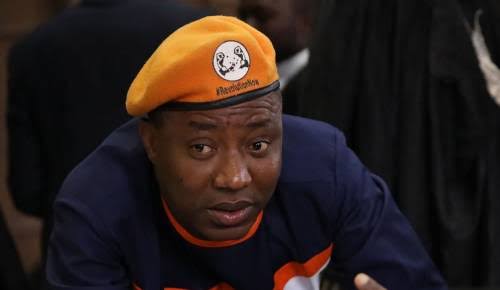
22nd June 2026 bore yet another remarkable development in the criminal trial of Omoyele Sowore . The Federal High Court, Abuja ordered his remand in Kuje Prison following what the court considered a deliberate absence from court during his trial. In the wake of this development, several opinions have naturally trailed the decision of the court. While some persons consider the order a necessary exercise of judicial powers, others have questioned the propriety of the decision in view of the events which preceded it. It is with similar concern that I have decided to view the entire episode not necessarily from the perspective of Omoyele Sowore or what the law says on the revocation of bail, but from the perspective of public confidence in the administration of justice.
I must confess from the outset that I find Sowore to be an interesting figure in Nigeria’s democratic space. Whether one agrees with his methods or not, his consistency in challenging authority and speaking on issues of governance cannot be denied. However, this piece is not intended to defend or eulogize Sowore, neither is it intended to attack the judiciary. Rather, it is intended to examine whether the sequence of events leading to the revocation of his bail is one that inspires confidence in the mind of a reasonable observer.
On 16th March 2026, Honourable Justice Mohammed Umar made a controversial order directing Sowore’s lawyer and member of the Bar, Barrister Abubaka Marshal, to kneel outside the Bar area of the court following an exchange concerning a court date.¹ The incident quickly found its way into public discourse and was received with mixed reactions from both lawyers and non lawyers alike. While the court may have considered its actions necessary for the maintenance of decorum (one which I opine as absolutely overreaching), it nonetheless raised questions in certain quarters regarding the nature of the sanction imposed and its compatibility with the dignity of the legal profession.
In the days that followed, concerns were openly expressed regarding the manner in which proceedings were unfolding in the matter. Sowore’s lawyers reportedly stopped appearing before the court, citing concerns over what they perceived as bias. Subsequently, Sowore himself brought an application seeking the recusal of the presiding judge from the matter. The application was however struck out. On the same day also, the court proceeded to revoke his bail on account of his alleged absence from court.
Now, while the court undoubtedly cited reasons which it considered cogent and sufficient in law for revoking the bail, the issue for me is not necessarily whether reasons existed or whether they are justified. The issue is whether the entire sequence of events would be considered as “justice” to a reasonable man observing the proceedings from the outside; the men at the newspaper stand without a wig or gown or the women greeted by the news on their morning radio! It would be difficult to ignore the fact that an application challenging the continued participation of the judge in the matter was struck out and the defendant’s bail revoked on the same day. Again, I make no allegation of impropriety. I merely ask whether the optics of such a development in the social mirror inspire confidence in the ordinary citizen.
A few days ago, I had a discussion with a journalist friend concerning this matter. One thing became apparent during that discussion. The perception of the judiciary by the average Nigerian is already shaky. Rightly or wrongly, many citizens approach judicial controversies with a considerable degree of suspicion. Sometimes, lawyers alike. It therefore becomes imperative that judicial proceedings not only meet the standards of justice in fact, but also the standards of justice in appearance.
There is a popular Yoruba jurisprudential proverb which says, “Aje ke lana, omo ku loni, tani ko mo pe aje to ke lana lo pa omo to ku loni?” Meaning, a witch cried yesterday and a child died today, who does not know that it was the witch that cried yesterday that killed the child that died today?
The wisdom behind the proverb is not that suspicion is always correct. Far from it. The lesson is that a reasonable man naturally connect events and draw conclusions from surrounding circumstances. Whether those conclusions are right or wrong is often secondary to the fact that they are formed in the first place.
It is for this reason that I consider the present trial before his Lordship, Honourable Justice Mohammed Umar, a slippery slope which must be tread cautiously by the Nigerian Judiciary. Criminal proceedings are particularly sensitive because they threaten the liberty of the defendant who, in the eyes of the law, remains innocent until proven guilty. The defendant on trial also draws significant attention to the country’s judicial system. Moreover, Judges, with all total reverence, must equally be acknowledged as human beings of flesh and blood. They are learned, disciplined and trained to be impartial. Nevertheless, where a series of events creates the appearance of friction between the court and a litigant as this, a reasonable man may begin to question whether the court can continue to approach the matter with complete objectivity. Whether such fears are justified is a different issue entirely. The fact that they can reasonably arise is itself in my opinion the bane of concern.
I also fear that developments of this nature may create an unintended consequence within our justice system. I have never seen an application for recusal that ends in harmony between the bench and the applicant. With Sowore’s event, Litigants may become reluctant to challenge the competence of a judge to continue hearing a matter, even where genuine grounds for recusal exist. The right to seek recusal where there is a reasonable apprehension of bias is an important safeguard within every judicial system, no matter how inconvenient. Such a right should not become one that litigants are afraid to exercise.
For this reason, I have increasingly come to the view that applications for recusal should perhaps be treated on a principle similar to contempt ex facie curiae. In my opinion, an application seeking the recusal of a judge should not be determined by the same judge whose recusal is sought. The principle of Nemo Judex in Causa Sua remains one of the cardinal pillars of fair hearing. No man should be a judge in his own cause. It may therefore be more appropriate for such applications to be addressed to the Chief Judge and determined expeditiously by a separate panel while the substantive matter is stayed. Costs may naturally be imposed where such applications are manifestly frivolous, but the determination itself should not rest with the judge whose impartiality has been called into question. It does not scientically sit well with reasoning that a person accused of bias in how he deal with matters concerning other persons, will not be bias in dealing with matters pertaining himself: his judgment.
I do not write in defence of Sowore. I write only in defence of what I consider to be the appearance of justice. The judiciary remains the last hope of the common man. Once confidence in its impartiality begins to diminish, even the most legally sound decisions may struggle to command public trust.
I draw a solid conclusion from the words of Sir Adetokunbo Ademola, the first indigenous Chief Justice of Nigeria, delivered decades ago in the case of Isiyaku Mohammed v Kano Native Authority:
“Justice must not only be done but must also be seen to be done… Meaning that the court should ask whether a reasonable man who was present at the trial would believe that justice has been done..”
I think I have answered for the reasonable man.
Olatunde Olayinka Damilola, a right advocacy lawyer at Heltavel LP . reflecting objectively on the heartbeat and the pulse of the reasonable man on the trials of Brother Sowore before his Lordship, Honourable Justice Umar.
Olatunde@nigerianbar.ng.
+2349060557789.