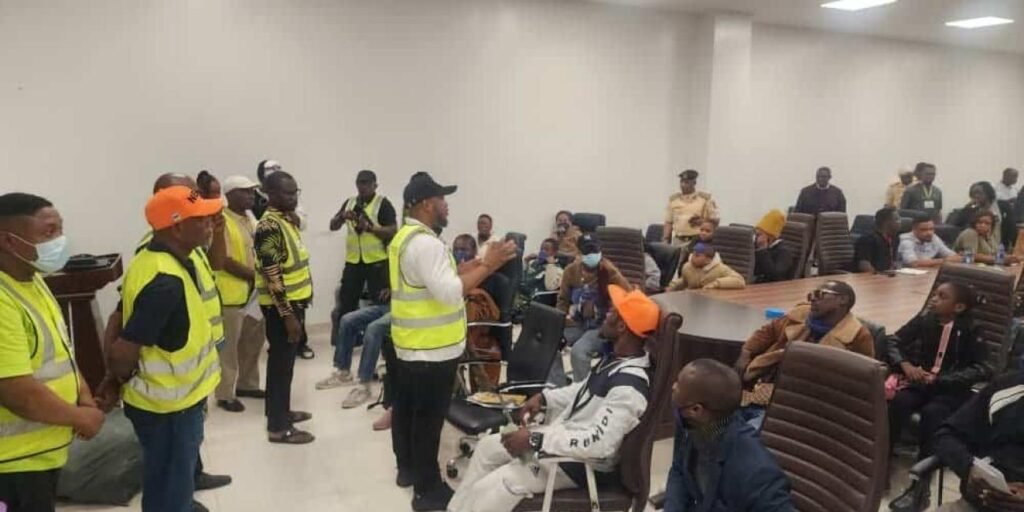
The Nigerian government has announced that at least 271 Nigerian nationals in South Africa will be repatriated on Tuesday as it continues its voluntary evacuation programme for citizens seeking to return home amid renewed anti-immigration tensions and recurring xenophobic attacks in the country.
The evacuees are expected to return aboard an Air Peace aircraft in another phase of the humanitarian operation being coordinated by the Federal Ministry of Foreign Affairs following growing fears among Nigerians living in South Africa.
According to a statement issued on Monday by the spokesperson for the Ministry of Foreign Affairs, Kimiebi Ebienfa, the aircraft will depart Nigeria at 3:00 p.m. on Monday and arrive in South Africa at about 9:00 p.m. local time.
The return flight is scheduled to leave shortly after midnight, with the 271 returnees expected to land at the Murtala Muhammed International Airport in Lagos on Tuesday morning.
The latest evacuation follows renewed anti-immigration protests and fresh waves of xenophobic hostility in parts of South Africa that have heightened fears among foreign nationals, particularly Nigerians, many of whom have reportedly sought government assistance to leave the country.
Hundreds of Nigerians had requested assistance from Nigerian authorities to return home, with government officials previously confirming that more than 1,000 citizens had registered for the voluntary evacuation exercise, reflecting growing anxiety within the Nigerian community.
The repatriation programme commenced earlier this month when the first batch of 262 Nigerians arrived in Lagos aboard an Air Peace flight, marking the beginning of a broader government effort to bring home citizens who no longer feel safe in South Africa.
For years, Nigerians have remained among the principal victims of xenophobic violence in South Africa, alongside migrants from Zimbabwe, Mozambique, Malawi, Ethiopia, Somalia and other African nations.
Repeated outbreaks of anti-immigrant violence have left behind a trail of deaths, injuries, destruction of businesses, looting of properties and the displacement of thousands of migrants whose livelihoods were built over decades of hard work.
Many Nigerians in South Africa have consistently complained of being stereotyped as criminals and drug traffickers, accusations community leaders argue have fuelled public resentment and reinforced discrimination against an entire nationality.
Human rights organisations have repeatedly accused South African authorities of failing to adequately protect foreign nationals from mob violence, hate campaigns and systemic discrimination. Rights groups have also raised concerns over allegations of profiling, harassment and extortion targeting African migrants.
Despite repeated assurances by President Cyril Ramaphosa that every resident would enjoy equal protection under the law, critics maintain that South Africa’s security institutions have failed to decisively confront xenophobic violence, while allegations persist that some law enforcement officials have either ignored attacks or participated in the intimidation of foreign nationals.
Political analysts contend that worsening economic conditions, soaring unemployment, failing infrastructure and widespread frustration over governance have created fertile ground for anti-immigrant rhetoric, with African migrants increasingly portrayed as convenient scapegoats for deeper national problems.
Rather than addressing structural economic challenges, critics argue that sections of the political class have repeatedly exploited anti-foreigner sentiments, redirecting public anger toward vulnerable migrant communities and deepening divisions among Africans.
The evacuation of another 271 Nigerians therefore represents more than a humanitarian exercise. It is a stark reminder of the fragile state of Pan-African solidarity and the painful irony that black Africans continue to face hostility and persecution within fellow African states.
For many of those returning home, South Africa’s promise of opportunity has been overshadowed by fear, uncertainty and repeated episodes of xenophobic violence, forcing them to abandon businesses, careers and years of investment in search of safety.
As another aircraft prepares to bring hundreds of Nigerians back to their homeland, the continent is once again confronted with an uncomfortable question: how did a nation that once symbolised Africa’s struggle for freedom become a place from which fellow Africans now seek rescue and escape?