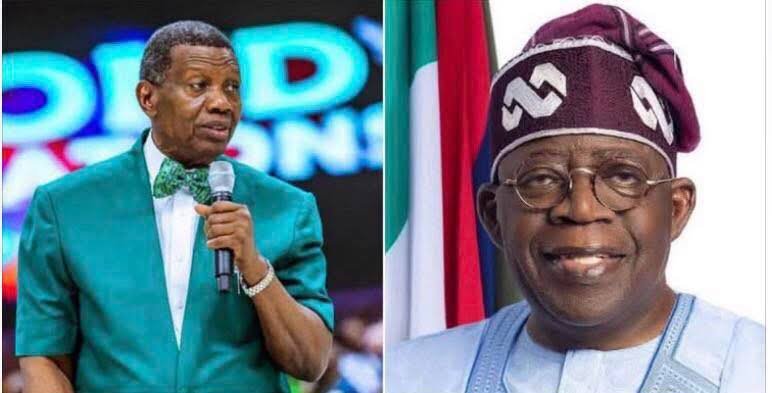
The General Overseer of the Redeemed Christian Church of God (RCCG), Pastor Enoch Adeboye, has stirred nationwide debate after declaring that President Bola Tinubu has fulfilled his responsibilities in tackling Nigeria’s worsening insecurity, insisting that the Commander-in-Chief cannot be expected to personally wear military fatigues and confront terrorists on the battlefield.
Speaking at the US-Nigeria Faith Heroes Award Gala organised by the Save Nigeria Group in Washington, D.C., Adeboye defended the president against mounting criticism over the relentless wave of terrorism, kidnappings and killings that continue to ravage communities across the country.
The revered cleric maintained that the constitutional duty of a president is to issue directives to military commanders and security agencies, arguing that operational failures should not automatically be laid at the doorstep of the nation’s leader.
“I need to make this one clear: I don’t support those who are accusing the president of not doing enough. When the commander-in-chief has given instructions to his subordinates, he has done his bit. You don’t expect him to go and put on khaki and fight,” Adeboye said.
Drawing parallels with global leadership practices, Adeboye referenced United States President Donald Trump, saying heads of state across the world issue military orders without physically participating in combat operations.
According to him, leaders provide direction while the responsibility for execution rests squarely on the shoulders of security institutions and military commanders.
Yet, even as he defended the Tinubu administration, the cleric admitted that the nation’s security crisis has deteriorated alarmingly, with terrorism and kidnapping no longer confined to northern Nigeria but spreading steadily into the southern regions.
He lamented that communities once considered relatively safe have become vulnerable, describing the current reality as one that has left many citizens questioning their faith and hope.
“Things have gone far, far worse. The terrorism and kidnapping that were in the North are now even at my doorstep. They have come all the way down to the South, and the sponsors are all known, yet they are still moving about freely,” he said.
Adeboye further disclosed that he had personally discussed the security situation with President Tinubu and First Lady Oluremi Tinubu, urging the government to adopt a far more aggressive strategy against both terrorists and their alleged financiers.
The cleric revealed that he advised the President to issue a 90-day ultimatum to the nation’s service chiefs, demanding the complete eradication of terrorist activities or their resignation from office.
“I told him to tell all the military boys, all the army, navy and air force: You have 90 days. Wipe out this rubbish or resign,” he stated.
More controversially, Adeboye insisted that the real battle lies not merely on the frontlines but against those allegedly financing and sustaining violent groups.
He claimed that many of the sponsors are influential businessmen and politicians whose identities, according to him, are already known to authorities but remain untouched.
“Some of them are businessmen. Some of them are politicians. Go after them. Because if you do not deal with those supplying arms and ammunition, the problem will continue,” the cleric warned.
His remarks have already ignited fierce reactions across political and social circles, particularly at a time when public frustration over insecurity has reached unprecedented levels, with citizens increasingly demanding greater accountability from the Federal Government amid recurring attacks, mass abductions and killings across several states.
While Adeboye’s defence of the President may resonate with those who believe military commanders bear primary responsibility for operational outcomes, critics argue that ultimate accountability must still rest with the Commander-in-Chief, whose constitutional powers include appointing, supervising and replacing the very officials entrusted with securing the nation.
The intervention by one of Nigeria’s most influential religious leaders has once again thrust the national conversation on insecurity into sharper focus, raising difficult questions about leadership, responsibility and the price ordinary Nigerians continue to pay as violence spreads across the country.