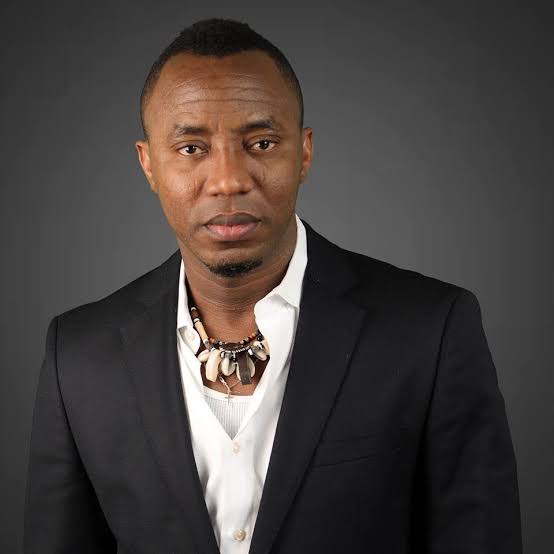
The question has been thrown at him repeatedly since he made the pledge: “Where will you get the money?”
Now, Omoyele Sowore, the presidential candidate of the African Action Congress (AAC), has answered—not with a budget document, but with a searing indictment of Nigeria’s political class.
The firestorm began last week when Sowore took to X (formerly Twitter) to declare that if elected in 2027, his administration would implement a ₦500,000 minimum wage for Nigerian workers—more than seven times the current national minimum wage of ₦70,000 .
In a series of posts on May 28, 2026, Sowore also promised to abolish casualisation and contract staffing, which he described as “exploitative” and “dehumanising,” and to build one million public housing units across the country .
“A minimum wage of ₦500,000 is not too much for Nigerian workers,” Sowore wrote. “Police officers, soldiers, teachers, doctors, nurses, and other public servants deserve a living wage, and those in critical sectors must earn additional allowances for the risks, sacrifices, and essential services they provide” .
Critics Pounce: ‘You Don’t Understand How Public Wage Works’
The proposal was met with immediate pushback from prominent voices.
Bayo Onanuga, Special Adviser to President Bola Tinubu on Information and Strategy, retweeted a post from a user identified as Dr Toks (@fimiletoks) that attacked the plan as economically unsustainable .
“You don’t understand how public wage works,” the post read. “At N70k minimum wage, the FG personnel wage bill is currently N10trn in a total budget of N58trn. At 500k minimum wage, the FG will need N100trn to pay salaries alone with consequential adjustments and allowances” .
The post further questioned: “How will the states cope? Will you ask the CBN to print N70trn for you in a year? … How will the private sector cope without creating massive inflation in the price of goods and services and job losses?”
Reno Omokri, Nigeria’s Ambassador to Mexico, also weighed in against the proposal. Citing an AI-generated analysis, Omokri described the N500,000 minimum wage as unrealistic given the country’s fiscal realities .
“Unless you want Nigeria to return to the era of borrowing to pay salaries, a ₦500,000 minimum wage is unrealistic,” Omokri stated .
‘Not a Shortage of Money, But a Surplus of Greed’ – Sowore Responds
But Sowore, never one to retreat, doubled down. In a follow-up post that has since gone viral, he turned the question on its head.
“The same tired question always comes up: ‘Where will the money come from to pay workers a decent minimum wage?’ Yet nobody ever asks where politicians find the money to pay themselves outrageous salaries and allowances, fund luxury lifestyles, or loot public treasuries,” he wrote.
Citing unverified allegations, Sowore claimed that Ondo State Governor Lucky Aiyedatiwa kept hundreds of billions of naira—approximately N500 billion—in bank accounts at First Bank solely to generate interest for himself and his cronies, while the people of Ondo struggle with poverty, unemployment, failing schools, and collapsing healthcare.
He also alleged that billions are available for political campaigns and re-election projects, claiming that Imo State Governor Hope Uzodinma serves as “treasurer of a heist worth N800 billion in stashed campaign funds for Tinubu.”
“Nigeria does not have a shortage of money,” Sowore argued. “It has a surplus of greed, corruption, and misplaced priorities. If there is money for politicians, there must be money for workers. ₦500,000 minimum wage is not the problem. The problem is a political class that treats public funds as private property while millions of Nigerians suffer.”
Many Nigerians Rally Behind Sowore: ‘It Is Possible’
Despite the criticism from political elites, Sowore’s proposal has found significant support among ordinary Nigerians who argue that the country’s vast resources can sustain a living wage if corruption is tackled.
Dozens of X users have backed the AAC candidate, with some arguing that Nigeria’s current revenue position—boosted by subsidy removal and exchange rate unification—makes the proposal feasible.
One user, @Danjuma_Abraham, wrote: “We have the money. In 2026, Nigeria’s FAAC allocations are hitting record highs monthly. The problem is not revenue—it is how the money is shared among a few. ₦500k is possible if we cut the cost of governance.”
Another user, @Official_Chidinma, argued: “Sowore is right. Lawmakers earn over N1 million monthly in running costs alone. If political office holders can vote themselves jumbo pay, why can’t a nurse or teacher earn a living wage? The resistance tells you who benefits from the current system.”
Civil society groups have also weighed in. The Nigeria Labour Congress (NLC), while yet to officially endorse the specific figure, has repeatedly argued that the current minimum wage is grossly inadequate. An NLC official who spoke anonymously said: “The debate Sowore has started is healthy. Whether ₦500,000 or not, the point is: Nigerian workers cannot survive on what they earn today.”
Some economists, however, remain sceptical. Dr. Muda Yusuf, a Lagos-based economist, told our correspondent: “While corruption is indeed a major problem, the arithmetic of a ₦500,000 minimum wage across all sectors is challenging. It would require fundamental restructuring of the economy, not just reallocating political spending.”
A Nation Divided, a Debate That Won’t Die
Sowore’s proposal has split Nigerians along familiar fault lines—between those who believe the country can afford anything if corruption ends, and those who insist that even with zero corruption, basic economic constraints remain.
But even critics acknowledge that Sowore has achieved something significant: he has forced a national conversation about why political office holders live in opulence while workers cannot afford rent, school fees, or healthcare.
As one X user, @PovertyIsAChoice, put it: “Whether you agree with Sowore or not, ask yourself this—why is it that every time a politician proposes to raise workers’ pay, the first question is ‘where’s the money?’ But when they vote themselves allowances, nobody asks them anything?”
As of press time, neither Governor Aiyedatiwa’s office nor the Presidency had responded to Sowore’s specific allegations regarding stashed campaign funds.
The AAC candidate, who has now positioned the minimum wage as the centrepiece of his 2027 campaign, appears ready to keep asking the question that makes the establishment uncomfortable: Not where the money is, but who is hoarding it.