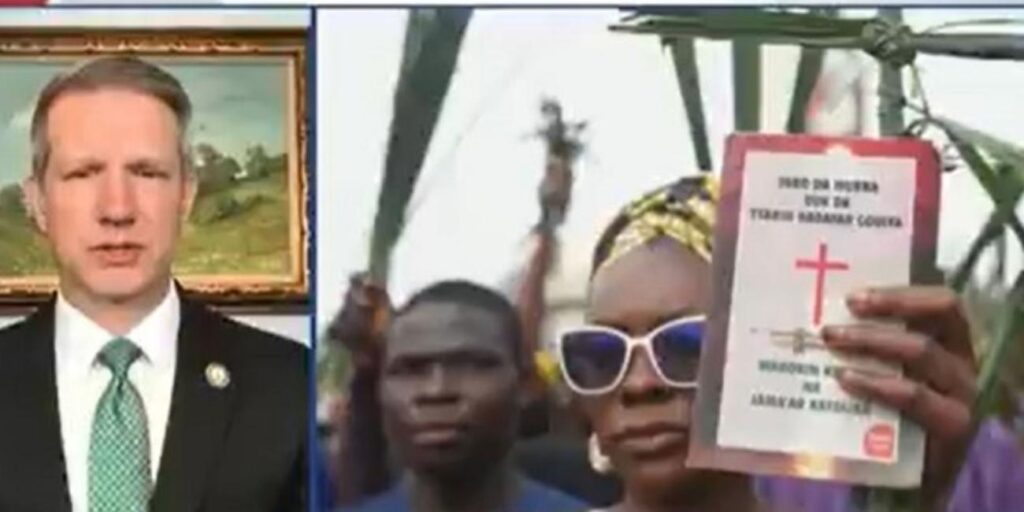
Fresh diplomatic tension is brewing between Nigeria and the United States after Riley Moore issued a stern warning to the Nigerian government over continued attacks on Christian communities, declaring that the administration of Donald Trump may intervene directly if Nigerian authorities fail to address the situation.
Speaking during an interview on Newsmax, the West Virginia congressman revealed that he had submitted a detailed report to the White House following an investigation into recent violent incidents in Nigeria, citing attacks on religious gatherings and growing insecurity affecting Christian communities.
Moore, a member of the U.S. House Appropriations Committee, said his findings were partly based on intelligence reports and insights gathered during his recent visit to Nigeria, where he reportedly met displaced persons and assessed the security situation firsthand.
According to Moore, one of the incidents referenced in his report involved the killing of 40 individuals during a Palm Sunday church service, an attack he described as tragic and alarming.
“So as you just reported, unfortunately, we’ve had 40 individuals who were killed at a Palm Sunday service, which is just tragic,” Moore stated during the interview.
He also cited another incident in Kaduna State, where 13 Christians were reportedly killed by suspected Islamic militants during a Christian wedding ceremony.
“And then on top of that, you had another 13 Christians killed by Islamic radical militants at a Christian wedding on Sunday,” he added.
The congressman further disclosed that the United States has already begun cooperation efforts with Nigeria, offering recommendations on how both countries can jointly address the escalating violence.
“So we have a number of suggestions here of how the Nigerian government can work with the United States government to address this,” Moore said.
However, Moore warned that Washington may take unilateral action if Nigeria fails to act swiftly.
“But as President Trump has been very clear on this, if they don’t address this, we’re going to address it for them. Now, we would like to address it in cooperation and coordination but if they don’t do that, if they don’t step up to the plate here, we are going to start to take the lead on this,” he stated.
The remarks have already sparked debate among analysts and observers who see the statement as a rare and direct warning that raises questions about Nigeria’s sovereignty and the extent of foreign involvement in domestic security matters.
Moore further revealed that the United States currently has about 200 military personnel working alongside Nigerian forces to help address capability gaps.
“Now, currently, we have 200 military individuals from our armed forces there training and working with the Nigerian military to try to address their capability gaps that they have there,” he explained.
He also disclosed the deployment of U.S. surveillance and strike capabilities, including the use of MQ-9 Reaper drones.
“We have MQ-9 Reapers there currently as well,” Moore added.
In a more controversial revelation, Moore referenced what he described as a Tomahawk cruise missile strike carried out around Christmas 2025 targeting extremist groups operating within Nigeria.
“Tomahawk cruise missile strike just around Christmas in Nigeria to try to address ISIS and Boko Haram, which also operate in that country, largely unfettered, which is a terrible, terrible situation,” he said.
The congressman acknowledged that Nigerian authorities have taken some steps but insisted the response has been too slow.
“But look, the Nigerian government has been trying to make some steps toward this, but they’re not doing it fast enough, things aren’t happening quick enough. And these things keep happening, so something’s got to give here,” he stated.
Rejecting claims that the violence is complex or rooted primarily in farmer-herder conflicts, Moore argued that attacks on religious gatherings suggest a deliberate pattern.
“Well, I mean, that’s just a false claim on its face,” he said, adding that attacks on Palm Sunday worshippers and Christian weddings point to targeted violence.
Drawing from his visit to Nigeria, Moore also described meeting Christian victims in internally displaced persons camps, alleging that extremists continue to attack vulnerable populations.
“When I was in Nigeria, I met with people who were Christians who were living in IDP camps,” he said.
He further claimed that armed groups were attacking displaced persons, describing the situation as alarming.
“So they’re in refugee camps where Islamic radicals just roll through there and murder people who are living in refugee camps,” Moore alleged.
While acknowledging that non-Christians are also victims of violence and that farmer-herder conflicts exist, Moore maintained that there is a broader pattern targeting Christian populations.
“And what they’ll argue is it’s about farmers and herders and things like that. Sure, that’s part of it. Are there non-Christians being killed in Nigeria? Of course, there are,” he said.
“But there is a systemic effort by Islamic radicals to eliminate Christian populations within Nigeria,” he concluded.
The remarks have already sparked conversations across diplomatic, security, and political circles, with many observers warning that the statement could escalate tensions while others argue that it reflects growing international concern over Nigeria’s worsening security situation.