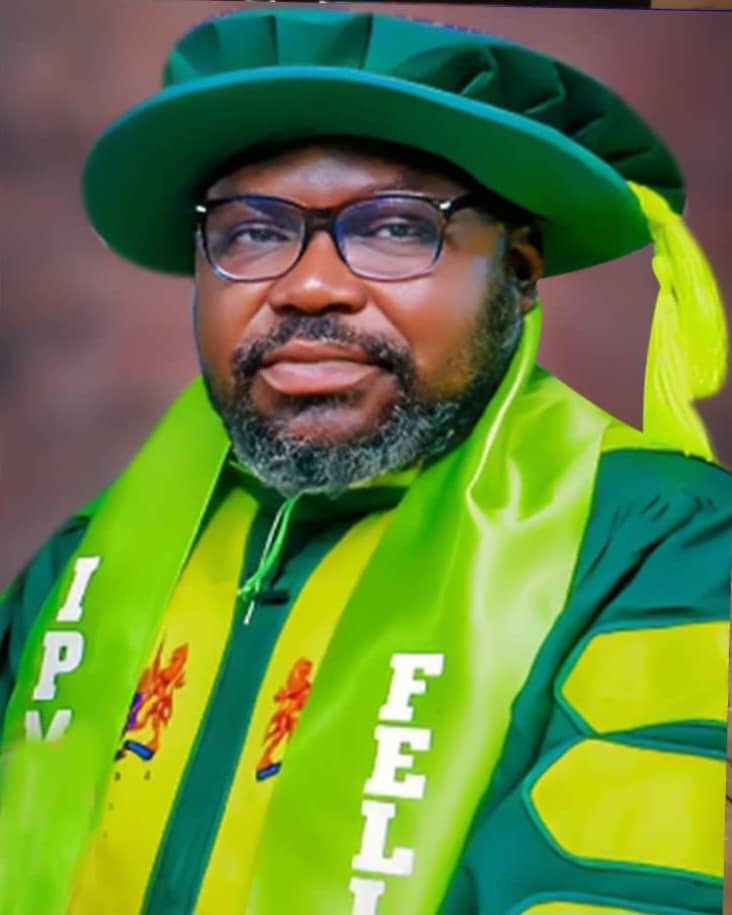
In a political climate often defined by promises without soul, Hon. Arc. Aker Vishigh Mark-Manasseh has stepped into the 2027 race for the Jechira Federal House of Representatives seat with a manifesto that blurs the line between governance and divine accountability, anchoring his entire agenda on the biblical doctrine of Matthew 25:31–46.
Framing leadership not as a privilege but as “sacred stewardship,” the Benue-born architect and administrator is pushing what he calls The Jechira Covenant—a six-point governance doctrine built on feeding the hungry, giving water to the thirsty, protecting the stranger, restoring dignity to the poor, healing the sick, and liberating the oppressed.
At a time when Nigeria’s political class faces growing distrust, Aker Vishigh’s approach is already stirring conversations across Jechira, not just for its religious undertone, but for the bold attempt to translate scripture into policy.
His first target is hunger, ironically in a region widely referred to as part of Nigeria’s food basket. He describes the current reality as a contradiction that must be corrected. His plan proposes a shift from subsistence farming to surplus production through mechanization, improved seedlings, and subsidized inputs. Central to this is the proposed Jechira Food Bank and Cooperative system designed to regulate market prices, protect farmers from post-harvest losses, and shield vulnerable households during scarcity.
On water and sanitation, the manifesto paints a grim but familiar picture of communities battling preventable diseases due to lack of clean water. His “Water for All Initiative” promises solar-powered boreholes across all wards and the rehabilitation of abandoned water infrastructure projects that have historically suffered from corruption and neglect in many constituencies.
Security and unity form the ideological core of his third pillar. In a region periodically strained by displacement and communal tension, Aker Vishigh’s framing of “the stranger” as both the marginalized and displaced signals a deliberate political message. His advocacy for community policing and structured welfare for internally displaced persons aims to position Jechira as a model of coexistence in Benue State, a bold claim in a time of rising insecurity.
But perhaps the most politically sensitive proposal lies in his economic empowerment strategy. Rejecting the popular loan-based intervention schemes often criticized for trapping beneficiaries in cycles of debt, he is proposing outright startup grants alongside vocational training through a planned Aker Vishigh Skill Acquisition Hub. The focus spans tech, tailoring, and trade sectors seen as immediate lifelines for unemployed youth and women.
Healthcare, another weak link in grassroots governance, is addressed through a proposed Constituency Health Insurance Scheme and recurring medical outreaches to rural areas. While such promises are not new in Nigerian politics, the challenge has always been sustainability, a question his campaign is yet to fully answer.
His final pillar justice reform ventures into territory many politicians avoid. By proposing a Pro Bono Legal Aid Desk for constituents facing wrongful detention or systemic injustice, he is directly confronting institutional failures within law enforcement and the judiciary. He expands this metaphorically, describing poverty itself as a “prison” his leadership intends to dismantle.
Aker Vishigh’s campaign is heavily built on symbolism, drawing parallels between spiritual duty and public service, while presenting himself as a technocrat with a moral compass. With credentials spanning architecture, urban planning, and education, he positions his candidacy as one grounded in structural thinking—arguing that a broken system cannot produce a stable society.
Yet beneath the poetic framing lies a familiar test Nigerian voters have seen repeatedly: the gap between manifesto and execution. While the Jechira Covenant is rich in vision and moral appeal, its success will ultimately depend on legislative influence, budgetary realities, and political will within the National Assembly.
Still, in a political environment saturated with recycled slogans, Aker Vishigh Mark-Manasseh’s entry into the 2027 race introduces a different narrative one that challenges both the conscience of leadership and the expectations of the electorate.
Whether this “Matthew 25 politics” becomes a transformative blueprint or just another well-crafted campaign document will be decided not by scripture, but by the unforgiving realities of governance and the memory of the people of Jechira.