A review of the 2026 budget of Cross River State has revealed plans by the state government to spend ₦2 billion on renovating the governor’s lodge, barely months after nearly ₦1 billion was reportedly used for similar work.
According to the budget document for the 2026 fiscal year, the ₦2 billion allocation forms part of several expenditures tied to the maintenance, renovation and furnishing of facilities associated with the governor’s official residence.
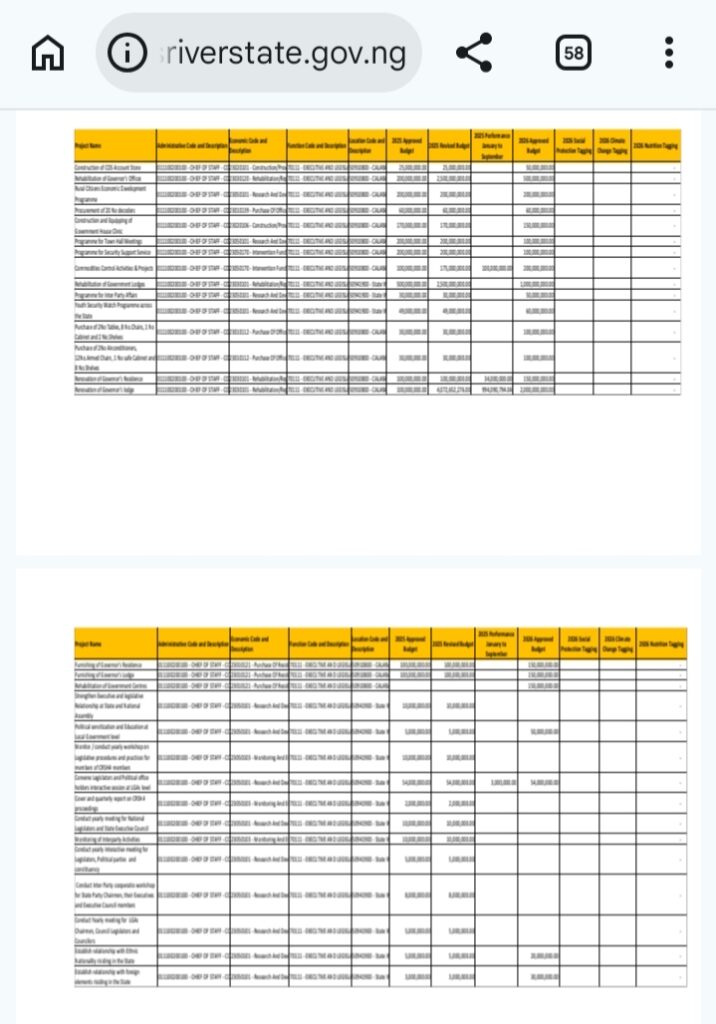
Further checks indicate that between January and September 2025, the state government had already spent about ₦994 million on renovation work at the governor’s lodge. Despite that spending within a nine-month period, the new budget proposal includes another ₦2 billion for the same project.
The document also allocates ₦150 million for furnishing the governor’s lodge. In addition, ₦150 million was set aside for renovation work at the governor’s residence, while another ₦150 million was earmarked for furnishing the residence.
Combined, the allocations for renovation and furnishing linked to the governor’s lodge and residence run into several billions of naira in the 2026 budget.
The new spending plans come amid renewed scrutiny of previous expenditures connected to government properties in the state.
Earlier budget records showed that ₦7.6 billion was spent on the rehabilitation of the governor’s offices during the 2024 fiscal year. However, official documents indicate that only ₦4 billion had been approved for that project.
The original 2024 budget initially allocated ₦1 billion for the rehabilitation of the governor’s offices. In July 2024, the Cross River State House of Assembly approved a supplementary budget that raised the allocation to ₦4 billion.
Budget performance data for the year shows that no further approvals were granted beyond the revised ₦4 billion allocation. Nevertheless, the final expenditure recorded for the project rose to ₦7.6 billion, suggesting that an additional ₦3.6 billion was spent above the approved budget.
The spending pattern has raised concerns among observers about government priorities, particularly at a time when many states are grappling with pressing development challenges and economic pressures.