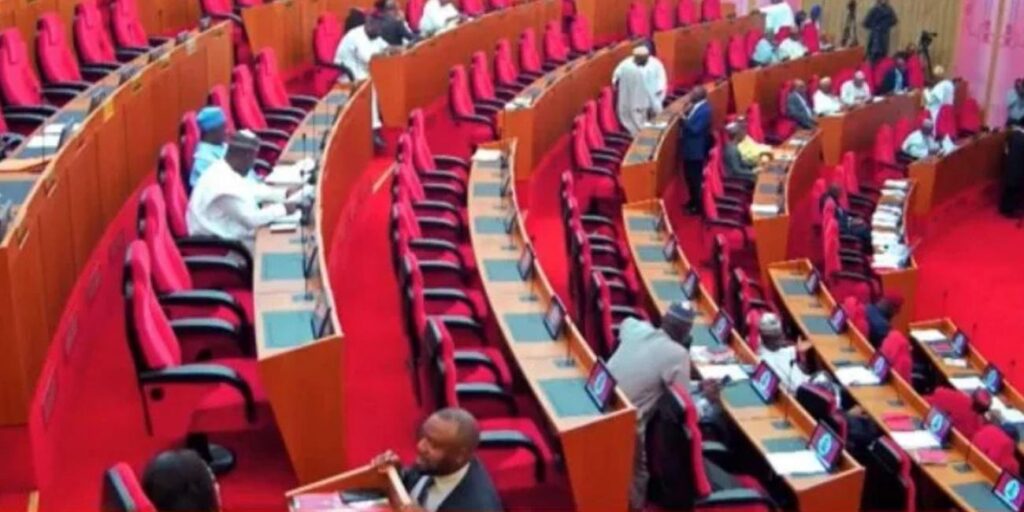
The Nigerian Senate on Tuesday amended the Electoral Act, revising Section 60 to mandate electronic transmission of election results to the Independent National Electoral Commission’s (INEC) Result Viewing Portal (IREV), while introducing a provision that allows manual result sheets to prevail where electronic transmission fails.
The amendment was adopted during plenary presided over by Senate President Godswill Akpabio.
Under the revised provision, presiding officers at polling units are required to electronically transmit results to the IREV portal after voting concludes and after Form EC8A has been completed, signed, and stamped, and countersigned by candidates or their polling agents where available.
However, the amendment adds a proviso that where electronic transmission is unsuccessful due to communication or network failure, the manually completed result sheet—Form EC8A—shall become the primary basis for collation and declaration of results.
While putting the motion to a vote, Akpabio told senators who opposed the amendment to formally move a counter motion.
“It’s very simple. If you disagree with him, move your counter motion. So, if you agree with him, you agree with me when I put the votes,” he said.
Akpabio explained that the motion sought to rescind an earlier Senate decision on Section 60(3) of the Electoral Act. Reading the amended clause, he stated that electronic transmission to IREV remains mandatory but acknowledged scenarios where transmission may fail.
“Provided that if the electronic transmission of the results fails as a result of communication failure maybe network or otherwise and it becomes impossible to transmit the results electronically, the Form EC8A shall in such a case be the primary source of collation and declaration of results,” Akpabio said.
The amendment has intensified concerns among civil society organisations and opposition figures, who argue that allowing manual results to override electronically transmitted ones weakens electoral transparency and opens the process to manipulation, especially in areas with poor network coverage.
Akpabio also announced the constitution of a 12-member Senate conference committee to harmonise differences between the Senate and the House of Representatives on the electoral amendment bills. The Senate increased its delegation from nine to 12 members to match the House.
“We expect everything to be done in the next few days or in a week. The President is expected to sign this into law in February,” he said.
The Senate President’s comments come amid growing public backlash and street protests over the electoral amendments. On Monday, former presidential candidate of the African Action Congress (AAC), Omoyele Sowore, joined protesters under the #OccupyNASS banner at the National Assembly complex in Abuja.
Sowore warned security operatives against attacking peaceful demonstrators and accused the political elite of weakening electoral laws to favour manipulation.
“This is an exposition that already existed. It is not new. That is why it is a surprise to everyone that this provision was yanked away from the Electoral Act that Akpabio and his friends are trying to put in place,” he said.
According to Sowore, resistance to full electronic transmission stems from fear of transparent elections.
“These people cannot win in free and fair elections. But the people have a duty to demand processes that guarantee free, legal and transparent elections,” he added.