
Tension escalated on Tuesday at the main entrance of the National Assembly complex in Abuja as protesters under the #OccupyNASS movement converged to demand mandatory electronic transmission of election results.
The demonstrators, drawn from civil society groups and concerned citizens, gathered to press for electoral transparency but were met with an overwhelming presence of soldiers and other armed security operatives, creating what protesters described as an intimidating, battle-ready atmosphere.
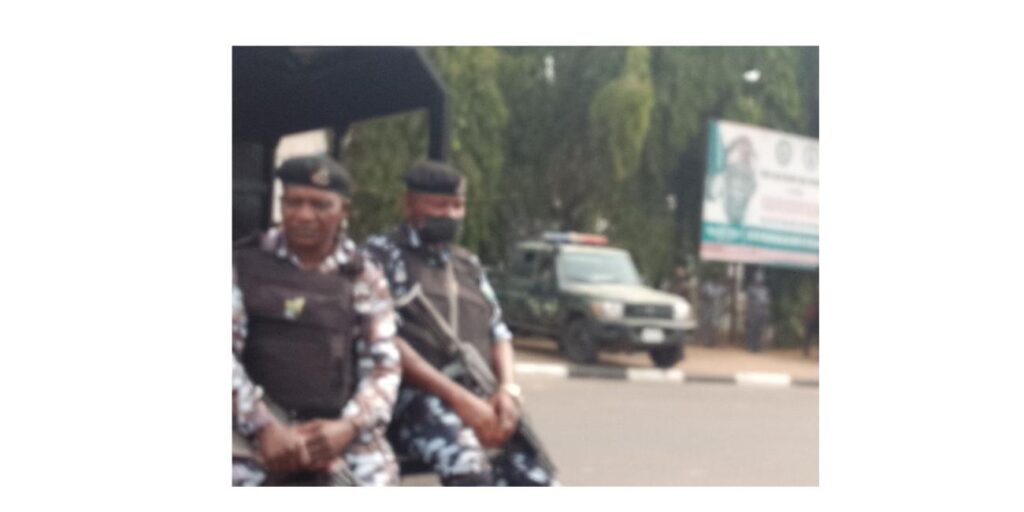
Chronicles Reporters observed that security deployment around the protest area was significantly heavier than on the first day of the demonstration, raising concerns among protesters who insisted their action was peaceful and constitutionally protected.
The protesters openly questioned the justification for the massive show of force, maintaining that their demands were civic in nature and posed no threat to public order.
Security agencies deployed to the National Assembly area included the Nigerian Army (Guards Brigade), Nigeria Police Force, Department of State Services (DSS), Nigeria Intelligence Agency (NIA), Nigerian Air Force, Nigerian Navy, Nigeria Immigration Service (NIS), Nigeria Security and Civil Defence Corps (NSCDC), and the Federal Road Safety Corps (FRSC), among others.
Several civil society activists condemned what they described as the militarisation of a peaceful protest, calling it undemocratic and contrary to constitutional principles.
Human rights activist Aisha Yesufu, who addressed protesters at the venue, criticised the deployment of armed operatives, describing it as an aberration and evidence of a weak democratic culture.
“Today again, we are seeing heavily armed security operatives brandishing tear gas and life-threatening weapons. We even saw the military deployed earlier today,” she said.
Yesufu questioned why soldiers were stationed at the protest ground while Nigeria continues to face serious security challenges elsewhere.
“Why is the Nigerian military here when the country’s territorial integrity is under serious threat in other parts of the country?” she asked.
She accused the Nigeria Police Force of failing in its constitutional responsibility to manage internal security, warning that the routine deployment of the military and other armed agencies against civilians undermines democratic order.
“The police are meant to handle internal security. Instead of reforming the police when they fail, we keep seeing soldiers and other armed agencies deployed against unarmed citizens,” she said.
Addressing soldiers directly, Yesufu warned that such deployments fall outside the constitutional role of the military.
“To every soldier deployed here today, you are here unconstitutionally. Standing against citizens exercising their right to protest is not part of your job description,” she said.
She also referenced past incidents where peaceful protesters were allegedly killed, urging security operatives to avoid repeating such events.
“Before you pull a trigger or carry out an order, ask yourself whether it is constitutional or unconstitutional,” she cautioned.
Yesufu further criticised the government’s handling of insecurity, alleging that force was being directed at civilians while violent groups continued to operate in other regions.
“Citizens are not the enemy. Terrorists are mocking the country daily, yet soldiers are deployed against peaceful protesters,” she said.
Despite the heightened security presence, the protest remained largely peaceful as of the time of filing this report. Protesters said their demand was straightforward and unchanged.
“All we are asking for is mandatory electronic transmission of election results,” they said.
Lawmakers were reportedly holding an emergency sitting at the National Assembly, with protesters awaiting engagement from the legislature on their demands.