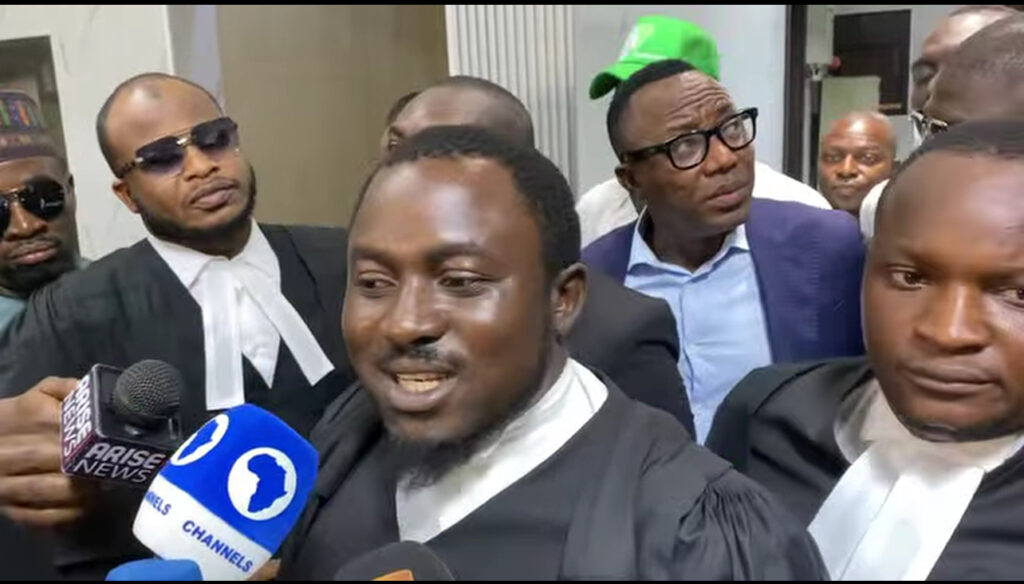
Lead counsel to human rights activist and former presidential candidate, Omoyele Sowore, Abubakar Marshal, has condemned the cyberstalking charges filed against his client by the Department of State Services (DSS), describing the case as a direct assault on Nigeria’s democratic freedoms.
Marshal said the conduct of the DSS during court proceedings showed that Sowore was not the real target of the trial. Instead, he argued, freedom of expression, press freedom, and accountability in governance were what stood accused.
Speaking with journalists on Wednesday after the court session, the senior lawyer described the prosecution’s case as weak and unsustainable, likening it to “a pack of cards” that would inevitably collapse.
According to him, the inability and refusal of the DSS’s key witness, Cyril Nosike, to provide clear answers during cross-examination exposed what he called the hollowness of the charges.
“What played out in court today was a show of shame,” Marshal said. “It became obvious that this case is not about Mr. Sowore. It is about silencing dissent and intimidating voices that demand accountability.”
He maintained that the trial was politically motivated and represented a broader attempt to shrink Nigeria’s democratic space.
“This is a trial of the Nigerian people,” he added. “The freedoms our forefathers fought for are now being dragged before the court.”
Marshal recalled several judicial warnings in the past, stressing that Nigerians must never surrender their constitutional rights to oppression, regardless of who holds power at any given time.
He emphasized that public office holders exercise authority on behalf of the people and must remain accountable to them.
“Public power does not belong to the individual occupying an office,” he said. “Sovereignty belongs to the Nigerian people. Government only holds power in trust and must use national resources strictly for the common good.”
The lawyer insisted that citizens have a constitutional right to question, criticise, and hold leaders accountable for their actions and statements, whether at home or abroad.
“Where a citizen feels aggrieved by the conduct or utterances of a public office holder, that citizen has the right to speak up and ask questions,” he said.
Marshal warned that the outcome of the case would have far-reaching implications beyond Sowore as an individual.
“Mr. Sowore is not the one on trial here,” he said. “It is freedom of expression, press freedom, and accountability in governance that are on trial.”
He called on Nigerians to remain vigilant and to collectively insist that the powers entrusted to elected officials are exercised in the interest of the majority, not for personal or political gain.