Two Abuja-based lawyers of Isoko extraction have taken legal action against the Delta State Government, accusing it of sidelining Isoko South and Isoko North Local Government Areas in the distribution of capital projects worth ₦230 billion.
The massive capital projects were recently approved during a State Executive Council (EXCO) meeting chaired by Governor Sheriff Oborevwori. The approval has triggered backlash, particularly from the Isoko community, which described the development as deliberate marginalisation and an infringement on their constitutional rights.
Leaders and rights advocates from the Isoko region have condemned the exclusion, branding it as unjust and discriminatory, especially considering the area’s status as an oil-producing community.
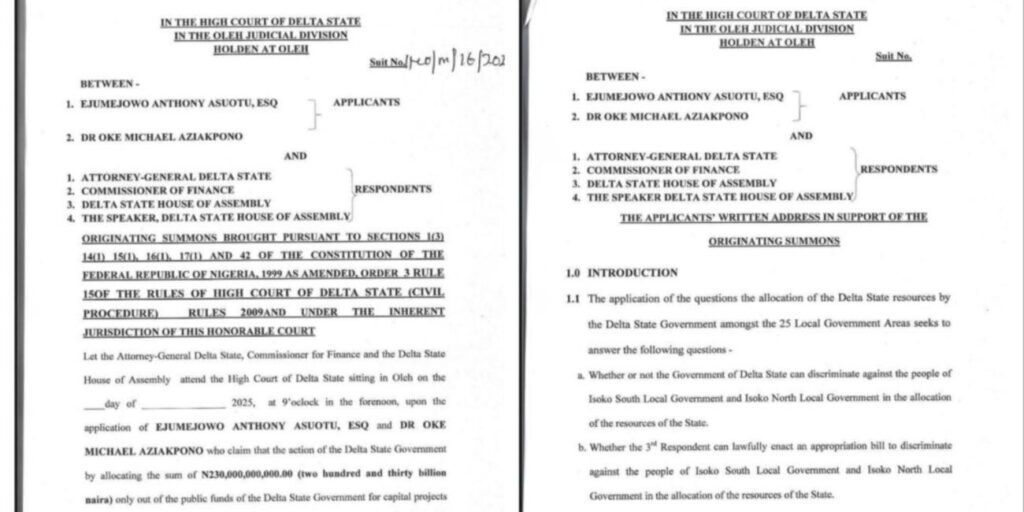
The suit, filed at the Delta State High Court in Oleh—the administrative center of Isoko South LGA—was brought forward by Barristers Anthony Asuotu Ejumejowo and Oke Michael Aziakpono. They are seeking judicial intervention to challenge what they view as the unlawful neglect of their people in the allocation of public resources.
The legal action, registered as Suit No: HCO/M/16/2025, names four respondents: the Delta State Attorney General and Commissioner for Justice, the Commissioner for Finance, the Delta State House of Assembly, and the Speaker of the House. The plaintiffs are represented by the legal firm Ejumejowo & Associates based in Abuja.
According to court filings obtained by BIGPENNGR, the lawyers are urging the court to determine whether the state government’s decision to omit the Isoko LGAs from the ₦230 billion capital project list violates the provisions of the 1999 Constitution and constitutes a discriminatory act.
In a sworn affidavit supporting the motion, Ejumejowo claimed on behalf of Aziakpono that in July 2025, the Delta State Government disclosed plans to execute capital projects valued at ₦230 billion across 23 local government areas, excluding both Isoko South and Isoko North.
He stressed that these projects were to be financed with public funds, implying that all regions, including Isoko, have a constitutional right to benefit from them.
The affidavit further alleges that the allocation pattern has heavily favored local government areas associated with the sitting governor and his predecessor, leaving others, like Isoko, largely ignored.
Ejumejowo stated, “Since the inauguration of the current administration, Isoko communities have been sidelined, with priority development directed toward the governor’s own LGA and that of his predecessor. This approach portrays Isoko people as if they are less deserving citizens within Delta State and Nigeria.”
The applicants also criticized the opacity surrounding the 2025 Appropriation Law, arguing that it lacks public scrutiny and is being manipulated by a privileged few in power.
They described the project allocation process as fundamentally unjust and called it “an insult to principles of equity and fairness.”
The legal team is asking the court to interpret whether the state government’s allocation—excluding their communities—violates constitutional provisions. They specifically want the court to pronounce on whether such an act is legally permissible and whether the governor can validly assent to an appropriation bill that discriminates against a section of the state.
Furthermore, the applicants are seeking a formal declaration that the exclusion of Isoko South and Isoko North from the ₦230 billion allocation is not only discriminatory but also unconstitutional and unlawful.
Their demands include a court order nullifying the current appropriation of ₦230 billion for capital projects, as they believe it violates their fundamental rights. They are also asking the court to set aside the entire 2025 Appropriation Law on grounds of bias and to issue an injunction preventing future exclusions in subsequent allocations.
In light of the public outcry, Delta State Commissioner for Works (Rural Roads) and Public Information, Charles Aniagwu, responded by defending the state government’s approach.
Aniagwu stated that the Oborevwori-led administration is dedicated to ensuring equitable development across the state, including in Isoko communities.
He said the Isoko Nation has already benefited from the MORE Agenda, highlighting that over 53 key projects—either completed, ongoing, or approved—are spread across Isoko North and South.
He cited initiatives in road construction, healthcare, and higher education as evidence of the government’s commitment to the region.
Despite the administration’s assurances, many within the Isoko ethnic group—renowned for their oil wealth and peaceful disposition—continue to express growing frustration over what they perceive as persistent neglect by successive Delta State governments.
As at the time of reporting, the court has not yet fixed a date for the hearing of the matter.
For updates, join our WhatsApp channel:
https://whatsapp.com/channel/0029VabITrvEAKW7DSkTfP0J