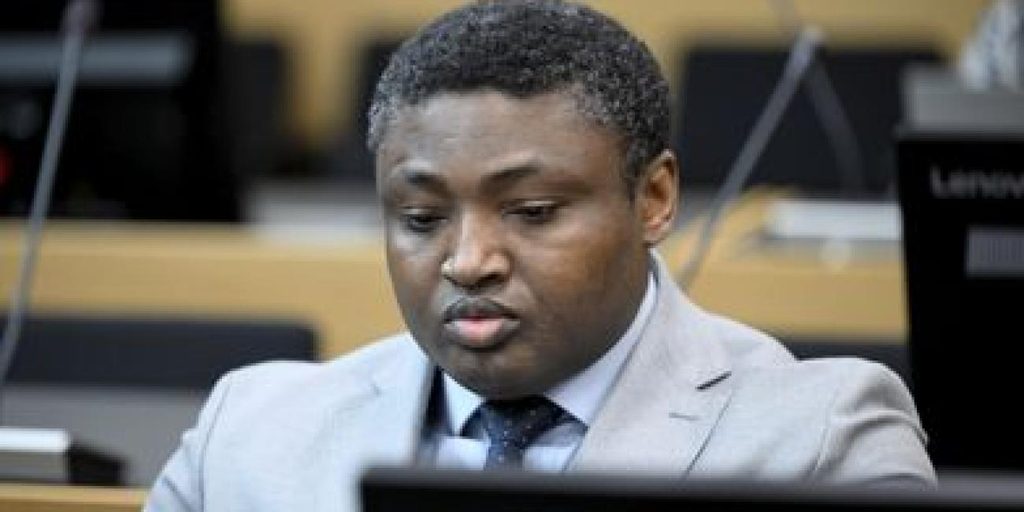
A Finnish appeal court has reduced the prison sentence of Nigerian-born Biafran separatist leader Simon Ekpa from six years to four years while upholding his convictions for terrorism-related offences linked to armed groups operating in southeastern Nigeria.
According to Helsinki Times, the East Finland Court of Appeal delivered the ruling on Thursday, finding that Ekpa participated in the activities of a terrorist group and publicly incited criminal acts for terrorist purposes.
The court upheld the September 2025 conviction by a district court but reduced his sentence after considering the circumstances surrounding the conflict in southeastern Nigeria.
The appeals court accepted the prosecution’s evidence concerning Ekpa’s involvement in armed separatist activities between 2021 and 2024, during which he allegedly used his social media influence to promote the campaign for an independent Biafran state.
Ekpa, 41, lives in Lahti, Finland, and has been accused of directing armed groups seeking independence for Biafra, a region in southeastern Nigeria.
The groups were linked to attacks on police stations, government buildings and military checkpoints as part of their campaign for an independent state.
During the appeal, Ekpa argued that southeastern Nigeria was experiencing an internal armed conflict and that international humanitarian law, rather than Finnish terrorism legislation, should govern his actions.
To support his argument, he presented evidence concerning the organisation of the armed groups, their weapons and the Nigerian government’s military operations in the region.
The appeals court examined whether the violence in southeastern Nigeria met the legal threshold for an internal armed conflict, drawing comparisons with assessments made by international tribunals concerning the Balkan wars.
The judges acknowledged that the weapons and equipment used by Nigerian government forces and the armed groups associated with Ekpa indicated conditions resembling those of an internal armed conflict.
However, the court concluded that the intensity and frequency of the fighting did not meet the threshold established under international case law.
It found that the attacks occurred intermittently and primarily targeted police stations and road checkpoints.
The judges also determined that there was insufficient evidence to establish that the armed groups possessed the operational capacity to sustain prolonged military campaigns.
The absence of reports documenting substantial civilian displacement from the affected areas further weakened the argument that the fighting amounted to a civil war, according to the report.
Although the court rejected Ekpa’s central defence, it concluded that the circumstances surrounding his offences bore similarities to situations involving civil war, self-defence and necessity.
The court considered these circumstances sufficient to justify a reduction in his prison sentence while maintaining his terrorism convictions.
Ekpa has remained in custody since November 2024, following his arrest in Finland over allegations connected to violent separatist activities in southeastern Nigeria.
Päijät-Häme District Court originally sentenced him to six years in prison in September 2025 after finding him guilty of participating in the activities of a terrorist group, publicly inciting crimes for terrorist purposes, aggravated tax fraud and violations of Finland’s Attorneys/Lawyers Act.
The district court ruled that between August 2021 and November 2024, Ekpa used his social media presence to incite violence and advance the campaign for Biafran independence through unlawful means.
The court also found that he had helped supply armed groups with weapons, explosives and ammunition.
Ekpa moved from Nigeria to Finland in 2007 as an athlete before becoming involved in Finnish local politics.
He was associated with Finland’s National Coalition Party and later served on a regional public transport committee before becoming prominent in the Biafran separatist movement.
His activities attracted significant attention in Nigeria, particularly amid concerns over violence, economic disruption and attacks associated with the separatist campaign in the southeastern region.
The appeals court’s latest ruling is not yet final, as both Ekpa and the prosecution have the option of seeking permission to appeal to Finland’s Supreme Court.
If no further appeal is pursued or permission to appeal is denied, the reduced four-year prison sentence will stand.