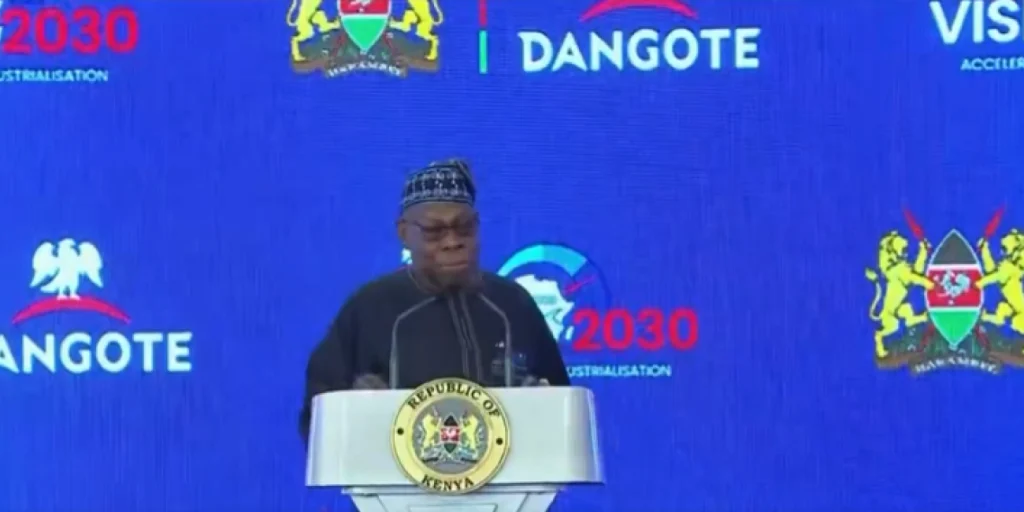
Former Nigerian President Olusegun Obasanjo has revealed how he personally monitored Aliko Dangote’s first major cement manufacturing project after challenging the businessman to stop importing cement and begin producing the commodity locally.
Obasanjo said he went as far as assigning two security personnel to Dangote’s construction site to monitor the progress of the project and report directly to him.
The former president made the disclosure while speaking at the groundbreaking ceremony of a $16 billion oil refinery project in Lamu, Kenya, involving Dangote.
Recalling the events that led to Dangote’s entry into large-scale cement manufacturing, Obasanjo said his intervention dated back to 2003, when he questioned why Nigeria was still importing cement despite having produced the commodity for about five decades.
According to him, he woke up at about 5am one day while in Abuja and called Dangote to question him about the continued importation of cement.
Obasanjo recalled asking the businessman: “Why are you importing cement and you are not producing cement?”
He said Dangote explained that importing and selling cement was more profitable than manufacturing it locally.
According to Obasanjo, Dangote subsequently suggested that the government should make cement importation conditional on companies having plans to establish local production facilities.
The former president said his administration adopted the proposal and began requiring companies seeking to import cement to demonstrate plans to produce the commodity locally.
He said Dangote subsequently proposed establishing a cement plant with a production capacity of five million metric tonnes, despite Nigeria’s existing cement production capacity at the time being only about two million to 2.5 million tonnes.
Obasanjo said some government officials were sceptical about Dangote’s proposal and questioned whether the businessman had another motive.
He, however, said he decided to support the project and personally followed its development.
“I put two security men on his site to monitor whether the contractors were working and report to me,” Obasanjo said.
He recalled that the extent of government involvement eventually surprised Dangote, who at one point confronted him over the presence of government security personnel at what was supposed to be a private-sector project.
“One day, Dangote said to me, ‘This cement project is not a government project. It is a private sector project. And you seem to know more about it than myself,’” Obasanjo recalled.
He said he responded: “This project is a Nigerian project. And any Nigerian project is a government project as far as I’m concerned.”
According to Obasanjo, the first five-million-tonne cement plant was completed and commissioned shortly before he left office.
He said Dangote subsequently constructed another five-million-tonne plant and continued expanding his cement business across Africa, including investments in Tanzania, Ethiopia and Senegal.
Obasanjo said the experience gave Dangote the confidence to pursue other large-scale industrial projects requiring significant capital and long-term commitment.
The former president also recalled visiting the Dangote Refinery in Lagos two or three months before the Lamu event, saying he was impressed by the scale of the facility.
According to Obasanjo, during the visit, Dangote gathered his workers and identified the former president as the person whose policies helped create the conditions that led to his cement manufacturing venture and eventually contributed to his confidence to undertake the refinery project.
Obasanjo said Dangote’s industrial expansion demonstrated what could happen when Nigerian businesses were encouraged to invest in local production rather than depend on imports.
He also praised Dangote for taking on projects requiring substantial financial investment and long-term commitment.
At the event, Obasanjo repeatedly praised Dangote and, while addressing the businessman, told him: “You are my boss.”