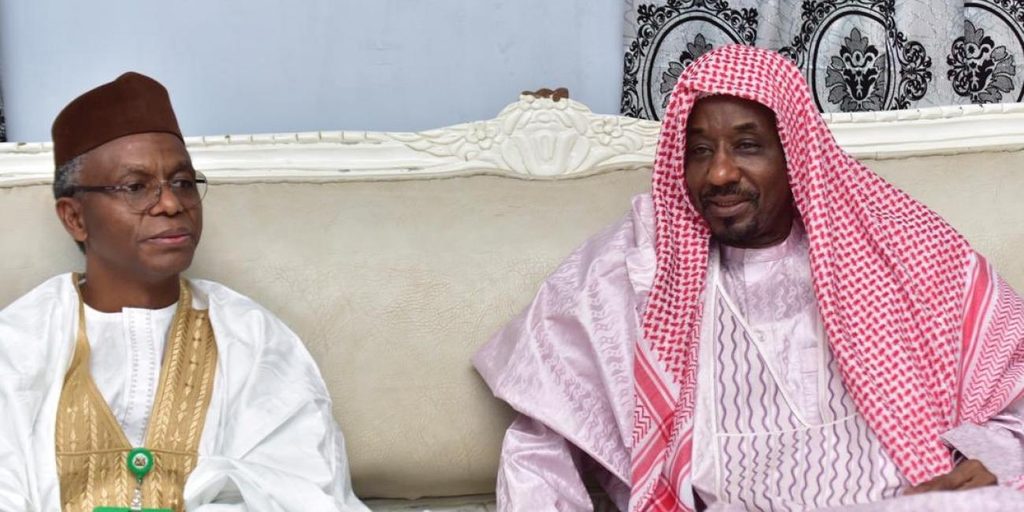
The Emir of Kano, Sanusi Lamido Sanusi, has questioned the continued detention of former Kaduna State Governor, Nasir El-Rufai, asking whether the case represents a genuine fight against corruption or has become a political battle.
Sanusi raised the concerns while discussing the effectiveness of Nigeria’s anti-corruption institutions, the judiciary and the need for laws and institutions established to fight corruption to operate without political interference.
Speaking in an interview published by Channels Television, the Emir said Nigeria had institutions responsible for identifying and prosecuting alleged corruption, as well as courts empowered to determine such cases.
He, however, expressed concern that political connections could influence how some corruption cases were handled.
“You have institutions that are supposed to identify corrupt people and prosecute them. You have courts that are supposed to do it. We have seen in this country people who are facing corruption charges who basically just get those charges dropped because they belong to the right political environment or have the right political support,” Sanusi said.
The Emir also said some legal proceedings had raised questions about whether anti-corruption measures were being pursued solely to uphold the law or were being influenced by political considerations.
“We have people who have legal processes where people are questioning if in fact, it is a fight against corruption or political persecution,” he said.
Sanusi specifically cited El-Rufai’s case, describing the former Kaduna governor as his brother and questioning the circumstances surrounding his continued detention.
“An example is my brother Nasir El-Rufai, he has been in detention for seven months, he has been denied bail, not having committed any offence using the courts, now people begin to wonder, is this a fight against corruption or a political battle,” he said.
El-Rufai has been in the custody of the Independent Corrupt Practices and Other Related Offences Commission (ICPC) since February 2026 in connection with investigations and criminal proceedings.
The ICPC initially confirmed that El-Rufai was in its custody on February 18, 2026, following his invitation by the commission. The commission subsequently said his remand was authorised by court orders and maintained that it was acting within the law.
The former governor is facing an ICPC case involving allegations of abuse of office, financial impropriety and fraud relating to his tenure as Kaduna State governor between 2015 and 2023. El-Rufai has denied the allegations, while the ICPC maintains that it has evidence supporting the charges.
He has also been involved in a separate case brought by the Department of State Services (DSS) over alleged unlawful interception of telephone communications involving National Security Adviser, Nuhu Ribadu. In that case, El-Rufai pleaded not guilty, while the court has fixed October 26, 2026, to rule on his no-case submission. He remains on ₦100 million bail in the phone-tapping case.
Beyond the criminal proceedings, El-Rufai has filed several legal actions challenging aspects of his detention and treatment while in custody.
In August, he filed a fresh ₦10 billion fundamental rights suit against the ICPC, its chairman and the Attorney-General of the Federation over the alleged denial of access to his wife, Aichatou Asabe, and son, Abba El-Rufai.
The suit, marked FHC/ABJ/CS/1852/2026 and filed at the Federal High Court in Abuja on August 13, seeks nine reliefs. El-Rufai asked the court to declare that his constitutional rights remain enforceable despite his detention and alleged that repeated restrictions on access to his immediate family violated his rights to dignity and private and family life.
He also alleged that ICPC officers physically restrained and intimidated his wife and son on July 7, 2026, and described the alleged denial of family access as unlawful interference with his relationship with his immediate family.
In another fundamental rights action, a Federal High Court in Abuja recently adjourned a separate ₦1 billion suit filed by El-Rufai against the ICPC, the Inspector-General of Police and the Attorney-General of the Federation. The case was adjourned to October 27, 2026, to allow his counsel to respond to a counter-affidavit filed by the Attorney-General of the Federation.
Sanusi, while questioning the circumstances surrounding El-Rufai’s detention, called on politicians and the judiciary to allow the laws and institutions established to administer justice and fight corruption to function according to their intended purpose.
“The politicians, judiciary except they are going to use the laws for why they are set up, we are not going to get anywhere, so the laws are there,” he said.
The Emir’s comments come amid continuing legal proceedings involving the former governor, whose cases have generated debate over the application of anti-corruption laws, the duration and conditions of detention, and the role of the courts in determining the allegations against him.
The ICPC has previously rejected claims that it was unlawfully extending El-Rufai’s detention, maintaining that his custody was authorised by court orders and that the commission was complying with the Administration of Criminal Justice Act.