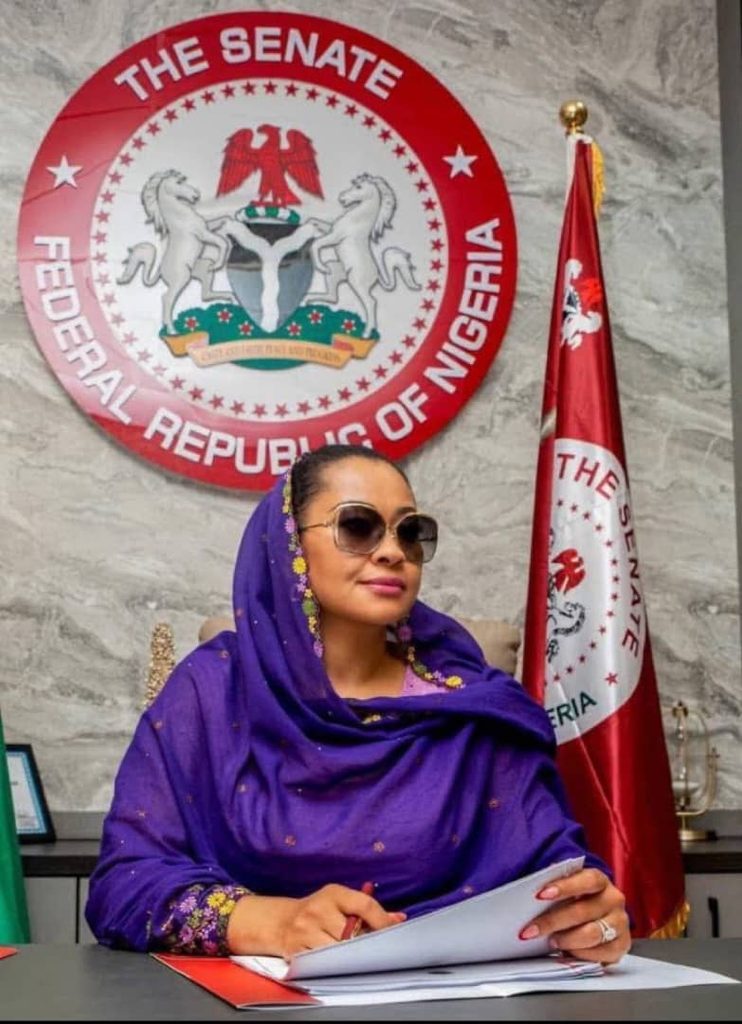
Senator Natasha Akpoti-Uduaghan has called for a stronger healthcare ecosystem in Nigeria, demanding improved remuneration, working conditions and welfare packages for doctors, nurses, midwives and other healthcare professionals.
Akpoti-Uduaghan made the call while speaking at the ongoing “Unfinished” event organised by Ward-C in collaboration with the National Human Rights Commission (NHRC), where she participated in discussions on maternal health, women’s rights and reproductive choices.
The senator said addressing maternal mortality required more than statistics, stressing that the country must examine the realities confronting women, children and healthcare professionals at the point of service.
She said healthcare workers, particularly those serving in underserved and rural communities, needed an enabling environment to perform their duties effectively.
According to her, improving the welfare of doctors and other health workers should form an integral part of efforts to strengthen Nigeria’s healthcare system.
She said doctors and other healthcare professionals should have access to adequate remuneration, functional medical equipment, essential medicines, reliable electricity, conducive working environments and opportunities for professional development.
Akpoti-Uduaghan stressed that healthcare infrastructure could not function effectively without the human capital required to operate and sustain it.
She therefore advocated a holistic approach that would bring together healthcare personnel, medical infrastructure, emergency services, equipment, medicines and professional welfare as interconnected components of one healthcare system.
The senator said better conditions of service would also encourage medical professionals to remain motivated and committed to their responsibilities, particularly in rural communities where healthcare workers often operate under difficult circumstances.
She said Nigeria must create a healthcare ecosystem capable of supporting both patients and the professionals responsible for their care.
Speaking on maternal mortality, Akpoti-Uduaghan said the issue remained a major concern, particularly for women living in rural communities where access to quality healthcare and emergency services could be limited.
She questioned whether many rural health facilities had the personnel and equipment required to manage complicated pregnancies and neonatal emergencies.
“When you want to tackle maternal mortality, either speaking from the side of your choice, or a woman who is married, has carried on her baby full term, walks into a hospital, a baby who was born premature and needs access to incubators, oxygen in villages,” she said.
The senator also raised concerns about the sustainability of critical medical equipment in communities with unreliable electricity supply.
“Are there electricity? Is there enough electricity in the rural areas to sustain the incubators wherever they are?” she asked.
She said the challenge went beyond the availability of equipment, stressing that medical facilities must also have qualified personnel capable of operating the equipment and providing appropriate care.
Akpoti-Uduaghan advocated stronger referral systems linking rural primary healthcare centres with general and specialist hospitals, particularly for women experiencing complicated pregnancies and other emergencies.
According to her, an effective healthcare ecosystem should include functional laboratories, adequate blood supplies, neonatal facilities, emergency transportation and reliable power and water supply.
The senator also questioned whether existing maternal mortality statistics adequately reflected the experiences of women in rural communities.
“I don’t think that data is really reflective of the situation in the rural communities. It will probably double up,” she said.
She noted that repeated exposure to maternal deaths in some rural communities could make such tragedies appear normal, while some deaths might not be formally captured in official records.
Akpoti-Uduaghan disclosed that her concern about the condition of maternal healthcare in underserved communities had influenced her decision to build a maternity centre.
She said practical interventions were necessary to complement policy discussions on maternal health and improve access to essential services for women and children.
The senator also spoke about reproductive choices, saying her exposure to different healthcare systems and advocacy initiatives had broadened her understanding of the difficult circumstances confronting some women and girls.
She called for support systems that would provide women facing difficult pregnancy-related circumstances with access to information, counselling and appropriate assistance.
“Public spaces, you see, the health lines, people down there, sometimes government sponsored, sometimes sponsored by civil societies or charities, willing to help young girls who are confused, lost to make decisions either to abort or those who want to carry the pregnancy full term,” she said.
Akpoti-Uduaghan said constructive dialogue had also challenged some of her previously held positions on reproductive choice.
“If I myself can be made to tilt from being pro-life to reasonably begin to appreciate the reason for choice, then I think I would say that I would love to support this kind of conversation,” she said.
The senator further maintained that the welfare and future of children must remain central to conversations around pregnancy and reproductive health.
“If we all agree that the mother as the first parent of the child, then you would also agree that it’s very important to ensure that every child is born into a home, that there is love and there is nurture,” Akpoti-Uduaghan said.