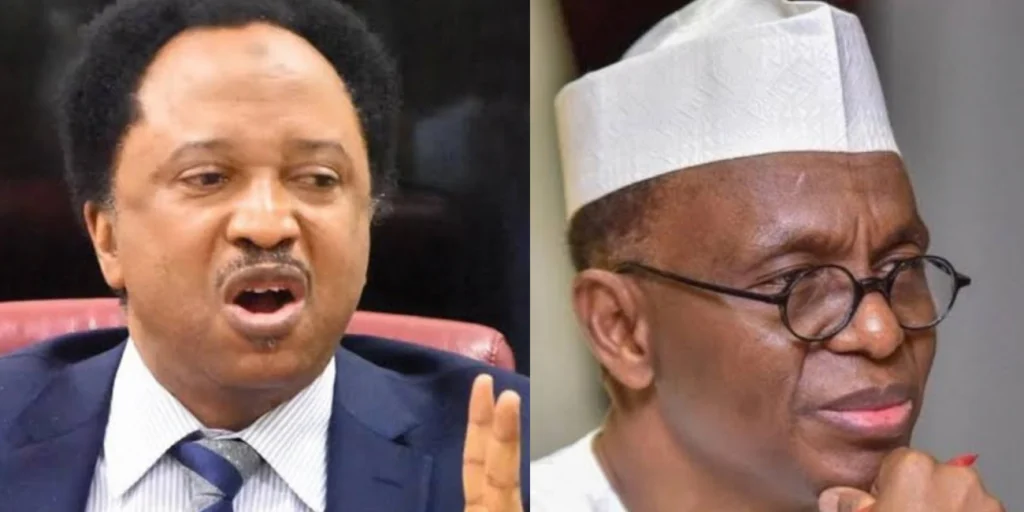
Former Kaduna Central Senator, Shehu Sani, has said former Kaduna State Governor, Nasir El-Rufai, is paying the price for what he described as “misgovernance” and “irresponsibility” during his eight-year tenure in office.
Sani made the remarks in an interview with Channels Television on Friday while commenting on the continued detention of the former governor amid ongoing investigations and legal proceedings.
The former senator said El-Rufai’s situation should serve as a warning to public officials that political power is temporary and that decisions taken while in office could later be subjected to scrutiny.
“When you are in office, always remind yourself that it is an opportunity and it is a very temporary opportunity for you,” Sani said.
He directly linked El-Rufai’s present circumstances to his record as Kaduna State governor between 2015 and 2023, saying the former governor was now experiencing the consequences of his actions in office.
“El-Rufai is paying the price of his misgovernance and his irresponsibility when he was in public office,” he said.
Sani, who spent several years in prison during his activism, said he understood the difficulties associated with prolonged detention.
“I think he is in detention for, like they say, 200 days or something like that. For someone like me, who has been in prison for four years, I don’t think anyone can lecture me on detention, on the pains of imprisonment,” he said.
He also observed that politicians and public officials could lose relationships and political support after leaving positions of influence.
“But it is natural, when you are out of circulation, you are bound to lose friends. You are bound to see things differently from the way you are,” Sani said.
The former lawmaker accused the El-Rufai administration of being characterised by what he called “misgovernance, irresponsible leadership, and the use of statecraft to attack and jail opponents.”
Sani further revisited the security situation in Southern Kaduna during El-Rufai’s tenure, arguing that several communities in the region suffered years of violence.
He criticised commentators who, according to him, discussed the situation without having firsthand knowledge of the affected communities.
“If you look at it, 80 per cent of those who are commenting have never been to Southern Kaduna. They don’t know where Sanga is. They don’t know where Kauru is. They don’t know where Kachia is,” he said.
The former senator also questioned the effectiveness of the security measures adopted under the former administration, arguing that the level of bloodshed in Southern Kaduna raised questions about the outcome of those efforts.
“If he has done anything, the bloodshed would not have been worse as they were,” Sani said.
He also referred to reports and past statements concerning alleged negotiations with bandits during El-Rufai’s tenure, including the controversy surrounding journalist Luka Binyat.
“It came from the lips of the former governor that they pay bandits not to kill,” Sani said.
Sani’s comments come amid renewed debate over El-Rufai’s continued detention and the allegations surrounding his time in office.
El-Rufai has remained in the custody of the Independent Corrupt Practices and Other Related Offences Commission since February amid investigations and separate criminal proceedings.
The former governor has challenged aspects of his continued detention and the proceedings against him.
In one of the cases before the Federal High Court in Abuja, El-Rufai is facing proceedings over the alleged unlawful interception of telephone communications involving the National Security Adviser, Nuhu Ribadu.
The Federal High Court recently reserved ruling on El-Rufai’s no-case submission in the matter and fixed October 26 for the ruling.
The former governor has denied wrongdoing in the various allegations against him and has challenged the legal basis for aspects of the proceedings and his continued detention.
Sani’s remarks have therefore added another political dimension to the debate surrounding the former Kaduna governor, with attention increasingly focused not only on his present legal predicament but also on his record in office, particularly his administration’s handling of insecurity, political opposition and governance in Kaduna State.