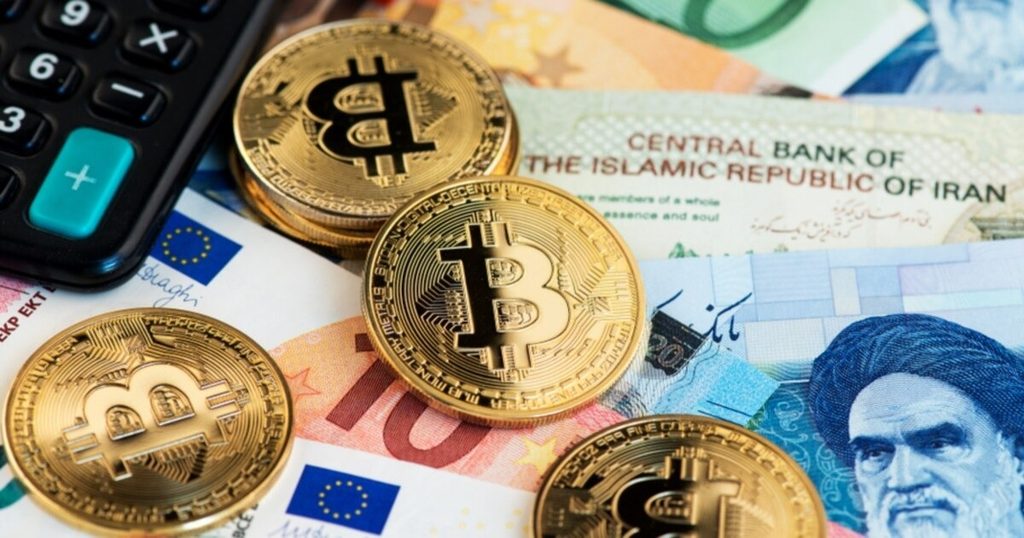
Iran is increasingly turning to cryptocurrencies as an alternative financial lifeline, using Bitcoin and dollar-pegged Tether to keep trade moving despite the tightening grip of US sanctions.
The shift marks a striking challenge to a sanctions regime designed to isolate Tehran from the international banking system. Rather than relying entirely on conventional banks and government-controlled foreign-exchange channels, Iranian traders are gaining greater room to settle cross-border transactions through digital assets.
The Financial Times reported that Iran’s central bank has relaxed foreign-exchange restrictions, allowing exporters to use cryptocurrencies such as Tether and Bitcoin for cross-border transactions through domestic crypto exchanges. The arrangement enables businesses to use export proceeds directly to finance imports, reducing their dependence on Iran’s official exchange mechanism.
The scale of the emerging crypto economy is significant. TRM Labs estimates that approximately $10 billion in cryptocurrency moved through Iran during 2025. Its subsequent analysis put Iran-linked crypto activity at about $11 billion from the beginning of 2025 into March 2026, underscoring the growing importance of digital assets in an economy cut off from much of the traditional financial system.
For Tehran, however, cryptocurrency is not merely a speculative asset. It can function as an alternative financial rail.
Bitcoin generated through domestic mining can be converted into an internationally transferable digital asset, while stablecoins such as Tether offer something particularly valuable to Iranians: a digital token designed to track the US dollar without requiring direct access to the American banking system.
Iran has been cultivating its cryptocurrency-mining industry for years. The country officially recognised crypto mining as an industry and provided miners with access to relatively cheap electricity, while requiring mined Bitcoin under earlier arrangements to be sold to the central bank. Tehran has also permitted domestically mined cryptocurrency to be used for imports of authorised goods.
The strategy has attracted increasing scrutiny in Washington.
In August, the US Treasury sanctioned cryptocurrency exchanges accused of helping Iranian actors launder billions of dollars and maintain covert access to international financial networks. Treasury said Iranian actors had exploited unlicensed or lightly regulated digital-asset platforms to move large quantities of cryptocurrency and conceal the origins of illicit funds.
US Treasury Secretary Scott Bessent has also warned that Washington is prepared to target digital assets as part of its campaign to intensify economic pressure on Tehran. The administration has increasingly threatened foreign companies and financial institutions that continue facilitating Iranian commerce.
The confrontation exposes an uncomfortable weakness in the architecture of modern sanctions.
Traditional sanctions depend heavily on control over banks, correspondent accounts, payment systems and access to the dollar. Cryptocurrency does not eliminate those controls, and it is not invisible to investigators—blockchains create permanent transaction records that can be analysed and traced. But digital assets can create additional routes around conventional financial chokepoints, particularly when transactions are conducted through offshore exchanges, intermediaries and networks designed to obscure ownership.
TRM Labs has already identified Iranian-linked crypto infrastructure operating through foreign jurisdictions. Its research on two UK-registered exchanges found approximately $1 billion in cryptocurrency movements associated with networks linked to Iran’s Islamic Revolutionary Guard Corps, illustrating how Iranian actors can combine offshore companies and digital assets to build alternative financial channels.
The development does not mean Iran has discovered a magic escape from sanctions. Cryptocurrency markets remain volatile, liquidity can be limited, exchanges can be sanctioned and wallets can be identified and frozen. Tehran still requires enormous amounts of conventional currency to sustain its economy and international trade.
But the central lesson is harder to dismiss.
Sanctions were designed for a world in which international money moved primarily through institutions that governments could pressure, regulate or shut down.
Iran is now testing what happens when some of that money can move through a decentralised digital network instead.
The battle is therefore no longer simply about who controls the banks.
It is increasingly about who controls the financial routes that exist beyond them.