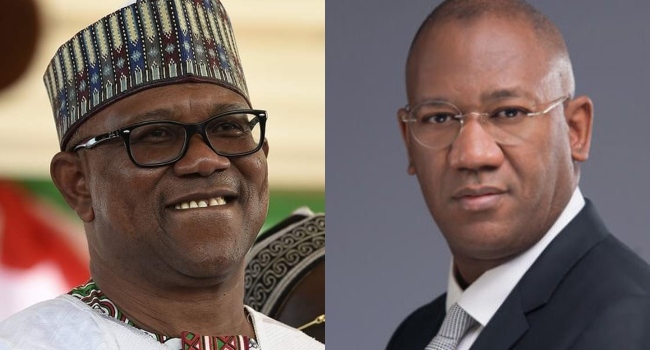
Senator Datti Baba-Ahmed, running mate to Peter Obi in the 2023 presidential election, has revealed that he personally warned the former Labour Party presidential candidate against joining the opposition coalition formed to challenge President Bola Tinubu ahead of the 2027 general election.
Baba-Ahmed said he advised Obi to avoid the coalition because he believed it was made up largely of politicians who had moved between established political parties without offering Nigerians a fundamentally different political direction.
The coalition brought together prominent opposition figures, including former Vice-President Atiku Abubakar, former Kaduna State Governor Nasir El-Rufai, former Rivers State Governor Rotimi Amaechi, former Kogi State Senator Dino Melaye, former Osun State Governor Rauf Aregbesola and Obi.
The group subsequently adopted a new political platform in mid-2025, with the stated objective of bringing opposition forces together to challenge the ruling All Progressives Congress, APC, in the 2027 election.
However, the arrangement later became embroiled in internal disagreements, including disputes over leadership, legal battles concerning control of the party and disagreements surrounding the primary election process.
Obi eventually left the coalition on May 2, 2026, citing what he described as a toxic political environment, government interference and compromised internal democracy within the party.
He subsequently joined the Nigeria Democratic Congress, NDC, which ratified him as its presidential candidate for the 2027 election on May 30, 2026. Former Kano State Governor Rabiu Kwankwaso later emerged as his running mate under the NDC platform.
Speaking during an interview on The Mic-On Podcast hosted by Seun Okinbaloye, Baba-Ahmed said he was disappointed that Obi ignored his advice and entered the coalition.
“I miss a good Nigerian. But to an extent, yes. It is, um, a shame that Peter Obi was drawn in,” Baba-Ahmed said.
According to him, Obi had moved away from the political position that defined his 2023 presidential campaign, making it difficult for him to continue offering political assistance.
Baba-Ahmed recalled that he went to the Yar’Adua Centre ahead of Obi’s arrival specifically to speak privately with him about the coalition.
“When he was going to join ADC, I had to go to Yar’Adua Centre ahead of him, call him aside,” he said.
“They were worried: ‘Why is he calling Peter Obi aside and talking to him?’ And I told him, ‘This is the last time I’m coming to this place. But I want to tell you 1, 2, 3, 4.’”
The former lawmaker said he presented Obi with several reasons why he believed the coalition was unsuitable for him.
“I gave him my reasons, ‘This is not a place for you.’ Was I proven wrong? I was proven right. Within four months, Peter Obi left ADC. I don’t like people who contradict themselves,” he said.
Baba-Ahmed said he had consistently opposed the idea of politicians from established parties coming together under a new coalition merely to pursue political power.
He maintained that Nigeria needs a credible political alternative capable of offering a departure from the political establishment.
“I have always been of the opinion that if you have one legit party, they don’t need to go into a coalition. And that’s what I tried to do with Peter Obi. Let’s stand on our own and go our own way. Forget this coalition of a thing,” he said.
He said Obi ultimately rejected that approach.
“He rejected it and went into the coalition,” Baba-Ahmed added.
The former lawmaker further criticised politicians who repeatedly change political parties whenever they fail to secure their preferred positions.
According to him, some politicians moved from the Peoples Democratic Party, PDP, to the APC after failing to achieve their ambitions within the PDP, only to leave the APC for another platform after becoming dissatisfied with the ruling party.
“When I’m talking about those who moved out of the then PDP because they wouldn’t have their way, haven’t changed anything about themselves and went into APC. Now that they’re disgruntled in APC, didn’t have their way, moved out of APC and go to ADC,” he said.
Baba-Ahmed argued that such political movements do not represent the fundamental transformation he believes Nigeria requires.
He also rejected the suggestion that his criticism of Obi or the coalition was motivated by a desire to return to political office.
“For your information, I am not a politician, and I’ve never been shy to say that I’m not a politician,” he said.
Asked about his previous political positions and electoral contests, Baba-Ahmed said holding or contesting for political office did not necessarily make him a politician.
“I’ve held political offices. I have contested political offices, yet I am not a politician,” he said.
“What am I? I’m a lover of Nigeria,” he added.
Despite his criticism of Obi’s political decisions, Baba-Ahmed said he still considered his former running mate a “good Nigerian” and acknowledged that he missed the relationship they had during the 2023 presidential campaign.
“I miss a good Nigerian,” he said.
He explained that their political partnership in 2023 was built largely around what he described as a shared commitment to changing Nigeria’s political direction.
Baba-Ahmed also recalled another meeting with Obi where he said he raised concerns about the political dynamics that could affect his 2027 presidential ambition.
According to him, the meeting took place at the Johnwood Hotel on January 31, 2024, at about 8:30pm.
“On the 31st of January, 2024, I sat with Peter Obi in Johnwood Hotel, 8:30 PM,” Baba-Ahmed said.
He said he warned Obi that several prominent political figures could become major factors in the 2027 contest.
“That’s when I told him, ‘Your Excellency, from the way I see, I’ve seen things, there is Kwankwaso, there is El-Rufai, and there is another person, if he doesn’t go back to his former office. For me, I think you’ll find it hard to…’”
Baba-Ahmed did not complete the statement during the interview.
The former lawmaker, however, stressed that his criticism of Obi and other opposition figures should not be interpreted as an endorsement of President Tinubu or the ruling political establishment.
He argued that Nigeria’s political crisis goes beyond the identity of the individual occupying the presidency and that simply replacing one established politician with another would not solve the country’s problems.
“I would simply advise ‘Uncle’ to please prepare to hand over and move away, but not to the people contesting against him, because none of them will improve Nigeria,” Baba-Ahmed said, referring to President Tinubu.
“None of that pack. Tinubu should leave the stage. All those people contesting against him, too, they were all in bed together at some point or another.”
When Okinbaloye asked whether that included Obi, Baba-Ahmed replied: “Including Peter Obi.”
Baba-Ahmed said his ultimate objective was not merely to replace one established politician with another.
“I’m calling for a whole new Nigeria,” he said.
He challenged Nigerians to identify a major political figure who had never been associated with a ruling political party, using the question to argue that the country needs fresh participants in politics.
Baba-Ahmed also called on Nigerians who have remained outside active politics to enter the political space and participate in efforts to change the country’s leadership.
He argued that Nigeria’s problems would continue if competent citizens remained in their comfort zones and left political affairs to the same political class.
“The good people in Nigeria must come out, sacrifice their comfort, leave their comfort zones, come out and push out the bad elements that have been destroying Nigeria,” he said.
Baba-Ahmed’s remarks add another dimension to the political differences surrounding Obi’s 2027 ambitions, particularly as the former running mates now appear to hold markedly different views about the alliances and strategy required to produce the change they both campaigned for in 2023.