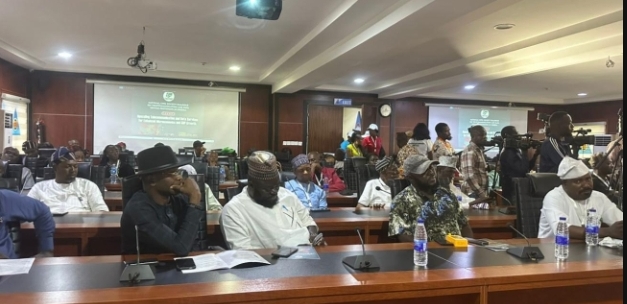
Major telecommunications operators, including MTN and Globacom, have come under fire after boycotting the National Civil Society Dialogue on Telecommunication and Data Service Provision in Nigeria, where angry consumers and civil society groups demanded answers over alleged data depletion, poor network quality, dropped calls and rising telecommunications costs.
The dialogue was held on Thursday, August 27, at the Nigerian Army Resource Centre, Asokoro, Abuja, and was designed to bring telecommunications operators, regulators and consumers together for a direct discussion on the worsening relationship between service providers and their customers.
But the absence of the major operators became one of the biggest controversies of the event.
Seats reserved for representatives of the telecommunications companies remained empty as consumers and civil society representatives openly criticised the operators for failing to appear and respond to the allegations being raised against them.
Some participants described the boycott as cowardly and accused the telecom companies of deliberately avoiding a platform where they would have been required to answer difficult questions from consumers.
The controversy came against the backdrop of the growing importance of telecommunications to Nigeria’s economy and the increasing dependence of citizens on mobile networks for communication, business, banking, education and other daily activities.
Delivering the keynote address, Special Adviser to the President on Media and Public Communications, Dr. Sunday Akin Dare, said Nigeria’s telecommunications sector remained a critical driver of economic and GDP growth.
Dare disclosed that active telecommunications subscriptions were approaching 190 million, while broadband penetration had crossed 50 per cent.
However, he warned that the expansion of the sector could not be measured only by the number of subscribers or the amount of investment made by operators.
“Growth in subscriber numbers alone is not enough. The quality of service experienced by citizens must improve at the same pace as investment and expansion. The Nigerian consumer increasingly expects reliability, transparency and value,” Dare said.
The presidential aide also recognised the economic pressures confronting telecommunications operators, including rising energy costs, foreign exchange challenges, multiple taxation and infrastructure vandalism.
Despite those challenges, he said operators must recognise their responsibility to the Nigerian public and work towards restoring confidence in the sector.
He called for greater transparency in billing, simpler systems that would allow consumers to track their data usage and stronger investment in network optimisation.
But the government’s attempt to acknowledge the challenges on both sides did little to calm the anger among participants.
The convener of the National Civil Society Dialogue and President of the movement, Comrade Blessing Akinlosotu, expressed disappointment over the failure of the telecommunications companies to attend the meeting.
Other participants also condemned the empty seats, arguing that operators should have been present to listen to consumers and respond directly to complaints about their services.
A major issue raised at the dialogue was the alleged rapid depletion of subscribers’ data, with participants questioning why data purchased by consumers often appears to disappear faster than expected.
Consumers also complained about recurring dropped calls, unreliable network connections, inconsistent internet speeds and the financial burden created by increasing telecommunications tariffs.
One participant, Mrs. Grace, demanded immediate intervention by the Nigerian Communications Commission and the National Assembly.
“The Nigerian Communications Commission (NCC) and the National Assembly must summon these service providers without delay to answer for this relentless, predatory exploitation of the masses,” she said, receiving loud applause from participants.
The participants argued that Nigerians should not continue paying increasingly high prices for telecommunications services while experiencing what they described as inadequate value in return.
The dialogue eventually produced a 10-point communiqué demanding stronger consumer protection and improved regulation of the telecommunications industry.
The demands included stricter monitoring of network speed and quality of service, improved infrastructure sharing among operators and stronger measures to protect consumers from unfair practices.
The communiqué also reaffirmed telecommunications as a strategic national asset whose importance extends beyond commercial interests to Nigeria’s economic development and the daily lives of millions of citizens.
The absence of MTN, Globacom and other major operators nevertheless remained the defining controversy of the gathering.
For the consumers and civil society representatives present in Asokoro, the empty chairs represented more than an absence from a public meeting. They saw it as a refusal by the companies to face their customers at a time when anger over telecommunications services is growing.
The pressure now shifts to the NCC and the National Assembly to determine whether the complaints raised at the dialogue will result in concrete action and whether the absent operators will eventually be compelled to explain themselves to Nigerian consumers.