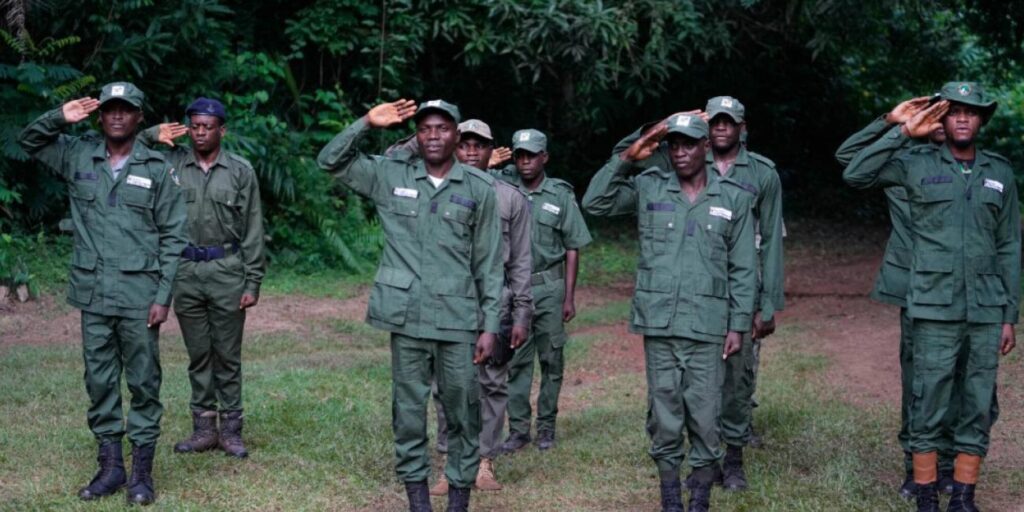
Forest guards deployed to some of the most security-challenged communities in Kwara and Enugu States have reportedly abandoned, or threatened to abandon, their posts over alleged months of unpaid salaries and allowances, inadequate feeding and welfare, and a shortage of weapons and other operational equipment.
The guards, recruited, trained and deployed under state and Federal Government-backed forest security initiatives, said they were sent into dangerous forests and remote communities to confront terrorists, bandits, kidnappers and other armed criminals, but were allegedly left without the basic support required to carry out the assignment safely.
In Kwara State, several guards deployed to communities across Kaiama, Patigi and Edu Local Government Areas have reportedly started leaving their posts and returning towards their bases after allegedly spending more than three months in remote locations without receiving promised welfare support.
The operatives said the prolonged absence of food and other basic provisions had forced some of them to depend on residents for survival, despite the fact that many of the communities they were deployed to protect are themselves struggling with poverty and insecurity.
One of the guards said they accepted the deployment because they were assured that the government would take responsibility for their welfare.
“We were told that when we were deployed to the communities, the government would take responsibility for our welfare. But for more than three months, there has been no food. We have been struggling to survive,” the guard said.
According to him, attempts by some guards to seek food from residents had created an uncomfortable situation because the residents also complained that they were struggling to feed their own families.
“When we ask the communities for food, they tell us that they are also hungry and that the government deployed us, so the government should feed us. We cannot continue to beg people who are themselves struggling to survive,” he said.
Another guard said the situation had become so difficult that some operatives no longer wanted to remain in their assigned locations.
“We did not join this work to become beggars. We were deployed here to protect people, but nobody is protecting us. If the government sends people into dangerous communities, it should also make sure that they have food and basic welfare,” he said.
The operatives also complained that assurances concerning their salaries and allowances had not been fully implemented.
“We were given assurances that there would be a proper payment arrangement. We believed the government and accepted the deployment because we thought our welfare would be taken care of. But the promises have not been fulfilled as we expected,” one of the guards said.
Another operative accused the authorities of prioritising deployment without putting adequate support structures in place.
“You cannot send people into areas where terrorists are operating and expect them to survive without proper welfare, equipment and weapons. We are ready to work, but the government must also do its part,” he said.
The guards further raised concerns about the weapons available to them, alleging that some personnel were being sent against criminal groups carrying more sophisticated firearms.
“We are being asked to confront people who are heavily armed, but many of our men do not have weapons that can match what the terrorists are carrying. What do you expect them to do when they encounter these people?” another guard asked.
The concern is particularly serious because forest guards are often expected to operate in isolated areas where conventional security forces may be unable to respond immediately if an attack occurs.
“We are the people who are expected to enter these forests and gather intelligence or confront the criminals. If something happens to us there, who will come quickly to rescue us? That is the question we are asking,” another operative said.
The situation in Enugu State is similarly troubling, with some recently recruited forest guards alleging that they have worked for months without receiving salaries or allowances.
Some of the personnel were initially recruited as volunteers and were reportedly assured that they would subsequently be regularised and placed on the state government’s payroll.
A source familiar with the situation alleged that some guards had been working in different communities and Local Government Areas in Enugu since November 2025 without receiving their expected payments.
“As I speak with you, some of them have been working in various communities and local government areas in Enugu State since November 2025,” the source said.
“For us who were selected and sent for national training, we are being owed allowances for more than four months now, and even the new salary scale the Federal Government approved, we have not been paid a dime,” the source added.
Some of the guards are reportedly attached to joint security operations involving the military, Nigeria Police Force, Nigeria Security and Civil Defence Corps and neighbourhood watch groups.
One of the personnel said some guards had been deployed to Isi-Uzo Local Government Area, which he described as one of the areas facing serious security challenges.
“Some of us are deployed in a joint task force with the military, Police, Civil Defence and Neighbourhood Watch in Isi-Uzo LGA, one of the most troubled council areas in the state that has witnessed the highest bloody attacks from herdsmen and criminals from Benue State in recent times,” the source said.
He said the uncertainty surrounding their salaries had become increasingly frustrating.
“We don’t know where the problem is from, whether it is from our commanders or the government,” he said.
“However, the government should pay us whatever they agreed to pay us. We volunteered for the work to defend our communities from the crawling terrorists masquerading as bandits,” he added.
The affected Enugu personnel are also demanding clarification regarding their employment status, particularly those who were initially engaged as volunteers and were subsequently promised regularisation.
The complaints have raised fresh questions about the implementation and sustainability of President Bola Tinubu’s forest guard initiative, which the Federal Government has promoted as a major component of its strategy to tackle terrorism, banditry, kidnapping and other criminal activities in Nigeria’s forests.
On November 26, 2025, Tinubu declared a nationwide security emergency and authorised the Department of State Services to deploy trained forest guards to flush terrorists and bandits out of forests.
“The DSS also has my authority to immediately deploy all the forest guards already trained to flush out the terrorists and bandits lurking in our forests,” Tinubu said in his security address.
The Federal Government subsequently announced the graduation of more than 7,000 forest guards drawn from seven frontline states, including Kwara, under the Presidential Forest Guards Initiative.
According to the Federal Ministry of Information and National Orientation, the programme was established to reclaim forests from terrorists, bandits, kidnappers and other criminal groups.
By July 2026, the Federal Government said more than 9,000 forest guards had been trained under the programme, which had expanded to 10 states.
The initiative is coordinated by the Office of the National Security Adviser and implemented under the operational leadership of the DSS, with the participation of the National Intelligence Agency, Defence Headquarters, Nigeria Police Force and National Park Service.
Kwara has been among the states receiving significant attention under the programme because of insecurity affecting remote communities and forest corridors.
In December 2025, the Federal Government said about 1,000 forest guards had passed out in Kwara ahead of their deployment against terrorists, kidnappers and illegal miners.
Kwara State Governor AbdulRahman AbdulRazaq had described the initiative as a “game changer” and commended Tinubu for strengthening forest security.
The guards were subsequently deployed to vulnerable parts of the state, including Kaiama, Edu, Patigi, Ifelodun and Ekiti Local Government Areas.
However, their deployment has also exposed them to significant security risks.
At least 12 forest guards and vigilantes were reportedly killed during an attack in Oke-Ode, Ifelodun Local Government Area, in September 2025.
In April 2026, six forest guards were also reportedly killed in Nuku, Kaiama Local Government Area, during an attack by suspected terrorists.
The reported deaths have intensified concerns about whether forest guards are being sufficiently equipped, protected and supported before being sent into areas where armed criminal groups operate.
Despite leaving some deployment locations, the Kwara guards insisted that they were not rejecting their responsibility to protect communities.
“We are not saying that we do not want to work. We are saying that the government must provide the things we need to work. Give us food, pay us properly and equip us with the weapons required to defend ourselves and the communities,” one operative said.
Another warned that deploying personnel without adequate welfare and weapons could place both the guards and the communities they were assigned to protect at greater risk.
“If you deploy us without food and without proper weapons, you are not only putting our lives in danger, you are also putting the communities we are supposed to protect in danger,” he said.
A further operative said the guards accepted the assignment believing they were joining a properly funded and supported government security programme.
“We were told that this was a serious government programme. We accepted the responsibility because we wanted to help protect our communities. But what we are seeing now is different from what we were promised,” he said.
The allegations also raise broader concerns over whether the rapid expansion of the forest guard initiative has been matched by adequate funding, logistics, remuneration, weapons, medical support, accommodation and emergency response arrangements for personnel operating in high-risk locations.
In Enugu, efforts by ChroniclesReporters to obtain a response from the state Forest Guards Commander, Dr Akinbayo Olasoji, were unsuccessful. Calls placed to his telephone were not answered as of the time of filing this report.
The Enugu State Government had also not publicly responded to the allegations of unpaid salaries and allowances.
In Kwara, the guards are demanding that the government urgently address their welfare, remuneration and equipment concerns before expecting them to continue operating in areas where they may encounter heavily armed criminal groups.
The crisis presents a potentially serious challenge for a Federal Government security initiative that depends heavily on personnel willing to operate in some of Nigeria’s most difficult and dangerous terrains.
If the allegations are established, the situation could also raise questions about the wisdom of deploying poorly paid or inadequately equipped personnel into hostile environments where they are expected to confront criminals possessing superior firepower.
ChroniclesReporters could not independently verify the exact number of guards affected in either state, the total amount allegedly owed to them or the precise terms and conditions of their engagement.
The governments and security authorities concerned are yet to publicly provide a comprehensive explanation regarding the allegations of unpaid salaries, delayed allowances, inadequate welfare and alleged shortages of weapons.