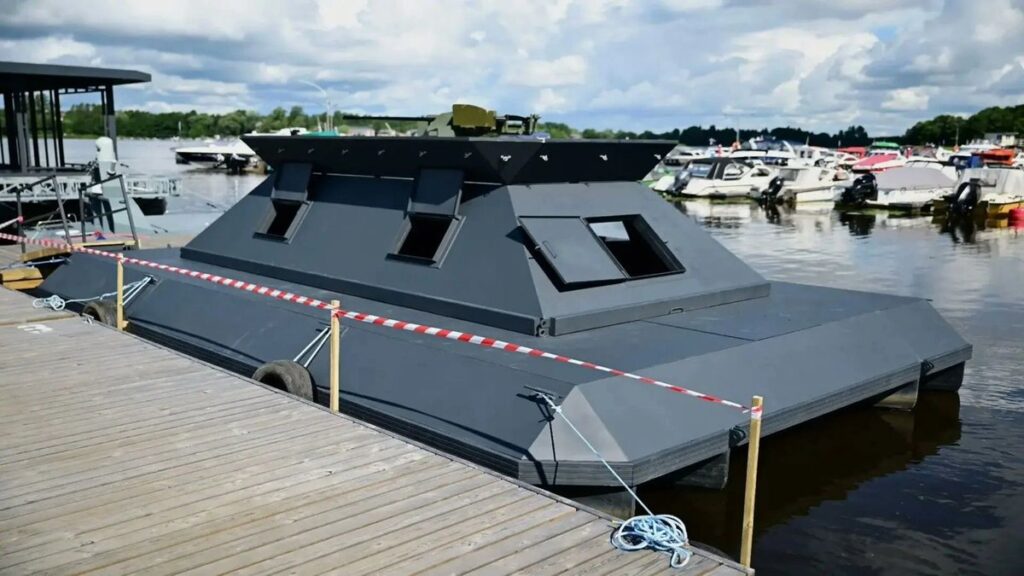
Russia is turning to an unusual and potentially revealing answer to the growing threat posed by Ukrainian drones: small floating gun platforms designed to act as sentries around naval bases, ports and other critical coastal facilities.
The experimental system, identified in Russian reports as the PLOT-40, while some official material has referred to it as PLOT-47, was recently displayed in Vyborg in the Leningrad Region. The project was presented as a new means of protecting naval bases, port infrastructure and fuel and energy facilities from unmanned aerial vehicles and unmanned surface vessels.
Rather than resembling a conventional warship, the platform looks more like a floating pillbox or heavily armed guard post. Available images show a compact structure mounted on four cylindrical floats, with a weapon station positioned above it. Defence observers say the weapon appears capable of carrying either a 12.7mm heavy machine gun or a 20mm-class automatic cannon, although the exact configuration remains unclear.
The concept is brutally simple: put a gun where a drone or unmanned boat is likely to approach and give Russian forces another layer of defence before an attacker reaches a valuable ship, harbour or installation.
The emergence of the PLOT platform is particularly significant because it illustrates how inexpensive unmanned weapons are changing the economics of modern warfare. Russia has increasingly had to reinforce naval facilities with improvised barriers, anti-drone cages, nets and other protective measures as Ukrainian attacks have demonstrated that expensive warships and strategic infrastructure can be threatened by relatively cheap unmanned systems. Recent satellite imagery has also shown expanded anti-drone netting around Russian submarines at the Pacific Fleet’s Rybachiy base.
But the PLOT-40 is hardly an impregnable fortress.
Images of the prototype suggest little conventional armour, while the platform does not appear to have an obvious propulsion system. That has led defence observers to conclude that it may need to be towed or otherwise positioned in areas where it is expected to operate. Its apparent lack of mobility could make it useful as a static defensive post, but potentially vulnerable if an attacker manages to locate and target it.
There are also unanswered questions over how the weapon would be operated, how targets would be detected and whether the system is genuinely autonomous or requires personnel to control it. Those uncertainties are important because a machine gun alone does not solve the wider problem of detecting small, fast-moving drones early enough to engage them effectively.
Russian officials say the prototype has already received preliminary approval from a specialised naval research institute, and the system has been demonstrated on the water. The Leningrad regional authorities have described it as an experimental response to the changing threat environment.
The striking message behind the project, however, may be less about the sophistication of the floating platform than about the pressure forcing Russia to develop it.
A navy that once relied heavily on expensive warships, missiles and conventional air-defence systems is now experimenting with what amounts to a floating armed guardhouse because small unmanned weapons can threaten assets worth hundreds of millions of dollars.
That is the uncomfortable lesson of the drone age: modern naval warfare is increasingly being shaped not only by who possesses the most powerful weapons, but by who can protect billion-dollar military infrastructure from weapons that may cost a fraction of the price.
For Russia, the PLOT-40 may be an ingenious low-cost defensive measure. It may also be an unmistakable admission that Ukrainian drones have forced Moscow to rethink how vulnerable its naval bases really are.