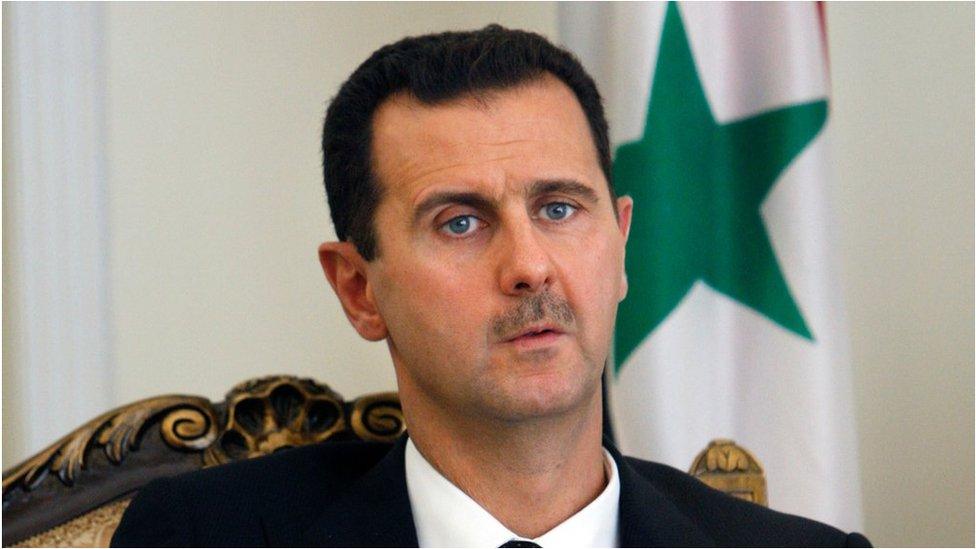
A Syrian court has sentenced ousted former President Bashar al-Assad to death in absentia after finding him responsible for war crimes and crimes against humanity committed during the country’s devastating civil war.
The landmark ruling, reported by the BBC, marks the first conviction secured against Assad, who fled to Moscow with members of his family after his regime collapsed in December 2024, ending more than five decades of Assad family rule in Syria.
Assad’s cousin, Atef Najib, the former head of political security in the southern province of Deraa, was also sentenced to death. Unlike Assad, Najib appeared before the court in a striped prison uniform and was held inside a cage as the judge delivered the verdict.
Najib was convicted of several offences, including murder, the intentional killing of children under the age of 15, and torture resulting in death.
Deraa, where Najib served during the early years of Assad’s rule, is widely regarded as the birthplace of Syria’s 2011 uprising. The unrest began after teenagers were detained and allegedly tortured for writing anti-government graffiti on walls.
The security crackdown that followed would transform local protests into a nationwide uprising, eventually plunging Syria into a brutal civil war that claimed hundreds of thousands of lives and displaced millions.
The court also handed down death sentences in absentia to six other former military and security officials, including Assad’s younger brother, Maher al-Assad, who commanded the powerful Fourth Division of the Syrian Army.
Former Defence Minister Fahd al-Freij was also among those convicted.
The verdict triggered scenes of celebration outside the courthouse, where hundreds of Syrians gathered holding photographs of relatives killed during Assad’s rule. Crowds waved Syrian flags, chanted and applauded as motorists sounded their horns.
“The joy is indescribable,” one man told the BBC while holding a photograph of his late father.
Another woman described the moment as a mixture of “victory and liberation,” saying the voices of victims had finally been heard and justice achieved.
For Nouha al-Masri, a prosecutor in the case who lost her brother during the March 2011 crackdown at Deraa’s al-Omari Square, the verdict represented a long-awaited moment of accountability.
She said victims had waited 15 years to reclaim even a fraction of their rights and called for the trials to continue.
“In the new Syria, there will be no impunity from this day forward,” she said.
Despite the historic verdict, a major obstacle remains: Assad is still in Russia.
It is unclear whether Syria’s new authorities will succeed in securing his extradition from Moscow. Maher al-Assad is also believed to be in Russia following the collapse of the regime.
The interim government had already issued an arrest warrant for Bashar al-Assad in December over allegations including murder and torture, while authorities have since detained numerous former regime officials and security personnel.
However, many of the former regime’s senior figures remain outside Syria.
Assad’s downfall came after forces led by Ahmed al-Sharaa, now Syria’s president, swept through the country in an 11-day offensive that brought his family’s decades-long grip on power to an end.
Bashar al-Assad became Syria’s president in 2000 following the death of his father, Hafez al-Assad, who had ruled the country for nearly three decades.
He had not originally been expected to inherit the presidency. That changed after his elder brother, Basil al-Assad, who had been groomed as his father’s successor, died in a car crash in 1994.
For nearly a quarter of a century, Bashar al-Assad ruled Syria through a system dominated by the military, security and intelligence establishments.
His fall has now opened a new chapter in Syria’s turbulent history—one in which former victims are demanding not only the prosecution of those who served the old regime, but a reckoning for the leadership that presided over years of bloodshed.
For many Syrians, Tuesday’s verdict is more than the conviction of a former president.
It is a declaration that the collapse of a regime does not have to mean the disappearance of accountability.