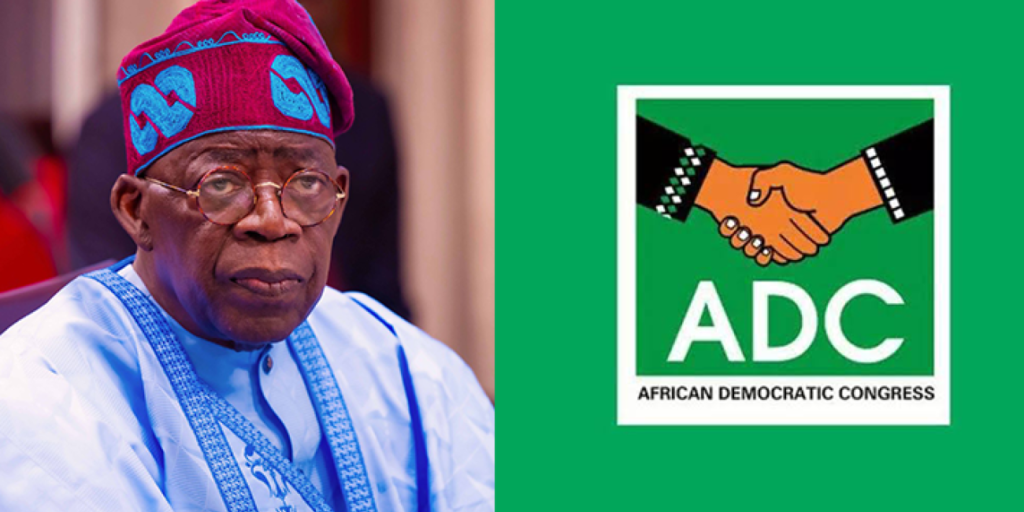
The African Democratic Congress (ADC) has launched a scathing attack on President Bola Tinubu’s decision to appoint his Chief of Staff, Femi Gbajabiamila, to lead a Federal Government delegation comprising five serving state governors to an investment conference in Canada.
The opposition party described the arrangement as inappropriate and a troubling inversion of public authority, questioning why an unelected presidential aide should lead elected governors on an official foreign mission.
The controversy followed an announcement by the Nigerians in Diaspora Commission (NiDCOM) that President Tinubu had approved a high-powered Nigerian delegation to attend the maiden Nigeria Diaspora Investment Economic Conference in Toronto, Canada, scheduled for August 12 to 15, 2026.
According to NiDCOM, Gbajabiamila will lead the delegation, which includes Borno State Governor Babagana Zulum, Anambra State Governor Chukwuma Soludo, Kaduna State Governor Uba Sani, Plateau State Governor Caleb Mutfwang and Zamfara State Governor Dauda Lawal.
The delegation will also include the Minister of Foreign Affairs, Bianca Odumegwu-Ojukwu; Minister of Industry, Trade and Investment, Jumoke Oduwole; and Minister of Interior, Olubunmi Tunji-Ojo.
Reacting to the composition of the delegation, ADC National Publicity Secretary, Bolaji Abdullahi, expressed strong disapproval, arguing that the arrangement diminishes the constitutional and political status of elected state governors.
“Just when you think that you have seen the worst of this Tinubu government, they will just surprise you,” Abdullahi wrote in a post shared on his verified X account.
“How can the President’s Chief of Staff, an unelected personal aide of the president, lead elected state governors on a foreign mission?
“It is well.”
The statement has triggered fresh debate over the hierarchy of political authority within the Federal Government and the extent to which presidential aides should exercise coordinating roles over elected public officials.
At the centre of the controversy is not the purpose of the Toronto conference itself, but the decision to place Gbajabiamila at the head of a delegation that includes five governors who derive their mandates directly from voters in their respective states.
The conference, themed “Invest Nigeria, Thrive Abroad,” is designed to bring together Nigerian government officials, members of the Nigerian diaspora, investors and business leaders to explore investment opportunities in Nigeria and deepen economic relations with Nigerians living abroad.
The Federal Government is expected to use the gathering to showcase investment opportunities, attract diaspora capital and strengthen Nigeria’s economic engagement with its citizens and businesses overseas.
However, the composition of the delegation has now become a political talking point, with the ADC questioning the symbolism and propriety of having a presidential aide occupy the leading position in a team containing serving governors.
The Presidency has yet to publicly provide a detailed explanation for why Gbajabiamila was selected to lead the delegation.
Supporters of the administration have, however, defended the arrangement, arguing that the Chief of Staff is one of the President’s senior representatives and plays a central coordinating role in official government engagements.
They maintain that leading the delegation does not amount to exercising constitutional authority over the governors, but rather reflects the President’s decision on who should coordinate the Federal Government’s participation in the investment forum.
The dispute nevertheless adds to growing opposition criticism of the Tinubu administration over appointments, governance structures and the exercise of executive authority.
Since the President assumed office in May 2023, opposition parties have repeatedly challenged various decisions of the administration, while the Presidency has maintained that its actions are driven by administrative efficiency, effective coordination and the national interest.
For the ADC, however, the Toronto delegation has raised a broader question about the boundaries between presidential administration and elected political authority: whether an unelected aide should be placed ahead of governors who hold direct electoral mandates when representing Nigeria on an official international assignment.
The controversy is therefore likely to persist beyond the Toronto conference, as political parties continue to scrutinise the structure, symbolism and exercise of executive power under the Tinubu administration.