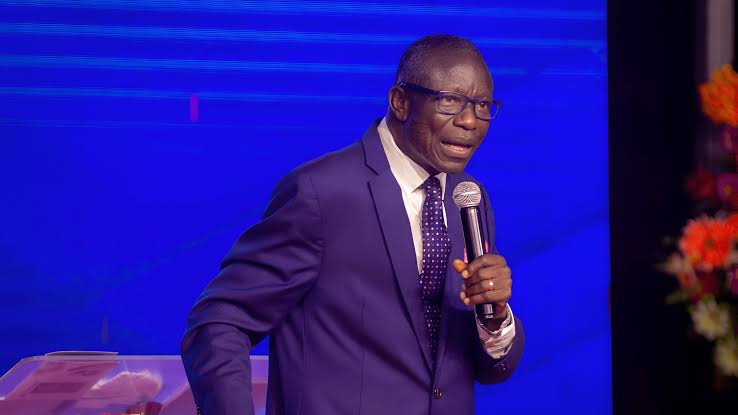
The President of the Pentecostal Fellowship of Nigeria (PFN), Bishop Wale Oke, has declared that Christians across the country will continue preaching in commercial buses regardless of the proposed legislation seeking to prohibit the practice, describing the move as an unjust attempt to silence the gospel.
Speaking during a church service on Sunday, Bishop Oke launched a blistering attack on the National Assembly, insisting that no law enacted by man would stop Christians from fulfilling what he described as a divine mandate.
“We will preach in buses. We will preach everywhere. Because you are making evil decrees. We will rather obey God than man,” the cleric declared to a cheering congregation.
Oke argued that lawmakers were focusing on the wrong priorities at a time when Nigerians were battling unprecedented insecurity. He questioned why the legislature appeared more concerned with regulating religious preaching than confronting the scourge of terrorism, kidnapping, banditry, rape and violent crimes that continue to claim lives across the country.
According to him, the PFN will not submit to any law that seeks to restrict the public proclamation of the Christian faith, warning that believers would continue evangelising despite any attempt to criminalise the practice.
His comments come amid growing opposition to the Federal Road Safety Corps (FRSC) Amendment Bill, 2026, which proposes sanctions against preaching, hawking and trading inside commercial vehicles. Under the bill, offenders could face a fine of up to ₦50,000 upon conviction.
The proposed legislation has triggered widespread debate, with several Christian organisations expressing concern that the provision could infringe on constitutionally guaranteed rights to freedom of religion and expression.
However, the Senate has dismissed claims that the restriction is a fresh legislative initiative. In a statement issued by the Directorate of Media and Public Affairs in the Office of the Senate Leader, Senator Opeyemi Bamidele explained that the prohibition has existed in the Federal Road Safety Commission (Establishment) Act and the National Road Traffic Regulations since 2007. According to the Senate, the 2026 amendment merely retains an already existing provision aimed at improving safety within commercial vehicles.
Despite the clarification, opposition has continued to mount. The Christian Association of Nigeria (CAN), alongside the Organisation of African Instituted Churches (OAIC), has called for a review of the provision, arguing that its enforcement could undermine fundamental constitutional freedoms.
As the bill advances through the remaining stages of the legislative process, the controversy has intensified, setting the stage for what could become a major confrontation between religious organisations and lawmakers over the limits of public worship, road safety enforcement and constitutional rights.