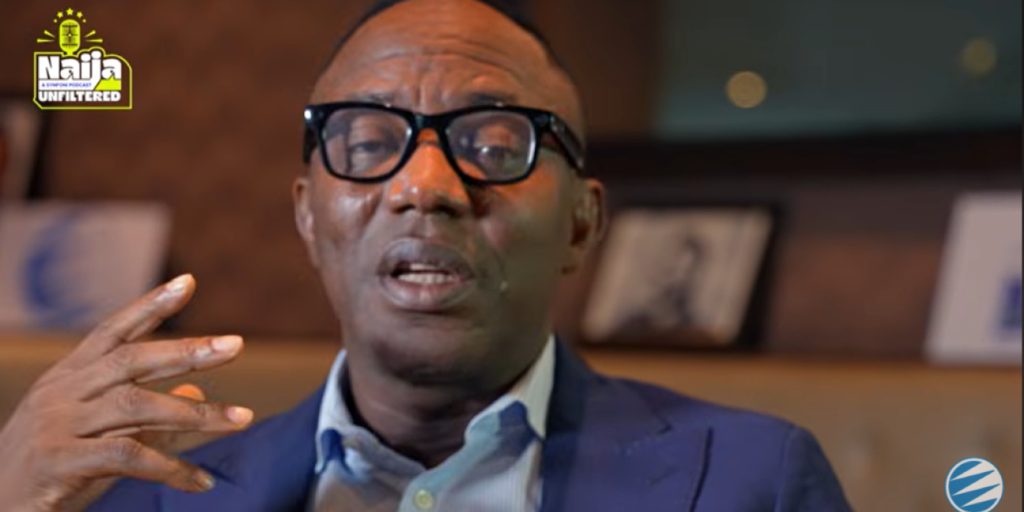
Presidential candidate of the African Action Congress (AAC) and human rights activist, Omoyele Sowore, has launched a sweeping attack on President Bola Tinubu’s administration, accusing it of prioritising personal enrichment over public service and describing the government as a “racket” rather than a legitimate democratic administration.
Speaking during an interview, Sowore alleged that those occupying public offices under Tinubu were driven by self-interest instead of a commitment to improving the lives of Nigerians.
According to him, the administration operates in a manner where personal gain takes precedence over governance, insisting that the President cannot claim ignorance of alleged corruption involving officials serving under him.
Turning his attention to the immediate past administration, Sowore argued that former President Muhammadu Buhari should not be absolved of corruption allegations simply because he was never successfully investigated.
He claimed that Buhari’s associates, including former Attorney-General Abubakar Malami and former Central Bank Governor Godwin Emefiele, were accused of massive corruption while serving in government, insisting that it was impossible for a president to be unaware of the activities of top members of his cabinet.
Sowore further alleged that although the Tinubu administration has investigated several officials who served under Buhari, the former president himself escaped scrutiny.
He suggested that Buhari was never subjected to a thorough investigation despite allegations that had trailed him since his involvement in managing the Petroleum Trust Development Fund (PTDF) during the military era.
Assessing Nigeria’s democratic governments since 1999, Sowore dismissed the notion that any administration deserved to be regarded as clean.
According to him, every government that came to power took advantage of the resources available to it.
He, however, said the late President Umaru Musa Yar’Adua only appeared less controversial because his ill health and brief tenure limited his time in office, while alleging that corruption still existed within his administration.
Drawing from his years as an investigative journalist, Sowore maintained that he witnessed and reported on the activities of successive governments, insisting that corruption had remained a recurring feature of Nigeria’s political leadership.
Reflecting on Nigeria’s military era, he recounted his involvement in the June 12 pro-democracy struggle and recalled witnessing major national events, including the Gideon Orkar coup attempt, the death of General Sani Abacha and the political crisis surrounding the late Chief Moshood Abiola.
He described the Abacha years as a period of fear and repression, alleging that security forces routinely killed and intimidated citizens on the streets.
Sowore also dismissed claims that Nigeria’s military strength under Abacha reflected national greatness, arguing that military interventions in countries such as Liberia became avenues for corruption through inflated and fraudulent supply contracts.
On the deaths of Abacha and Abiola, he admitted he had no direct evidence regarding Abacha’s death but described the sequence of events surrounding both men as suspicious, suggesting there were unanswered questions that history had yet to resolve.
Beyond Nigeria, Sowore criticised United States President Donald Trump, accusing him of undermining democratic values and pursuing policies driven by personal and political interests.
He further condemned Israel’s military campaign in Gaza, describing it as genocide and arguing that countries supplying weapons or refusing to acknowledge the humanitarian crisis were equally complicit.
Sowore also expressed surprise at what he described as the growing admiration for Trump among Nigerians, claiming that many of his supporters viewed the American leader as a political saviour despite his controversial record.
Throughout the interview, the activist insisted that his views were informed by decades of involvement in Nigeria’s pro-democracy movement and investigative journalism, maintaining that he had participated in and documented many of the country’s defining political moments.