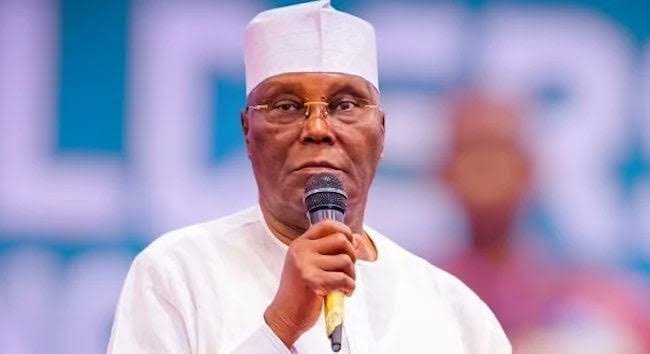
Former Vice President and presidential candidate of the African Democratic Congress (ADC), Atiku Abubakar, has launched a scathing attack on the administration of President Bola Tinubu, accusing it of operating an alleged ₦8.8 trillion “shadow treasury” outside Nigeria’s constitutional budgetary process and warning that the funds could be part of a massive political war chest ahead of the 2027 general elections.
In a statement issued on Saturday, Atiku said he was deeply disturbed by findings contained in the International Monetary Fund’s latest Article IV consultation on Nigeria, as reported by Reuters on July 1, 2026, which indicated that public expenditures equivalent to about two per cent of Nigeria’s Gross Domestic Product were omitted from recent official budgets.
According to the former vice president, the revelation translates to approximately ₦8.8 trillion in public spending that was allegedly executed outside the statutory appropriation framework and beyond the scrutiny of Nigerians.
“My attention has been drawn to a deeply troubling report by the International Monetary Fund, published on July 1, 2026, by Reuters, which reveals that the Tinubu-led APC administration failed to record public expenditures amounting to approximately two per cent of Nigeria’s Gross Domestic Product in recent official budgets,” Atiku stated.
With Nigeria’s GDP estimated at about ₦441.5 trillion, Atiku argued that the figure represents one of the most serious cases of fiscal opacity in the country’s democratic history.
He described the alleged off-budget spending as “the most consequential act of fiscal impunity in Nigeria’s recent democratic history” and called on the National Assembly, civil society organisations, the media and other democratic institutions to demand full accountability.
Citing the IMF’s Article IV report and comments reportedly made by the Fund’s Resident Representative in Nigeria, Christian Ebeke, Atiku alleged that several large-scale government projects had been executed outside the official budget framework, thereby escaping constitutional oversight and public auditing.
“Let us be absolutely clear about what this means: The Tinubu administration is awarding multi-trillion-naira contracts, moving massive public capital, and commissioning infrastructure projects entirely beyond the reach of the Auditor-General, the nation’s procurement laws, and the legitimate oversight of the National Assembly. It is a parallel fiscal universe, one governed by executive whim and shielded from the constitutional accountability that the Nigerian people are owed,” he said.
The former vice president further alleged that the arrangement bears similarities to the controversial Alpha Beta revenue model associated with Tinubu’s years as governor of Lagos State, claiming that a comparable system had now been elevated to the national level.
He also accused the Federal Government of unlawfully withholding and deducting about ₦800 billion from statutory allocations due to state governments, insisting that the cumulative figures raise disturbing questions about the possible creation of a huge election funding structure ahead of 2027.
“We state clearly and without equivocation that this ₦800 billion, combined with the ₦8.8 trillion in unrecorded federal expenditures, points unmistakably to the construction of a massive, multi-source political war chest being assembled ahead of the 2027 general elections,” Atiku alleged.
The opposition leader equally linked the controversy to the recent uproar surrounding the ₦1.3 billion allocation reportedly made to the Presidential Foreign Investment Promotion Council (PFIPC), a body whose existence later became a subject of national debate after questions emerged over its legal status.
According to him, the incident reflects what he described as a broader pattern of fiscal secrecy and institutional manipulation under the current administration.
Atiku argued that while Nigerians were being asked to endure painful economic reforms, including subsidy removal, naira depreciation, soaring inflation, rising electricity tariffs and high interest rates, trillions of naira were allegedly being spent outside public knowledge and legislative supervision.
“The IMF has now exposed that narrative as a big fat lie. While the poor were told to bleed, the government maintained access to a ₦8.8 trillion shadow treasury, entirely outside public view, entirely beyond legislative oversight, and entirely at the disposal of those who hold executive power,” he declared.
He maintained that if properly appropriated and transparently managed, the funds could have been deployed towards stabilising the economy, strengthening the naira, improving infrastructure, creating employment opportunities and easing the burden on ordinary Nigerians.
Consequently, Atiku demanded six immediate measures, including emergency investigative hearings by the National Assembly, an independent forensic audit by the Auditor-General of the Federation, full public disclosure of all off-budget expenditures, the restoration of the alleged ₦800 billion deducted from state allocations, investigations by anti-corruption agencies, and increased scrutiny by civil society organisations and international partners.
“A government that governs in secret spends in secret. A government that spends in secret does not govern, it plunders,” he said.
“The Tinubu administration has been exposed, not by its political opponents and not by partisan advocacy, but by the International Monetary Fund. The evidence is on the record. The figures are not in dispute.”
As of the time of filing this report, the Presidency had yet to issue an official response to Atiku’s allegations.
However, it is important to note that the IMF report referenced by Atiku called for improved fiscal transparency and stronger public financial management mechanisms but did not directly accuse the Federal Government of corruption or the creation of any political fund. The allegations regarding a “shadow treasury” and a possible 2027 war chest remain Atiku’s claims and have not been independently verified.