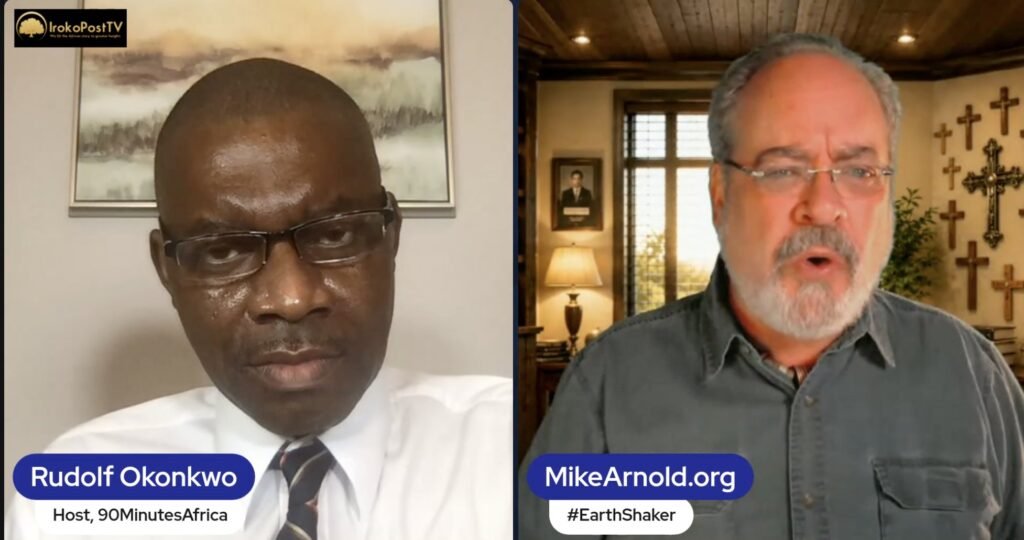
Mike Arnold, a former mayor of Blanco, Texas, has launched a blistering attack on some of Nigeria’s most influential and wealthiest clerics, accusing them of amassing enormous personal fortunes while millions of displaced Christians continue to endure hardship and insecurity across parts of the country.
Arnold, who spoke during an interview with journalist Rudolf Okonkwo on the programme 90MinutesAfrica, described the situation as a profound moral failure within sections of Nigeria’s Christian leadership, arguing that the prosperity gospel culture has thrived even as violence and displacement have devastated many Christian communities.
Checks confirm that Arnold served as Mayor of Blanco, Texas, after winning the city’s 2023 mayoral election and held office until 2025, contrary to suggestions in some quarters that his claim to the position was inaccurate. Official records of the City of Blanco identify him as the town’s elected mayor during that period.
In the interview, Arnold alleged that Nigeria has become home to what he called “counterfeit Christians” occupying strategic positions in both society and the church, insisting that genuine Christian service has been overshadowed by the pursuit of wealth and influence.
The American activist, who has campaigned internationally against what he describes as the persecution and killings of Christians in northern Nigeria, claimed that the country hosts eight of the world’s ten richest pastors, arguing that their rising affluence has coincided with worsening humanitarian conditions for victims of violence.
He questioned why enormous church revenues, including tithes and offerings, have not been deployed more aggressively to support millions of displaced believers struggling in camps and vulnerable communities.
According to him, resources spent on private jets and luxury acquisitions by prominent religious figures could instead provide significant humanitarian assistance to Christians displaced by years of insecurity.
Arnold described the situation as “horrific,” accusing some church leaders of enriching themselves while neglecting faithful adherents who have suffered because of their religious identity.
Despite his criticism, he expressed optimism about the future role of Christianity in Nigeria, maintaining that the church could become a powerful force for national renewal if it embraced charity, compassion and practical support for vulnerable citizens rather than personal enrichment.
The founder of Africa Arise argued that authentic Christian leadership must be measured by service and sacrifice, insisting that a renewed commitment to humanitarian values would strengthen both the church and the wider Nigerian society.
Arnold also weighed in on Nigeria’s constitutional structure and the operation of Sharia law within the federation, contending that legal systems which, in his view, undermine fundamental human rights are incompatible with constitutional democracy and equal citizenship.
“There is no way a government can tolerate Sharia and enforce human rights at the same time. It’s incompatible,” Arnold said, reiterating arguments contained in his book, Epicenter: Nigeria, Radical Islam, and the War for Global Order.
He further warned that Nigeria’s prolonged security challenges could produce far-reaching regional and global consequences if left unresolved, urging the administration of U.S. President Donald Trump not to ignore developments in the country.
According to him, extremist groups operating within Nigeria could expand their influence if international support diminishes, potentially turning the country into what he described as a launchpad for global jihadist activities.
Arnold also called for the release of the detained leader of the Indigenous People of Biafra (IPOB), Nnamdi Kanu, arguing that his continued incarceration amounts to political persecution, although he acknowledged that he did not endorse all of Kanu’s previous statements.
He maintained that Kanu had not personally carried out acts of violence and insisted that justice and political dialogue remain essential to resolving Nigeria’s lingering national tensions.