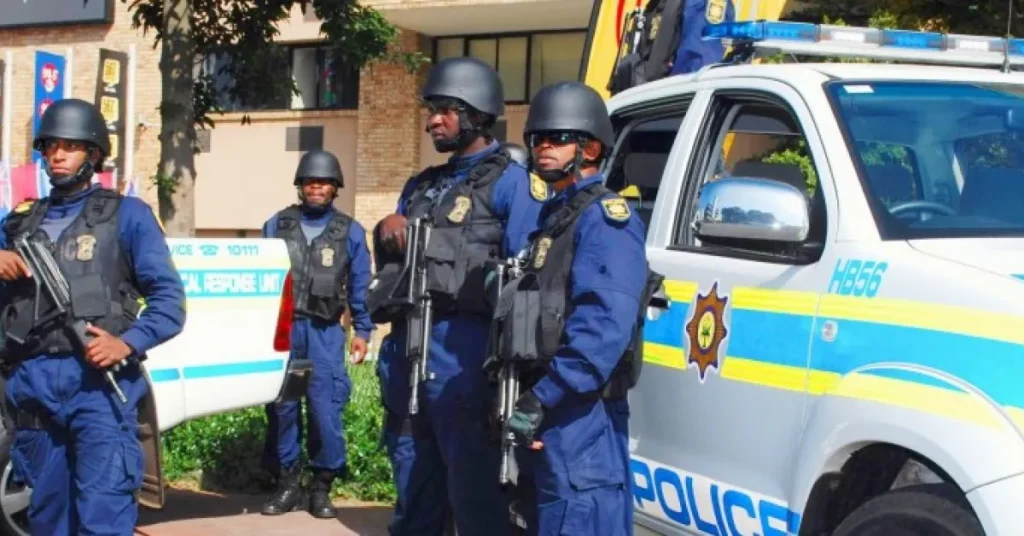
South Africa’s handling of recent anti-migrant demonstrations has sparked fresh debate across Africa after police officers escorted protesters and provided security throughout the marches instead of dispersing them with force.
The development drew praise from CNN international correspondent, Larry Madowo, who questioned whether countries such as Nigeria, Kenya, Uganda and Tanzania could learn from South Africa’s approach to managing public protests without resorting to deadly violence.
Madowo, who covered the demonstrations on Tuesday, observed that South African law enforcement agencies deployed heavily to maintain order while allowing citizens to exercise their constitutional right to peaceful assembly.
In a video shared on social media, police officers were seen leading the marchers through various communities, ensuring public safety without using tear gas, live ammunition or other lethal measures to break up the protests.
“They are escorting the protesters without necessarily getting their way, blocking them or tear-gassing them or shooting them dead,” Madowo said.
He further noted that many residents openly supported the demonstrations, cheering and applauding as the protesters moved through different areas.
“They have a lot of public support as well. People celebrating as they go past. But it’s been great to see police making sure they don’t harm any civilians but at the same time, they are free to march peacefully,” he added.
According to reports, South African police maintained their escort operations over two days without recording any fatal shootings involving demonstrators.
Even in instances where some protesters allegedly engaged in acts of looting and vandalism, security personnel reportedly relied on non-lethal methods to contain the situation rather than employing deadly force.
The scenes have generated wider conversations about protest policing across Africa, particularly in countries where demonstrations have frequently ended in bloodshed and allegations of human rights violations.
Taking to X, Madowo drew a direct comparison between South Africa and other African nations that have faced criticism over their handling of protests.
“I watched South African police escort protesters without executing them for two days. Even when marchers started looting or vandalizing property, they responded with non-lethal force. Can police in Kenya, Nigeria, Uganda, and Tanzania learn from their counterparts here?” he wrote.
His remarks have reignited memories of Nigeria’s #EndSARS protests in October 2020, which began as peaceful demonstrations against police brutality before descending into violent confrontations between protesters and security forces.
The protests climaxed with the controversial shooting incident at the Lekki Toll Gate in Lagos on October 20, 2020, where human rights organisations, including Amnesty International, accused security agencies of using excessive force against unarmed civilians. Nigerian authorities, however, disputed several aspects of those allegations.
Kenya also witnessed similar accusations during the anti-government protests of 2024, which were largely fuelled by opposition to proposed tax hikes and broader governance concerns.
The demonstrations, particularly those that culminated in the storming of Parliament in Nairobi in June 2024, left dozens dead and hundreds injured, with rights groups documenting the use of live ammunition, tear gas and mass arrests. Kenyan authorities insisted that security operatives acted within the law to restore order amid widespread violence and destruction.
Against this backdrop, South Africa’s decision to escort demonstrators and prioritise non-lethal crowd control measures has emerged as a striking contrast, raising uncomfortable questions about the methods employed by security agencies elsewhere on the continent and renewing calls for a more rights-based approach to policing public protests.