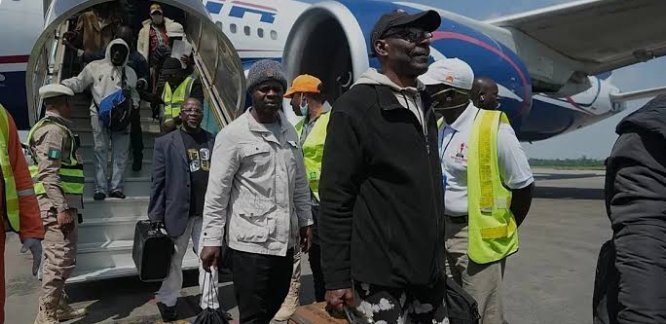
The Federal Government on Tuesday received another batch of 269 Nigerians evacuated from South Africa as intensifying anti-immigration protests and rising xenophobic tensions continue to force foreign nationals out of the country.
The returnees arrived aboard an Air Peace aircraft at the Murtala Muhammed International Airport, Lagos, under the government’s ongoing voluntary repatriation programme for citizens seeking to escape growing hostility and insecurity in South Africa following the June 30 ultimatum issued by anti-immigration groups against undocumented foreigners.
The evacuees were received by the Director of African Affairs at the Ministry of Foreign Affairs, Ambassador Haruna Ali-Gombe, who delivered President Bola Tinubu’s message of solidarity and reassurance, pledging that the Nigerian government would continue to protect the rights, welfare and dignity of Nigerians wherever they reside.
According to a statement issued by the Ministry of Foreign Affairs, the latest operation represents the second evacuation flight in the current exercise and brings the total number of Nigerians brought home from South Africa to 335.
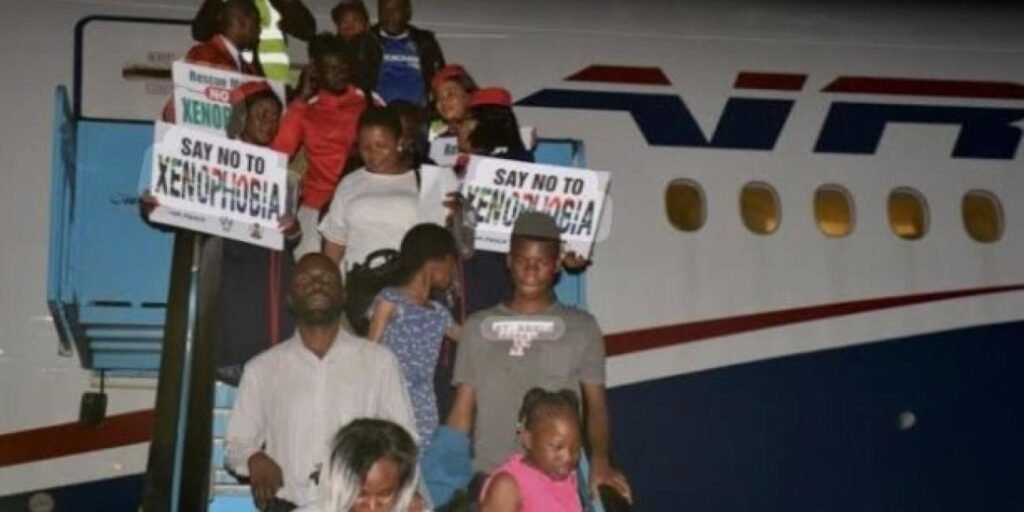
The ministry reaffirmed that Abuja would sustain diplomatic engagement with the South African government to ensure the safety and well-being of Nigerians who remain in the country, while promising that additional evacuation flights would continue as more citizens complete the required screening and clearance procedures.
The latest airlift comes amid mounting anxiety within migrant communities after anti-immigration demonstrations erupted across several South African cities, fuelled by groups demanding the removal of undocumented foreign nationals from the country.
Hundreds of Nigerians have reportedly sought assistance from Nigerian authorities to return home, with government officials previously disclosing that more than 1,000 citizens had registered for the voluntary repatriation programme.
The exercise commenced earlier this month when the first batch of 262 Nigerians was evacuated to Lagos aboard an Air Peace flight, marking the beginning of one of the largest government-assisted returns in recent years.
For decades, Nigerians have remained among the principal victims of xenophobic violence in South Africa, alongside migrants from Zimbabwe, Mozambique, Malawi, Ethiopia, Somalia and several other African countries whose citizens have repeatedly borne the brunt of anti-foreigner attacks.
The continent’s most industrialised nation has witnessed successive waves of xenophobic unrest that have left scores dead, countless others injured, businesses destroyed and entire communities uprooted, exposing the fragility of African solidarity in the face of economic hardship and political discontent.
Human rights organisations have consistently accused South African authorities of failing to provide adequate protection for foreign nationals, alleging institutional indifference and ineffective policing during outbreaks of mob violence directed at migrants.
The latest developments have deepened fears within Nigerian communities across South Africa, compelling many families to abandon years of labour, investment and aspirations in pursuit of safety back home.
Although President Cyril Ramaphosa has repeatedly condemned xenophobic attacks and appealed for tolerance, South African law enforcement agencies have continued to face allegations of complicity, with critics accusing some officials of enabling the profiling, harassment and extortion of foreign nationals rather than safeguarding their constitutional rights.
As another aircraft touched down in Lagos carrying citizens fleeing uncertainty and hostility, the evacuation underscored a troubling reality: that for many Africans seeking opportunity beyond their borders, the promise of continental brotherhood remains vulnerable to the politics of exclusion and the recurring spectre of xenophobic violence.