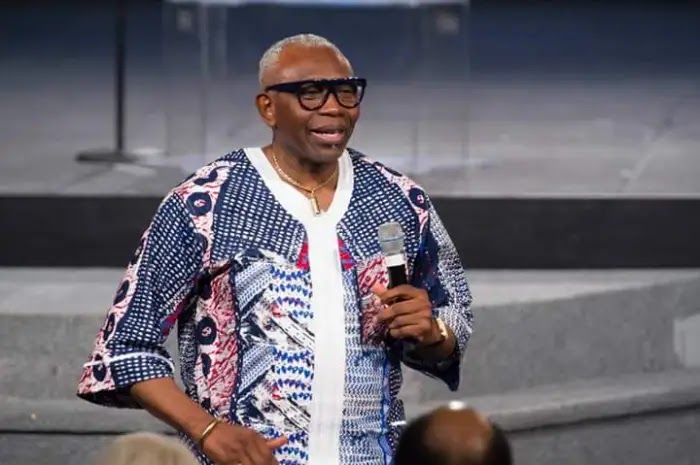
Former President of the Christian Association of Nigeria (CAN) and former National President of the Pentecostal Fellowship of Nigeria (PFN), Pastor Ayo Oritsejafor, has launched a blistering assessment of Nigeria’s leadership trajectory, declaring that the country’s condition under President Bola Ahmed Tinubu has deteriorated beyond the hardships experienced during the administration of former President Muhammadu Buhari.
Speaking on Monday during an appearance on Channels Television’s Politics Today, the outspoken cleric explained why he had largely refrained from commenting on national affairs in recent years, despite mounting economic and security challenges confronting the country.
According to Oritsejafor, his silence was deliberate, stemming from frustrations over ignored warnings he issued ahead of the 2015 presidential election regarding the consequences of a Buhari presidency.
“When the Buhari government was getting ready to come in, I knew that it was going to be a mess. From there, I don’t know what to call where we are now, but it has grown worse,” he said.
The former CAN president stated that Nigeria’s worsening economic hardship, insecurity and governance failures have now compelled him to speak out once again.
“It has gotten to a point where I feel I have to say something. I must begin to say something because I pastor people; they are human beings, they are Nigerians, and we must begin to hold people accountable for what is happening,” he declared.
Recounting events leading to the 2015 elections, Oritsejafor insisted that he had repeatedly cautioned Nigerians about the direction the country was heading.
“I intentionally stayed away. Why? Because in 2014, I tried to warn this nation of the direction it was going,” he said.
The influential cleric, who was widely perceived as being close to former President Goodluck Jonathan, dismissed suggestions that his criticism of Buhari and his subsequent silence were driven by political loyalties or bitterness over Jonathan’s electoral defeat.
Instead, he maintained that his concerns were rooted in his fears for Nigeria’s future, fears he believes have now materialised as millions of Nigerians grapple with soaring inflation, rising poverty, worsening insecurity and declining living standards.
Oritsejafor also revisited his longstanding concerns about religious extremism and its implications for governance, national unity and the survival of Nigeria’s democracy.
“I hold a grudge against them because they hold strongly to their faith. I hold a grudge against them because they are ready to take their faith to any level, and that includes planning for people to be killed, for people to die,” he said.
Clarifying his repeated use of the term “jihadist,” the cleric argued that extremism extends beyond armed violence and can manifest in political, social and institutional forms.
“A jihadist is an extremist. You can be a jihadist with your pen. You can be a jihadist in so many different ways. It’s not just those who carry a gun,” he stated.
“You can be a jihadist by doing everything to make sure nobody else, no other religion, has any place in the governance or in the progress of a nation.”
In one of the most striking moments of the interview, Oritsejafor questioned the role played by former Vice President Professor Yemi Osinbajo during Buhari’s eight years in office.
“When Osinbajo was vice president, what was he doing for the eight years he was there? How many times did he join to make certain decisions the government made?” he asked.
His comments come at a time of growing public frustration over the country’s economic direction, persistent insecurity, widespread unemployment and increasing poverty levels. Across the country, citizens continue to grapple with soaring food prices, rising transportation costs and a declining purchasing power that has left many households struggling to survive.
For Oritsejafor, the crisis facing Nigeria today is not merely a failure of policy but a failure of leadership and accountability. He warned that unless those in positions of authority are held responsible for their actions and decisions, the nation’s challenges could deepen further.
His intervention adds to the growing chorus of influential voices expressing concern over the state of the nation and intensifies the debate over the legacies of the Buhari administration and the future direction of President Tinubu’s government as political calculations ahead of the 2027 general elections begin to gather momentum.