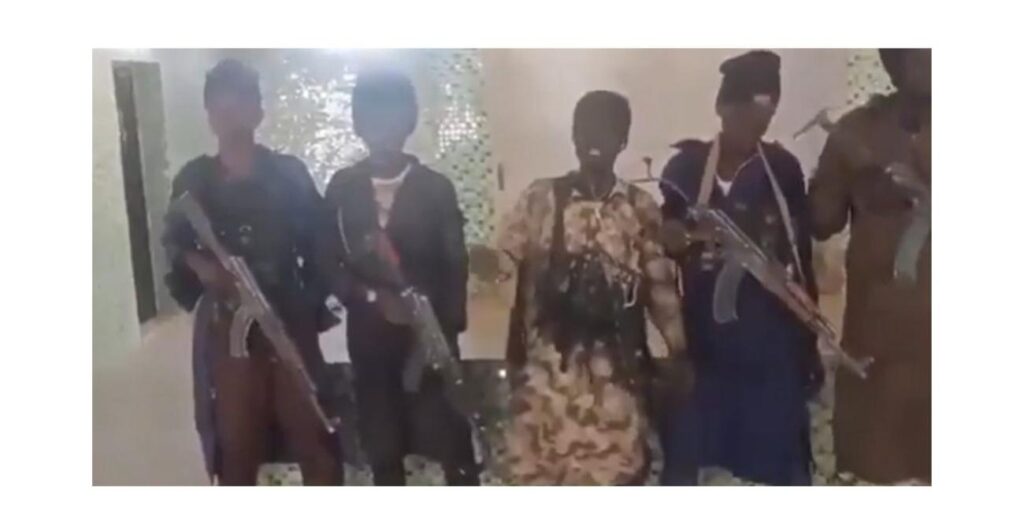
Suspected members of Boko Haram have released a video claiming they have taken control of Ngoshe, a community in Borno State, while also threatening to rename the town and expand their activities beyond the region.
In the video circulating online, a leader of the group speaking in Hausa declared that the insurgents were already inside the town and planned to openly hold Eid prayers there despite the presence of Nigerian security forces.
The speaker, who claimed to represent the faction historically linked to Jamā’at Ahl as-Sunnah lid-Da’wah wa’l-Jihād — widely known as Boko Haram insisted that the group would not hide while observing the religious celebration.
According to him, the militants intend to remain in Ngoshe and transform it into one of their strongholds.
He also mocked the Nigerian government, claiming the group had earlier issued warnings before launching the latest attack on the community.
During the recording, the insurgent leader alleged that the fighters had killed several people during the raid and taken women and children captive, while claiming they had not harmed them.
The militant further boasted that the group would expand its operations beyond the northeast and eventually target Abuja, Nigeria’s capital.
Ngoshe is located in Gwoza Local Government Area of Borno State, close to mountainous border regions that have long served as hideouts for insurgent groups such as Islamic State West Africa Province (ISWAP) and Boko Haram.
Security sources earlier reported that the town came under a coordinated attack in the early hours of Wednesday. During the assault, militants reportedly targeted a military base belonging to the 82 Division Task Force Battalion under the 26 Brigade and also attacked a camp for internally displaced persons.
The attackers were said to have operated in the area for several hours, burning armoured tanks and military vehicles while also carting away an unspecified quantity of weapons and ammunition.
The incident has once again raised concerns over persistent insecurity in parts of northeastern Nigeria, where communities continue to face repeated attacks despite ongoing military operations against insurgent groups.