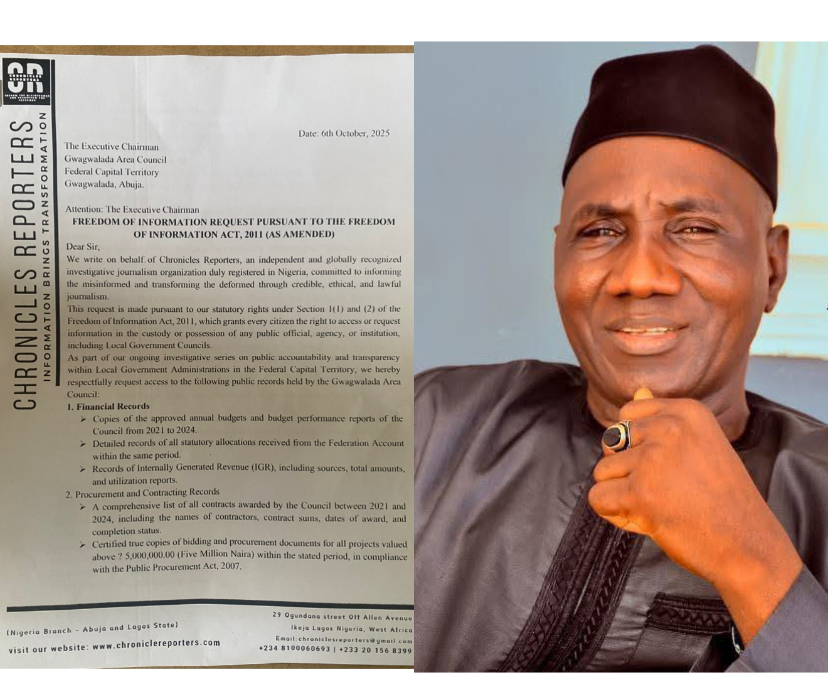
The long-simmering tension in Gwagwalada Area Council has deepened as Chronicles Reporters confirmed that a Freedom of Information (FOI) request sent to the office of Chairman Hon. Abubakar Jubril Giri was deliberately rejected by his personal assistant, in what observers describe as an “attempt to obstruct public accountability.”
The FOI request, issued by Chronicles Reporters under the Freedom of Information Act, 2011, sought detailed records of all federal allocations and council expenditures from the period of Giri’s assumption of office to date. The request specifically demanded documentation of projects executed, budgetary disbursements, and the council’s fiscal account statements for the past two years.
However, sources at the council secretariat disclosed that the chairman’s aide refused to acknowledge or receive the document, insisting that the request must be delivered “in person” by the petitioner — a move activists and legal observers have described as an intimidation tactic and a breach of the law.
According to our newsroom’s conversation with Manasseh B.P., also known as the Revolutionary Chief Priest and one of the leading civic voices spearheading the legal and media scrutiny of the Gwagwalada administration, this act of defiance “proves beyond doubt that the chairman has something to hide.”
“The refusal to receive a lawful FOI request is not only contemptuous but deliberate,” Manasseh said. “They know the records of Gwagwalada’s allocations cannot withstand public scrutiny. Billions have disappeared while our people live in poverty and decay.”
Manasseh, who was recently seen alongside his legal counsel, Barrister Marshal Abubakar of Falana & Falana Chambers, following the high-profile Sowore vs. Ned Nwoko court session in Abuja, reaffirmed that the struggle for transparency in Gwagwalada “has just begun.”
“We are taking this beyond the council. The FCTA, National Assembly, and relevant anti-corruption agencies will receive petitions backed by documented evidence. Giri will account for every kobo spent since he assumed office,” Marshal Abubakar told Chronicles Reporters.
The FOI request, which grants the chairman seven working days to respond, has already sparked renewed conversation among residents and political observers. Many believe the council’s rejection is an admission of mismanagement, especially in light of growing reports of uncompleted projects, unpaid workers, and deteriorating public infrastructure.
Evidence gathered from Chronicles Reporters’ field investigation paints a grim picture of governance within the Gwagwalada Area Council:
• Schools in Ruin: Classrooms across wards are in disrepair, with leaking roofs, worn-out desks, and unpaid teachers struggling to keep learning alive.
• Health Centers Neglected: Clinics remain underfunded, with shortages of staff and essential drugs, forcing residents to seek care in neighboring councils.
• Civil Servants in Distress: Local government staff allege months of unpaid salaries and allowances, despite consistent federal allocations.
• Infrastructure in Collapse: Major roads remain riddled with potholes; electrification projects and town halls stand abandoned.
“This is not governance; it is organized neglect,” Manasseh declared. “While Gwagwalada suffers, the chairman lives large — building hotels, acquiring new properties, and throwing parties with public money.”
The activist further revealed that Chronicles Reporters will, in partnership with its legal and civic allies, pursue the case through institutional channels. Should the council fail to comply with the FOI request within the stipulated time frame, the following actions are planned:
1. Filing a formal suit at the Federal High Court.
2. Submitting detailed petitions to the EFCC and ICPC.
3. Publishing investigative findings across national and international media.
4. Mobilizing residents of Gwagwalada for peaceful civic action and accountability campaigns.
For Gwagwalada, a strategic council that hosts the University of Abuja and serves as a key socio-economic hub of the FCT, this standoff could become a watershed in Nigeria’s grassroots governance. Civic organizations argue that the refusal to honor a legal FOI request symbolizes a wider culture of impunity that has plagued local councils nationwide.
As Chronicles Reporters continues its independent audit of Gwagwalada’s financial records and asset ownership trail, the questions remain:
Where did the allocations go? Who truly benefits from the council’s budgets? And how long will the people of Gwagwalada wait for transparency and justice?
The countdown begins. The truth, as Manasseh vowed, “will not be buried under concrete or political influence.”